


Most denials and angry billing calls in a chiropractic clinic trace back to a single decision point: the moment your front desk said "yes, we've got you scheduled" before anyone confirmed the patient actually had coverage for what you're about to do.
That gap — between booking and verified coverage — is where the money leaks. A patient shows up thinking they have a $20 copay, gets adjusted three times over two weeks, and then receives a $340 bill because their plan excludes chiropractic entirely or capped visits at 12 per year and they'd already used 11 elsewhere. Now you're either eating the balance, chasing a patient who feels betrayed, or writing off a claim that never had a chance.
This is a fixable process problem. The fix isn't "verify insurance better." It's building a scheduling rule that refuses to fully confirm certain appointments until coverage is verified — and giving your front desk exact language so verification actually happens instead of getting skipped when the lobby is full.
Why verification gets skipped (and it's not laziness)
Front desks don't skip verification because they're careless. They skip it because the incentive structure at the desk rewards filling the schedule, not protecting the claim. When someone calls at 4:45pm wanting a Thursday slot, the receptionist's job — as they understand it — is to say yes and move on.
Verification is invisible work. Nobody thanks the front desk for catching that a plan doesn't cover 98941. But everyone notices an empty slot. So the natural behavior is: book now, sort out insurance "later." Later usually means the morning of the appointment, or after the visit, or never.
A few patterns show up again and again in clinics where surprise balances are a constant problem:
-
Verification is treated as a task instead of a gate. There's no rule preventing a booking from being confirmed without it.
-
The person booking and the person verifying are different, and the handoff has no real deadline.
-
Self-pay and insurance patients flow through the exact same scheduling path, so nobody flags the ambiguous cases.
-
Nobody re-verifies established patients, so a plan change in January quietly turns every visit into a denial for two months.
That last one is sneaky. A patient who's been coming for a year isn't a "new insurance" case in anyone's mind, but their employer switched carriers and now their old member ID is dead. The clinic keeps billing the old plan on autopilot.
What a coverage-gated schedule actually looks like
The core idea: an appointment can exist in two states — tentative and confirmed — and only verified coverage (or collected self-pay) moves it from one to the other.
Never miss another patient appointment.
Spinesly helps you schedule, confirm, and manage every patient visit efficiently.
- Unified appointment management
- Automated patient reminders
- Staff and resource scheduling
No credit card required
A patient requests an appointment. The front desk creates the slot as tentative and immediately runs the intake questions (script below). If the patient is self-pay or cash, verification isn't needed — collect payment terms and confirm. If they're using insurance, the slot stays tentative until benefits are verified against the specific CPT codes you're likely to bill.
Verification happens same-day for anything booked more than 48 hours out, and before the patient leaves the phone for anything booked inside 48 hours. If coverage can't be confirmed in time, the patient is told clearly: "We can hold this as a self-pay visit at $X, or I can confirm once your benefits come back — which would you prefer?"
The two-state scheduling rule
| Appointment type | Booking state on creation | What moves it to confirmed | Deadline |
|---|---|---|---|
| New patient, insurance | Tentative | Benefits verified for expected CPTs | Within 24 hrs, always before first visit |
| New patient, self-pay | Confirmed | Payment terms acknowledged | Immediate |
| Established, same insurance on file | Confirmed | Auto-verified if last check <30 days | N/A if recent |
| Established, plan year rollover (Jan–Feb) | Tentative | Re-verification of active coverage | Before next visit |
| Mixed (insurance + likely non-covered service) | Tentative | Verify covered codes, quote self-pay for rest | Before visit |
The mixed row is where most clinics get burned. A patient has coverage for the adjustment but wants an add-on that isn't covered. If you don't split that at booking, you've set up a partial denial and a confused patient.
Front-desk verification scripts
Scripts matter because verification quality depends entirely on asking the right questions in the right order. A receptionist who asks "do you have insurance?" gets a useless yes. A receptionist working from a script gets the information that actually predicts whether the claim pays.
Script 1 — New patient intake (phone)
> "Great, I've got a tentative slot for you on [date]. Before I lock it in, I need a few insurance details so we can confirm your coverage — that way there are no surprises on your bill. Do you have your card handy?" > > Then collect:
-
Carrier name and plan type (PPO, HMO, Medicare, etc.)
-
Member ID and group number
-
Subscriber name and date of birth (if patient isn't the subscriber)
-
"Do you know if chiropractic care requires a referral or prior authorization on your plan?"
-
"Have you seen a chiropractor this year under this insurance?" (flags visit caps)
That last question about prior use of visits is worth its weight. Plans with a 12- or 20-visit annual cap don't tell you the patient already burned most of them somewhere else. Asking upfront catches it.
Script 2 — The coverage-can't-be-confirmed conversation
> "I want to make sure you're not surprised by a bill. Your benefits haven't come back from [carrier] yet. I can do one of two things: hold your appointment as a self-pay visit at $[X], and if your insurance confirms coverage we'll adjust it — or I can call you back the moment verification clears. Which works better for you?"
This does two things. It protects the clinic, and it signals to the patient that you're actually looking out for them. Patients rarely get angry about a number they agreed to in advance.
Script 3 — Established patient, new year
> "Quick one before your next visit — has anything changed with your insurance for the new year? New card, new employer, anything like that?"
Simple and short, but it needs to be a triggered step every January:
The follow-up sequence that closes the loop
Verification isn't one action. It's a short sequence, and the failure point is usually the middle step — the benefits check that gets started but never finished before the patient walks in.
Here's the sequence that keeps tentative bookings from slipping through unverified:
-
At booking create tentative slot, run intake script, log carrier + member ID + expected CPTs.
-
Same day (or immediately if <48 hrs out) run eligibility and benefits check for the specific codes. Record copay, deductible status, visit cap, referral/auth requirement.
-
If verified flip to confirmed, note the patient's expected out-of-pocket in the chart so the person collecting at the desk isn't guessing.
-
If not verified within deadline trigger the coverage-can't-be-confirmed call. Patient chooses self-pay hold or reschedule.
-
Morning of visit front desk reviews the confirmed list. Any still-tentative appointment gets a final call or gets converted to self-pay before check-in — never adjusted first, billed later.
-
Post-visit, if a denial hits anyway log the reason code against the appointment so you can see which step failed and fix the pattern, not just the one claim.
Here's a quick visual of the verification workflow.
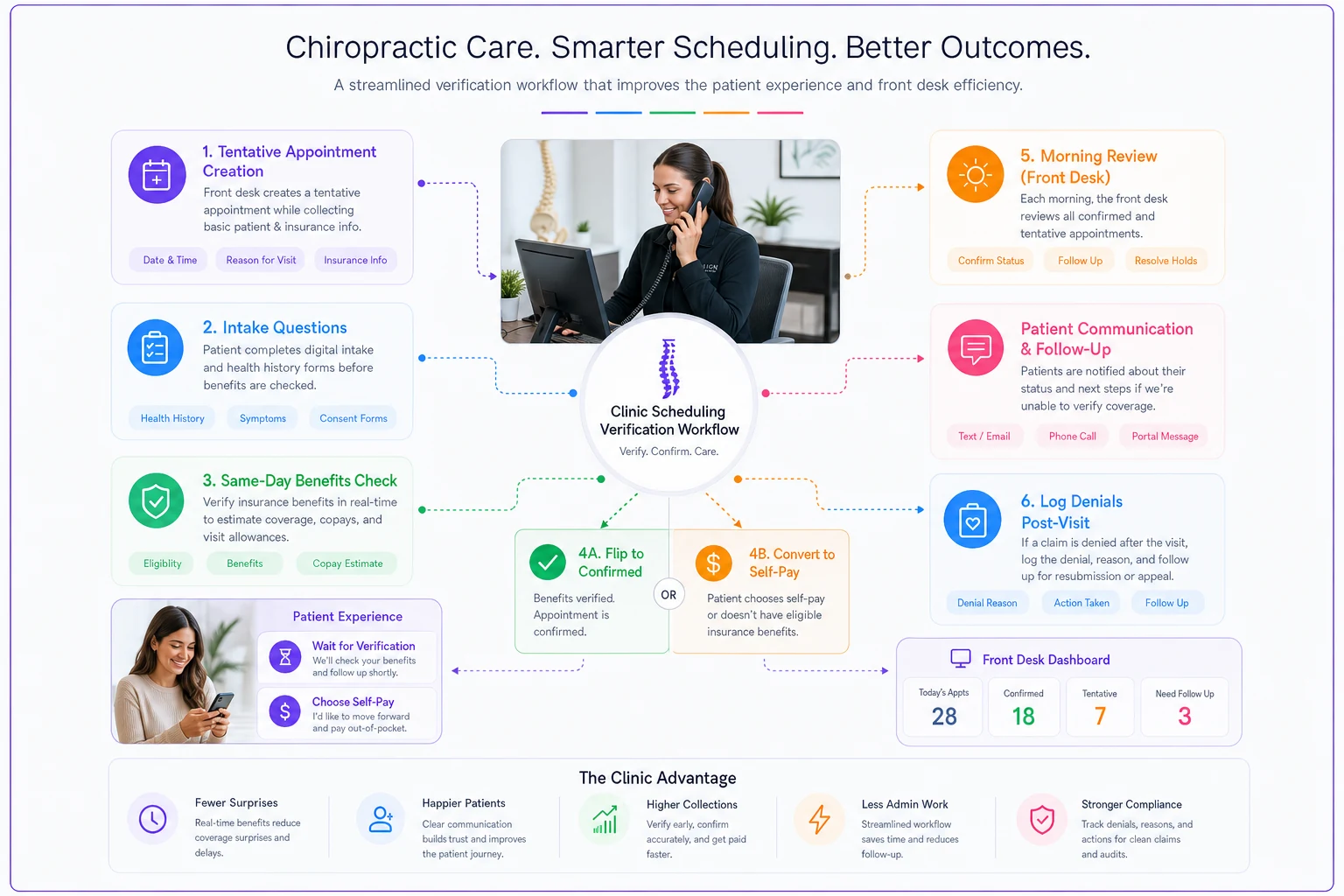
Log denial reason codes immediately against the appointment so you can spot which step in the workflow failed.
That sixth step is what separates clinics that keep getting surprised from clinics that stop. If your denials consistently trace back to "verified late" or "visit cap missed," you know exactly which part of the process to tighten. Tracking those patterns ties directly into a broader denial-prevention approach — the goal is making preventable denials genuinely preventable, not just documented after the fact.
Where automation quietly earns its keep
Nothing above requires software. You can run this SOP with a whiteboard and a disciplined front desk. But the two steps that break down under real-world lobby pressure — running the benefits check same-day, and re-verifying established patients at plan rollover — are exactly where an AI-assisted scheduling platform earns its keep.
In practice, that looks like: an appointment gets created as tentative, and the system won't let it flip to confirmed until the eligibility fields are filled in. It automatically flags established patients whose last verification is older than 30 days, or whose next visit falls in January. It pushes the "coverage pending" list to the front desk each morning so nothing slips through to check-in unverified.
The point isn't to replace the front desk's judgment. It's to make the gate impossible to forget when the phone's ringing and the lobby's full. Verification fails at the moments when someone is busiest — so the automation's job is simply to hold the line at those moments, flagging, reminding, and refusing to confirm bookings that haven't cleared the check.
A real scenario
A two-provider clinic in a mid-size suburb was writing off somewhere around $2,800–$3,500 a month in denied or unbillable visits, plus dealing with two or three furious patient calls a week about unexpected balances. Most of it traced to one habit: booking everyone as confirmed and verifying "when there was time."
They put in the two-state rule. New insurance patients booked tentative, self-pay booked confirmed, and every January every established patient got the "anything change?" question. Benefits checks got done same-day instead of morning-of.
The first month was bumpy — the front desk hated the extra step and a few patients grumbled about being asked to hold a slot. By the second month, write-offs dropped to roughly a third of what they'd been. The angry billing calls mostly disappeared, because patients were hearing their real out-of-pocket before the visit instead of in a statement three weeks later. Nothing about the clinical work changed. They just stopped letting unverified appointments reach the chair.
When this is worth the friction — and when it isn't
When it makes sense: If you bill insurance for more than a small slice of visits, if you've got any plans with visit caps or referral requirements in your mix, or if you're getting more than an occasional surprise-balance complaint. The friction pays for itself fast.
When it's overkill: A pure cash or membership-model clinic doesn't need a coverage gate — there's no coverage to verify. Bolting this SOP onto an all-self-pay practice just slows down booking for no reason.
Who should NOT roll this out cold: Don't drop the two-state rule on a front desk with zero warning and no script practice. The most common failure isn't the SOP itself — it's a receptionist improvising the "coverage pending" conversation and either scaring patients off or waving them through anyway. Run the scripts in a couple of role-play sessions first. The language has to feel natural before it works.
The whole system rests on one boundary: an appointment isn't really booked until coverage is verified or self-pay terms are agreed. Hold that line, give the front desk the exact words, and the surprise bills and the preventable denials mostly stop showing up on their own.
Ready to streamline your chiropractic clinic operations?
Join 1,200+ clinics using Spinesly to save time, reduce scheduling errors, and improve patient care experiences.