



Last month, a chiropractic clinic owner in Denver showed me their scheduling data. They'd booked 47 new patients across three weeks. Only 31 showed up for their first appointment. That's $4,200 in lost initial exam revenue, not counting the lifetime value those patients would have brought.
Most of those no-shows happened because of fixable operational gaps between booking and arrival. Not because patients suddenly decided they didn't need care.
After working with hundreds of clinics, there's a clear operational framework that consistently reduces new patient no-shows to under 15%. The clinics getting these results run a systematic pre-visit sequence that addresses the three main reasons new patients ghost their first appointment.
Why New Patients Actually No-Show (The Real Reasons)
Forget what you've heard about people being flaky. New patient no-shows happen for operational reasons that most clinics accidentally create.
Insurance confusion kills more first visits than anything else. A patient books thinking they're covered. Three days later, they call their insurance and find out they need a referral. Or their deductible hasn't been met. Or chiropractic isn't covered at all. They're too embarrassed to call and cancel, so they just don't show up.
The second killer is "booking amnesia." Someone calls with acute back pain on Monday. By Thursday, the pain has subsided. They can't remember exactly why they booked or what the appointment involves. Without reinforcement between booking and arrival, that appointment feels optional.
Then there's the logistics spiral. Patient realizes they don't know where to park. Or how long the appointment takes. Or whether they need to bring X-rays. These small uncertainties compound until not showing up feels easier than figuring it all out.
One clinic in Phoenix tracked their no-show reasons for two months. Out of 28 new patient no-shows, 19 were insurance-related, 6 were "forgot why they booked," and 3 were logistics confusion. Zero were actual emergencies.
The Pre-Visit Cadence That Actually Works
The most effective clinics run a four-touch sequence between booking and arrival. Four specific touchpoints that each serve a distinct purpose.
Never miss another patient appointment.
Spinesly helps you schedule, confirm, and manage every patient visit efficiently.
- Unified appointment management
- Automated patient reminders
- Staff and resource scheduling
No credit card required
Touch 1 happens immediately after booking. While the patient is still on the phone, your front desk confirms their email and mobile number. Then sends an instant booking confirmation with appointment details, what to expect during the first visit, and parking instructions. This anchors the appointment while their motivation is highest.
Touch 2 comes 24 hours later. This is your insurance verification and eligibility check. Don't wait until the day before. Run their benefits immediately and call them with clear information about coverage, copays, and any requirements. If there's an issue, you have time to resolve it or help them understand their options.
Most clinics mess up here. They think insurance verification is about protecting revenue. It's actually about reducing patient anxiety. When someone knows exactly what they'll pay, they show up. When they're unsure, they disappear.
Touch 3 arrives 48 hours before the appointment. Send a prep message that includes your intake forms (digitally), a short video tour of your office, and a reminder about what to bring. One clinic started including a 90-second video of the chiropractor explaining what happens during the first visit. Their no-show rate dropped from 22% to 14% just from that addition.
Touch 4 is the morning-of confirmation. Text at 8am for afternoon appointments, or the evening before for morning appointments. Include the option to confirm or reschedule. Make rescheduling easy – patients who need to move their appointment but can't reach anyone will just no-show instead.
The Eligibility Gate That Protects Your Schedule
Running insurance verification after booking is backwards. Smart clinics verify eligibility during the scheduling call, before confirming the appointment.
Build this into your scheduling script. After collecting basic information, your front desk says: "Let me verify your insurance benefits while we're on the phone, so you'll know exactly what to expect cost-wise." Then put them on a brief hold while you check eligibility through your clearinghouse or carrier portal.
This does three things. It catches coverage issues immediately when you can address them. It sets clear financial expectations upfront. And it positions your clinic as organized and professional.
About 20% of new patient calls will have some insurance complication. Maybe they need a referral first. Maybe their plan doesn't cover chiropractic. Maybe they have a high deductible they weren't aware of. Better to handle these conversations during scheduling than lose the appointment entirely.
For cash patients or those without coverage, this is when you present your cash rates and payment options. Don't assume someone can't afford care. Plenty of patients choose to pay cash when they understand the value.
First-Visit Prep Incentives That Drive Show Rate
Generic appointment reminders don't move the needle. But strategic incentives tied to showing up for the first visit do.
The most effective approach isn't discounting your exam. It's creating value that's contingent on attendance. One clinic offers a free cervical pillow (wholesale cost: $18) for new patients who complete their intake forms online before arriving. Another provides a posture analysis photo session (takes 3 minutes) free with the initial exam.
These aren't bribes. They're commitment devices. When someone completes their forms to get the pillow, they've invested effort. When they know they're getting something tangible beyond the exam, the appointment feels more valuable.
A clinic in Portland tested three different incentive structures:
-
Group A
Standard reminders only
-
Group B
$20 off initial exam if forms completed online
-
Group C
Free recovery tool kit (foam roller + stretch band, $22 cost) with first visit
Results after 90 days:
| Group | No-show rate | Notes |
|---|---|---|
| Group A | 18% no-show rate | |
| Group B | 16% no-show rate | |
| Group C | 11% no-show rate | The physical incentive outperformed the discount by creating anticipation. Patients actually wanted to show up to get their recovery tools. |
The physical incentive outperformed the discount by creating anticipation. Patients actually wanted to show up to get their recovery tools.
Contingency Scripts for Common Scenarios
Your front desk needs exact language for handling situations that typically lead to no-shows. Not suggestions. Actual scripts they can follow.
When someone calls to reschedule last-minute:
"I understand things come up. I can move you to [specific day/time]. Since we've already prepared for your visit and reviewed your insurance, I want to make sure you don't lose that information. Can we lock in [proposed time] right now? I'll send you a confirmation immediately."
When insurance verification reveals no coverage:
"I just checked your benefits, and it looks like your plan doesn't include chiropractic coverage. However, many of our patients actually find it more affordable to use our cash plan, which is $X per visit. Would you like me to explain how that works?"
When someone seems hesitant about cost after verification:
"I know healthcare costs can be concerning. What most patients find is that addressing this issue now prevents much larger problems down the road. We also offer care plans that break the cost into smaller amounts. Would it help to discuss those options?"
When following up on a no-show:
"Hi [Name], we had you scheduled yesterday at 2pm and wanted to make sure everything's okay. I know Dr. [Name] was looking forward to helping with your [specific issue they mentioned]. I have an opening tomorrow at [time] or Friday at [time]. Which works better for you?"
Never shame or lecture no-shows. The goal is recovery, not punishment. About 40% of no-shows will rebook if contacted within 24 hours with a non-judgmental, solution-focused message.
Testing Your Way to Lower No-Show Rates
Every clinic's patient base responds differently. Instead of implementing everything at once, run controlled tests to see what moves your specific numbers.
Start with your baseline. Track your current new patient no-show rate for 30 days. Include all scheduled first visits, whether they showed, cancelled, or no-showed. Most clinics run between 20-30% without a systematic approach.
Pick one intervention to test first. Usually, the insurance pre-verification gives the biggest immediate impact. Run it for 30 days with half your new bookings (randomly assigned). Track show rates for both groups.
A realistic testing sequence:
-
Month 1-2
Test insurance pre-verification
-
Month 3-4
Add the four-touch cadence
-
Month 5-6
Layer in first-visit incentives
-
Month 7-8
Optimize based on results
Document what you test and the results. One clinic found that texting 48 hours before worked better than 24 hours before. Another discovered that sending forms 3 days early got higher completion than 1 day early. These small optimizations compound.
Your target should be getting below 15% no-show rate for new patients. The best clinics run under 10%, but that takes time. Every 5% improvement in show rate is worth roughly $8,000-12,000 annually for an average clinic.
The Workflow Map That Ties It Together
Here's the full operational sequence that clinics use to reduce new patient no-shows to predictable levels:
-
Collect patient information
-
Run insurance verification while on phone
-
Discuss coverage and costs clearly
-
Confirm appointment and contact preferences
-
Send immediate confirmation email/text
Day 1 Post-Booking:
-
Send intake forms digitally
-
Include first-visit prep information
-
Remind about any incentives for form completion
Day 2-3 Post-Booking:
Confirm forms received. Answer any questions via text/email. Send office tour video or welcome message.
Day Before Appointment:
Text reminder with confirmation request. Include parking and arrival instructions. Remind what to bring.
Day of Appointment:
Morning confirmation text (for PM appointments). Easy reschedule option included.
If No-Show Occurs:
Call within 2 hours. Text if no answer. Follow up next day with specific rebooking times.
Below is a visual map of this workflow.
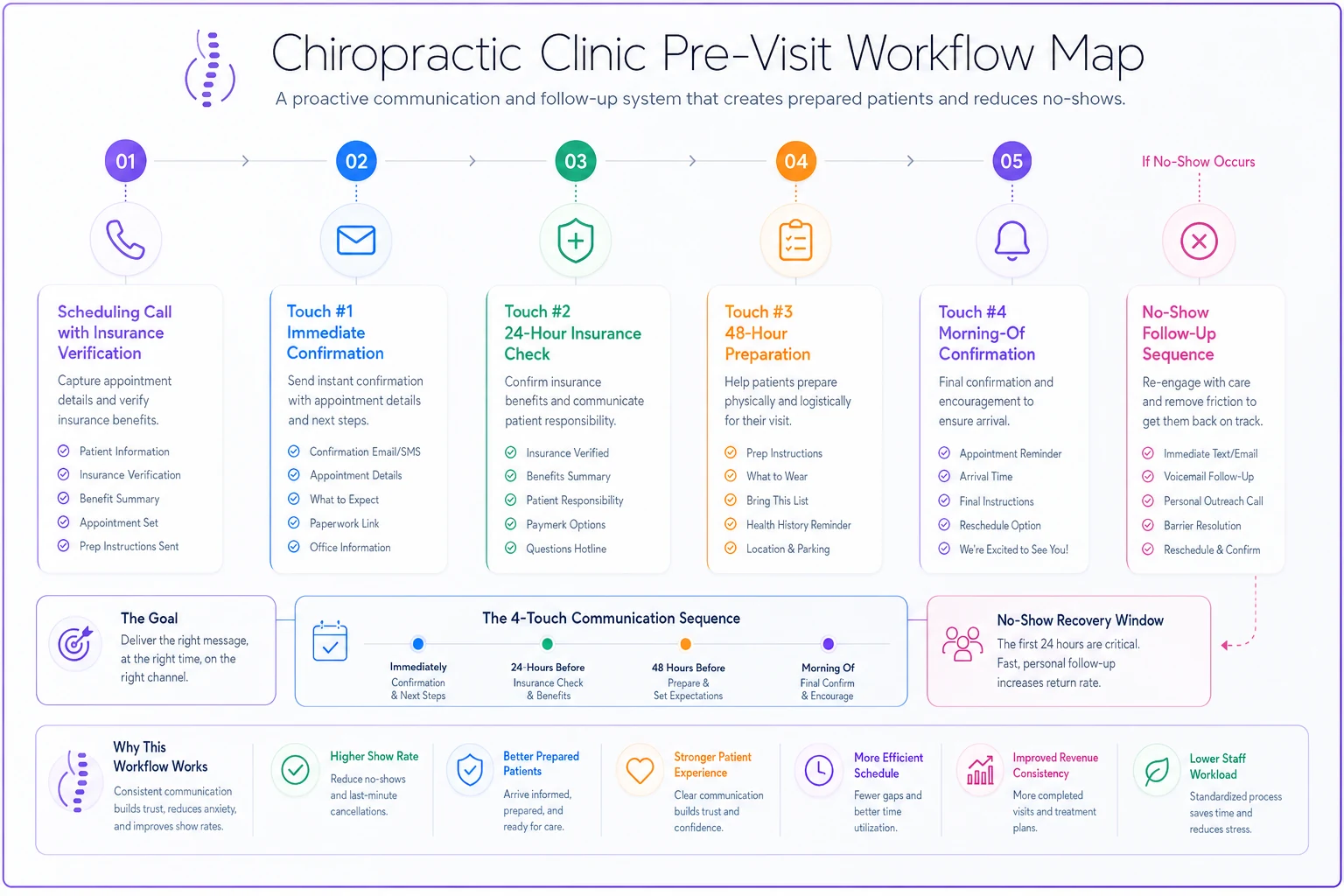
This isn't about hammering patients with reminders. Each touch has a specific purpose and provides value. Patients actually appreciate the organization.
Measuring Lift and ROI
Track three metrics to gauge improvement:
Show Rate: (Completed first visits / Scheduled first visits) × 100 Target: >85%
Recovery Rate: (No-shows who reschedule / Total no-shows) × 100 Target: >40%
Revenue Impact: (Increased shows × Average new patient value) This tells you the actual dollar impact of your improvements
A typical clinic booking 40 new patients monthly with a 25% no-show rate loses 10 patients. Reducing that to 15% saves 4 patients monthly. At $150 for an initial exam plus an average patient lifetime value around $2,000, that's $8,600 in monthly revenue protected.
The operational investment is minimal. Maybe 2 extra minutes per new patient booking for verification, plus automated messages that take seconds to trigger. The ROI usually shows up within the first month.
Software That Makes This Systematic
Managing this manually works but doesn't scale well. The clinics consistently hitting sub-15% no-show rates use operational software to automate the repetitive parts while keeping the human touch where it matters.
The right platform handles insurance verification in real-time during scheduling, triggers your four-touch sequence automatically, and tracks show rates without manual counting. More importantly, it centralizes patient communication so nothing falls through cracks.
Some clinics try cobbling together separate tools for scheduling, reminders, and verification. This creates gaps where patients disappear. An integrated operational platform ensures every new patient gets the same consistent experience that drives show rates.
The AI automation component handles the routine tasks – sending reminders, checking insurance, updating records – while your team focuses on the human elements like answering questions and building relationships. This combination of systematic process and personal touch is what separates clinics with exceptional show rates from everyone else.
The Reality Check
Not every patient will show up. Life happens, emergencies occur, and some people genuinely change their minds about seeking care. The goal isn't perfection. It's building a system that consistently converts 85%+ of your new patient bookings into actual first visits.
The clinics struggling with 30-40% no-show rates don't have a patient problem. They have a process problem. Fix the process with a systematic pre-visit sequence, clear insurance communication, and strategic follow-up, and the numbers fix themselves.
Start with one piece. Test it. Measure the results. Then add the next component. Within 90 days, you'll have transformed your new patient experience and protected thousands in monthly revenue that was walking out the door.
The difference between clinics that grow and those that struggle often comes down to seemingly small operational details like this. Get your new patient process right, and everything downstream becomes easier. Your schedule stays full, your revenue stays predictable, and you can focus on what you actually went to chiropractic school for – helping patients get better.
Start with one piece. Test it. Measure the results. Then add the next component. Within 90 days, you'll have transformed your new patient experience and protected thousands in monthly revenue that was walking out the door.
The difference between clinics that grow and those that struggle often comes down to seemingly small operational details like this. Get your new patient process right, and everything downstream becomes easier. Your schedule stays full, your revenue stays predictable, and you can focus on what you actually went to chiropractic school for – helping patients get better.
Ready to streamline your chiropractic clinic operations?
Join 1,200+ clinics using Spinesly to save time, reduce scheduling errors, and improve patient care experiences.