



Most scheduling problems in multi-provider clinics don't come from having too few slots. They come from having the wrong shape of slots. You'll see a clinic with three DCs and technically enough open appointment times, yet the front desk is turning away new patients while two adjustments cancel and leave dead air on the board. The template looked fine on paper. In practice it was built once, never revisited, and slowly drifted out of sync with how the clinic actually runs.
This is a template-first resource. You can lift these grids, plug in your provider count, and adjust from there. But the templates are only half of it — the rules and utilization math underneath are what let you adapt a schedule as your new-patient flow, payer mix, and provider availability shift throughout the year.
Building blocks first, then the actual grids, then how to stress-test them.
The Four Inputs Every Template Needs Before You Draw a Single Slot
Before you build any grid, four decisions need to be locked down. Skip these and you'll end up rebuilding your template every quarter because the underlying assumptions were never written down.
1. Your appointment-type menu and true durations. Not the durations you wish were true — the ones your providers actually hit. A new patient exam plus first adjustment might be booked at 45 minutes but consistently runs 55. A routine adjustment booked at 15 might take 12 with a fast provider and 20 with a thorough one. Track the last 30 of each type and use the real median.
2. Provider-specific rules. Some DCs can run three adjustment rooms at once with a tech rooming patients; others work one room straight through. Your template has to reflect who can double-book and who can't, or the grid lies to you.
3. Buffer and block philosophy. How much cushion you keep between appointment types, and where you deliberately block time so it can't be booked. More on this below — it's where most templates fail.
4. Your target utilization. Almost nobody sets this on purpose. Without a target, you can't tell whether a slow Tuesday is a real problem or just noise.
Appointment-Type Rules That Actually Hold Up
The pattern worth internalizing: the more appointment types you allow into a template, the faster it degrades. Every additional type multiplies the ways the schedule can jam.
Never miss another patient appointment.
Spinesly helps you schedule, confirm, and manage every patient visit efficiently.
- Unified appointment management
- Automated patient reminders
- Staff and resource scheduling
No credit card required
A workable menu for most multi-provider clinics stays at five or six types:
| Type | Typical booked length | Buffer after | Can double-book? |
|---|---|---|---|
| New patient exam + Rx | 40–50 min | 10 min | No |
| Re-exam / re-eval | 20–30 min | 5 min | No |
| Routine adjustment | 12–15 min | 0–3 min | Yes (with tech) |
| Adjustment + modality | 25–30 min | 5 min | Partial |
| Therapy / rehab only | 20–30 min | 0 min | Yes |
| Consultation (no treat) | 20 min | 5 min | No |
The rule that saves the most chaos: new-patient exams get a hard buffer that can't be reclaimed by the front desk. New patients run long more often than any other type — paperwork gaps, unexpected history, insurance questions. If the desk is allowed to fill that buffer when the board looks empty, you get a cascade where a 10-minute overrun on the exam pushes every adjustment behind it for the next two hours.
A related mistake: letting routine adjustments book right up against a new-patient slot with no cushion. The exam runs over, the provider now has three routine patients stacked in the hallway, and the whole afternoon feels frantic even though the volume was completely normal.
Buffer and Block Rules (the Part Most Templates Skip)
Buffers absorb overrun. Blocks protect capacity you want to hold open. They're different tools, and confusing them is common.
Buffer rules that work in practice:
-
Put buffer after long appointment types, not before. A buffer before an exam just gets eaten by the previous patient.
-
Never buffer between two back-to-back routine adjustments if you have a tech rooming — that's dead capacity.
-
Keep one "recovery buffer" mid-morning and mid-afternoon per provider. A single 10-minute gap around 10:30 and 3:00 lets a provider who's fallen behind catch up without cancelling anyone.
Block rules that protect the business:
-
New-patient blocks. Hold 1–2 slots per provider per day that only the front desk can release, and only for new patients, until 24 hours out. This is the single biggest lever for growth — if new patients can't get in this week, they call the clinic down the street.
-
Same-day / acute blocks. Hold a couple of slots for acute walk-ins and same-day cancellation fills. If you've built a same-day fill workflow, these blocks are where it lives on the grid.
-
Admin blocks. Protected time for report writing, callbacks, and provider documentation. If you don't block it, it disappears, and notes pile up fast.
Pro-tip: Assign a single daily owner to release blocks on schedule so they don't quietly open early.
A block that everyone ignores is worse than no block. The rule has to be: blocks release on a schedule (e.g., new-patient blocks open to any booking at the 24-hour mark), and someone owns that release each day. That ownership detail is what most clinics skip, and it's why the rules erode.
The Utilization Math You Actually Need
Utilization is where "the schedule looks full" and "the schedule is profitable" diverge. Two numbers matter.
Slot utilization = booked slots ÷ available slots.
Revenue-weighted utilization = booked provider-minutes at value ÷ available provider-minutes.
The second one is what actually matters, because a board that's 90% full of low-value therapy-only visits is performing worse than a board that's 75% full with a healthy exam-and-adjustment mix.
A worked example: say a single provider works a 7-hour treating day, roughly 420 minutes. After lunch and two recovery buffers, call it around 380 productive minutes.
-
Mostly routine adjustments at 15 minutes puts the theoretical ceiling somewhere around 25 visits.
-
In reality, factoring in new patients, re-exams, and occasional overruns, a sustainable day lands closer to 18–22 visits.
-
Booked to 20, slot utilization sits around 80% of realistic capacity — which is actually the sweet spot, not 100%.
Aiming for 100% utilization is a mistake. A schedule booked to the absolute ceiling has zero slack, so any cancellation is pure lost revenue and any overrun creates a delay that snowballs. Most well-run multi-provider clinics target 78–85% realistic utilization — full enough to be efficient, loose enough to absorb reality.
-
Available treating minutes per day (after lunch and admin blocks).
-
Subtract recovery buffers.
-
Divide by your weighted average appointment length.
-
Multiply by 0.80 for your daily booking target.
-
Compare actual booked slots against that target weekly.
If you're consistently over target and turning people away, you need more capacity or a schedule redesign — not a busier front desk. If you're consistently under, the problem is demand or fill rate, which is a marketing and recall problem, not a template problem.
Template 1: The 2-Provider Clinic
Two DCs, one shared front desk, one or two therapy rooms. Most common setup, and the one where over-stacking hurts fastest — there's no third provider to absorb overflow.
Daily shape (per provider):
-
8
00–8:30 — Team huddle + first-patient prep (blocked)
-
8
30–10:30 — Adjustment block (routine + one acute-hold slot)
-
10
30–10:45 — Recovery buffer
-
10
45–12:00 — New patient block (1–2 slots) + adjustments
-
12
00–1:00 — Lunch (staggered so one provider covers acute walk-ins)
-
1
00–3:00 — Adjustment block
-
3
00–3:15 — Recovery buffer
-
3
15–5:00 — Mixed: adjustments, re-exams, new-patient hold
-
5
00–5:30 — Documentation block
Weekly rule: Stagger the two providers' heavy new-patient days. If Provider A holds new-patient blocks Monday, Wednesday, and Friday mornings, Provider B holds them Tuesday and Thursday — the front desk is never juggling two long exams during the same rush.
Weekly capacity, rough: Two providers, around 20 visits per day each, five days — roughly 190–200 visits per week at target utilization. Below 150, look at fill. Above 215, you're running hot and cancellations will start costing real money.
Template 2: The 3-Provider Clinic
Three DCs give you something the 2-provider setup doesn't: an overflow provider. The template should name one every half-day.
Key structural rule: Rotate a "float" role. At any given time, two providers run their full grids and one carries lighter booking plus the acute and same-day holds. The float catches overruns and walk-ins so the other two stay on time. Rotate the float role by half-day so no one gets stuck with the low-volume block all week.
Daily shape (staggered starts recommended):
-
Provider A
7:30 start, ends 4:00
-
Provider B
8:30 start, ends 5:30
-
Provider C
9:00 start, ends 6:00 (evening coverage)
Staggered starts widen your bookable hours without adding rooms — matters a lot for working patients who can only come early or late.
New-patient blocks: With three providers you can spread new-patient slots across the full day instead of clustering them. Aim for 4–6 protected new-patient slots per day total across providers and times. If new-patient demand outpaces that, the fix is usually pushing start times further apart, not cramming exams into buffer time.
Weekly capacity, rough: Around 55–60 visits per day across three providers — roughly 270–300 visits per week. Watch the float provider's utilization separately; it should run lower by design.
The 3-provider structure is also where block-release discipline starts to matter most. Two providers can manage it informally. Three is where you need one person to own it each morning, or the blocks quietly open early and your new-patient capacity leaks away.
Template 3: The 5-Provider Clinic
At five providers, the template stops being one grid and becomes a system of coordinated grids. The failure mode here isn't overrun — it's invisibility. No single person can hold the whole board in their head anymore, so slots get double-sold, new-patient blocks get released early, and providers end up unevenly loaded.
Structural rules that matter at this size:
-
Pod the providers. Split into two pods (e.g., 3 and 2) each with defined room assignments. Overflow stays within a pod first, so a delay doesn't ripple across all five schedules.
-
Two rotating floats — one per pod on busy days.
-
Centralized block release. One person owns releasing new-patient and same-day blocks each day, at set times, across all five grids. Without a single owner, someone always releases early "just this once" and your growth capacity slowly leaks away.
-
Provider-specific double-book flags. With five DCs of different speeds, the template must encode who can run parallel rooms and who can't. Treating all five identically guarantees the slower providers run perpetually behind.
Weekly capacity, rough: Around 450–520 visits per week depending on modality mix and how many providers run parallel rooms.
[Morning Block] Pod A (3 DCs) → Full grids + Float A handles acute/walk-ins Pod B (2 DCs) → Full grids + Float B handles overflow [Midday] Float roles rotate → Float A moves to Pod B coverage [Afternoon Block] Pod A → Continues full grids Pod B → Float B resumes, block-release owner checks same-day holds
This isn't a rigid minute-by-minute schedule — it's a coordination framework so nobody's improvising when a provider runs behind or a walk-in arrives. At five providers, improvisation is how things fall apart.
Visualizing the pod rotation and block-release flow helps teams coordinate handoffs and who owns same-day releases.
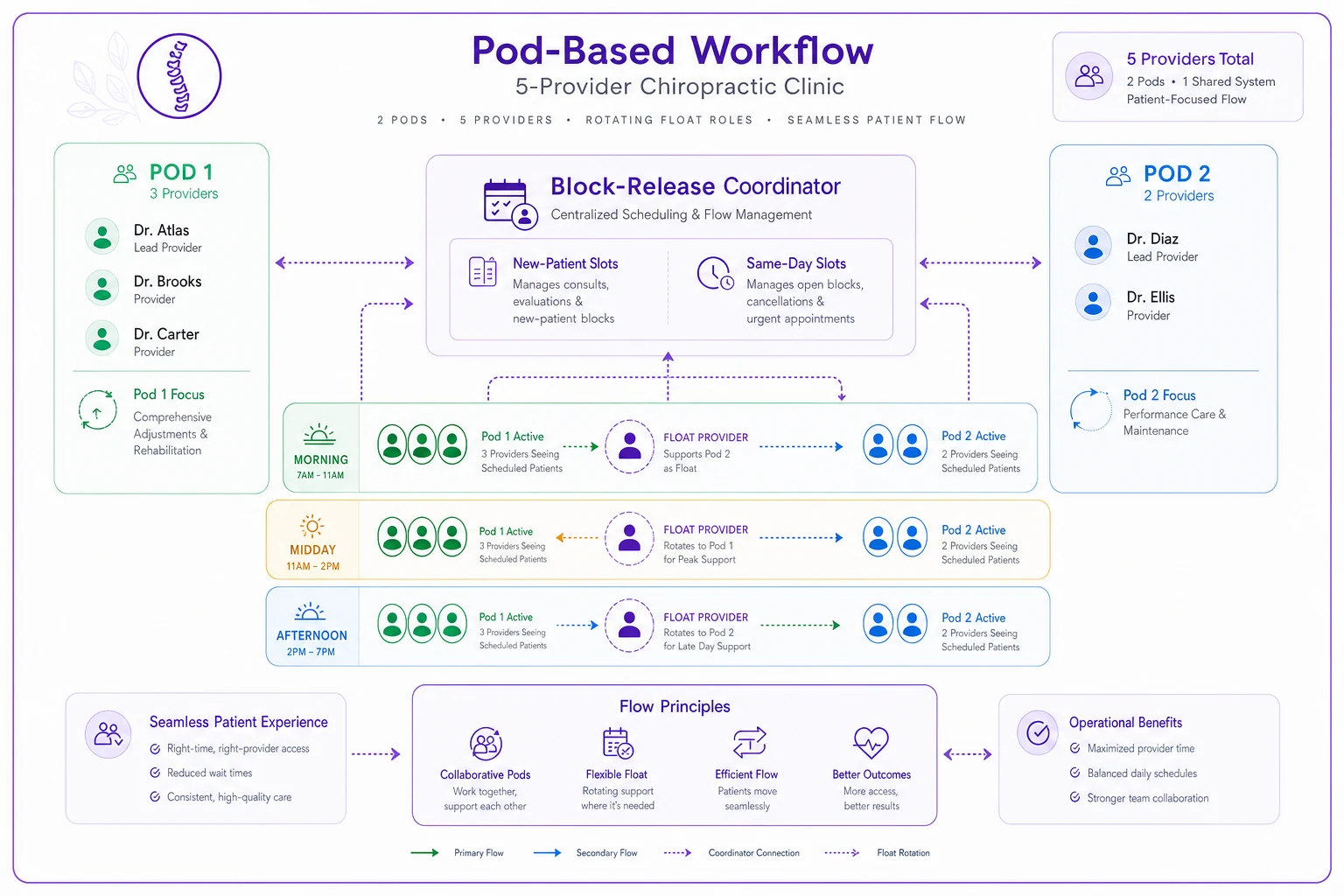
The diagram shows floats, pod boundaries, and the central block-release owner so teams don't have to remember who releases what and when.
Adapting the Template as Demand Shifts
Templates aren't set-and-forget. Three shifts force a redesign.
New-patient surge — after a marketing push or a new referral source. Your held new-patient blocks fill within hours of release. The wrong response is stealing from buffers. The right response: convert one recovery buffer per provider into a new-patient slot temporarily, and push routine adjustments toward the float or pod overflow. Re-measure weighted utilization after two weeks. If it's holding above 85%, that's the signal to add hours or capacity.
Seasonal dip — post-holiday, deep summer. Slot utilization drops below around 70%. Don't leave dead slots on the board. Consolidate: shorten hours on the slowest day, combine two light providers into shared coverage, and redirect freed time into recalls and documentation catch-up.
Payer-mix or provider-availability change. A provider drops to part-time, or a high-volume payer changes reimbursement. This shifts your revenue-weighted utilization even if slot utilization looks steady. Recompute your weighted target and rebalance which providers carry which appointment types.
The habit that separates clinics that stay on top of this: a weekly 15-minute schedule review. Pull three numbers — slot utilization, weighted utilization, and new-patient fill rate — per provider. If all three sit inside target, don't touch the template. If one drifts two weeks running, adjust one variable and watch.
A Quick Checklist for Your Weekly Review
-
Slot utilization per provider inside 78–85%?
-
Weighted utilization holding (mix not drifting toward low-value visits)?
-
New-patient blocks filling — but not filling instantly (which means too few)?
-
Recovery buffers still intact, or getting cannibalized?
-
Same-day/acute holds being used or sitting empty?
-
Any provider consistently running behind (double-book rules wrong)?
Running this weekly takes about 15 minutes once you have the numbers in one place. If you're pulling from three different reports and building a spreadsheet every time, that's a sign your data is fragmented — which is a separate problem worth solving before the review habit can stick.
When These Templates Don't Fit
Very small single-provider practices with unpredictable volume are often better served by a rules-only approach than a rigid grid. The overhead of maintaining a full template outweighs the benefit when you're one DC and a part-time front desk.
If you're at three providers and planning to grow, don't pre-build the podded 5-provider system. Build clean 3-provider grids with the block-release discipline in place first. The discipline is what scales; the extra complexity added too early just creates confusion without the volume to justify it.
And regardless of size — if your front desk overrides blocks without authority, no template survives. The rules have to be enforced, not suggested. A perfectly designed grid with a "we'll just squeeze them in" culture drifts back to chaos within a month.
A Real Scenario
A three-provider clinic in a mid-size suburb was booking around 260 visits a week and felt completely slammed — providers running 20–30 minutes behind most afternoons, front desk apologizing constantly. Monthly revenue was flat and they were turning away new patients on Tuesdays and Thursdays.
The board was over-stacked with routine adjustments and had no protected new-patient blocks. The desk filled every open slot the moment it appeared, including buffers. Slot utilization was effectively over 95% — which sounds great, and was actually the problem.
They rebuilt around the 3-provider template: staggered starts, a rotating float, two recovery buffers per provider, and 5 protected new-patient slots released on a 24-hour schedule by a single owner. Realistic utilization settled into the low 80s. Providers stopped running chronically behind, and new-patient bookings rose because there were finally slots available. Within about two months, weekly volume moved to roughly 285–295 — not a dramatic jump, but the mix shifted toward exams and re-exams, so revenue climbed more than the visit count suggested. The afternoon chaos mostly went away.
Nothing exotic happened. They stopped confusing a full board with a well-built one.
Where Software Makes This Easier
None of this requires software — you can run these templates on paper if you have the discipline to enforce the rules. But at three or more providers, the manual overhead of releasing blocks on schedule, tracking per-provider utilization weekly, and catching double-book violations gets heavy fast, and that's usually where things quietly slip.
A scheduling platform with automated block-release rules, per-provider double-book logic, and utilization reporting built in removes the parts humans tend to forget — the buffer that got cannibalized, the new-patient slot released three hours early, the provider who's been running at 95% for two weeks straight. The template still comes from your operational decisions. The tooling just keeps the rules from eroding when everyone's busy, which is exactly when they tend to.
Start with the grid that matches your provider count, lock the four inputs, set a realistic utilization target, and review three numbers a week. That's the whole system. The template gives you structure; the math tells you when it's time to change it.
Ready to streamline your chiropractic clinic operations?
Join 1,200+ clinics using Spinesly to save time, reduce scheduling errors, and improve patient care experiences.