


Three years ago, a chiropractor in suburban Atlanta called me in a panic. His practice was bleeding patients faster than he could attract new ones. Not because his adjustments weren't working—his clinical outcomes were solid. The problem was everything happening between adjustments.
He'd built his practice to 180 weekly visits, but couldn't break through that ceiling. Every month looked the same: attract 25 new patients, lose 20 existing ones. The treadmill was exhausting.
We spent a day mapping every single patient interaction from first phone call through their tenth visit. What we found was shocking—not because it was broken, but because there was no system at all. Each patient's experience depended entirely on which staff member they encountered, what day they called, how busy the clinic was that moment.
Today that same practice maintains around 280 weekly visits with the same staff, same hours, same adjustment techniques. The difference? They built a patient journey system that guides every interaction, automates critical touchpoints, and catches patients before they drift away.
The Retention Crisis Nobody Talks About
Chiropractic has a dirty secret. Most patients quit before getting better.
Industry data suggests that typical clinics lose 55-65% of new patients before visit ten. More than half your patients—people who sought help, paid for exams, started care—simply vanish before completing even basic treatment plans.
The standard excuses sound reasonable. People get busy. Insurance runs out. They feel somewhat better. Life happens.
But dig deeper into actual patient data and different patterns emerge. Patients don't randomly disappear. They follow predictable exit ramps based on specific operational failures.
A patient misses visit three because of a scheduling conflict. Nobody calls for two days. By the time someone reaches out, the patient has already mentally checked out. They've rationalized that they're "probably fine" and the pain "wasn't that bad anyway."
Another patient completes six visits but never really understands why they need twelve. Each appointment feels like a repeat of the last one. Progress seems invisible. The financial pressure mounts. They ghost.
Or consider the patient who actually completes their initial care plan. They're feeling great, ready to prevent future problems. But nobody explains maintenance care until visit eleven, positioning it as an afterthought rather than the natural next step. They leave thinking they're "fixed" and only return when pain flares up months later.
These aren't clinical failures. The adjustments work. The treatment plans make sense. But the operational wrapper around the clinical care—the journey system—doesn't exist. So patients fall through predictable cracks at predictable moments.
Mapping Reality (Not Theory)
Most patient journey maps look beautiful in PowerPoint presentations. Neat flowcharts showing patients moving smoothly from awareness through treatment into wellness care. Clean. Linear. Completely divorced from reality.
Never miss another patient appointment.
Spinesly helps you schedule, confirm, and manage every patient visit efficiently.
- Unified appointment management
- Automated patient reminders
- Staff and resource scheduling
No credit card required
Real patient journeys look more like tangled spaghetti. Patients don't move through stages—they bounce between them, skip steps, move backward, get stuck in loops.
New patient scheduling seems straightforward: patient calls, schedules appointment, shows up. Simple enough.
Reality? Patient researches online for days. Calls during lunch break but gets voicemail. Leaves message. Gets callback during meeting so misses it. Phone tag for two days. Finally connects. Wants appointment tomorrow but nothing available. Schedules for next week. Three days later, finds another clinic with immediate availability. Cancels. You never knew they existed beyond a missed connection.
Or the supposedly straightforward "acute care phase." Theory says patients come twice weekly for four weeks, symptoms improve, everyone's happy. Reality? Patient feels worse after visit two (normal healing crisis), panics, Dr. Google convinces them chiropractic is dangerous, they no-show visit three and never return.
Shadow your front desk for a morning to document real-world friction points.
Effective journey mapping requires documenting what actually happens, not what should happen. Shadow your front desk for a morning. Listen to the seventeen different ways they explain your cancellation policy. Watch new patients try to figure out where to park, which door to use, whether to sit or stand at the desk. Track how many rings before phones get answered. Count the minutes between a missed appointment and follow-up contact.
One clinic discovered their biggest retention leak wasn't clinical or financial—it was parking. Their lot required a specific validation process that confused new patients. About 30% showed up late and flustered, or circled the block and left. A simple pre-appointment text with parking instructions increased first-visit completion by roughly 20%.
The Five Stages That Actually Matter
Hundreds of patient paths reveal five critical stages where retention is won or lost:
Stage 1: Pre-Commitment Exploration This starts way before first contact. Potential patients are researching symptoms, reading reviews, checking insurance coverage, comparing options. They're forming opinions about you before you know they exist.
Smart clinics influence this stage actively. They create content addressing specific concerns ("why your shoulder clicks during overhead movements"), showcase patient stories similar to their target demographic, and answer the unspoken questions ("will I have to undress?" "does it actually hurt?" "how many visits will this take?").
Stage 2: The Commitment Moment Something shifts between "thinking about it" and "booking the appointment." Usually it's a specific trigger—pain disrupting sleep, missing a golf game, inability to pick up their kid. The gap between this trigger and their first appointment determines everything.
Most clinics lose patients here through friction and delay. Four-day wait times for new patients. Complicated insurance verification. Unclear pricing. Each obstacle gives doubt time to creep in.
Stage 3: The Proof Period Visits 1-6 determine whether someone becomes a real patient or another dropout statistic. They're evaluating everything: Do adjustments help? Is the commute manageable? Can they afford this? Do they trust you?
But patients can't actually tell if adjustments are working during this period. Changes are subtle. They judge progress through proxy metrics: how they're treated, whether appointments run on time, if anyone remembers their name, whether explanations make sense.
Stage 4: The Danger Zone Weeks 3-5 are where most patients bail. Initial motivation has worn off. The time commitment feels heavy. Improvements plateau. Life's regular pressures resurface.
This is when that missed appointment becomes a permanent exit. When "I'll reschedule next week" turns into never coming back. When financial pressure overrides health goals.
Stage 5: Transition to Maintenance Most clinics fumble this transition badly. They either push too hard (feeling salesy) or don't address it at all (losing the patient). The conversation happens too late, positioned as an add-on rather than a natural progression.
High-retention clinics weave maintenance care into the narrative from day one. The examination includes discussion of both correction and prevention. Progress reports show not just current improvement but future risk factors. The transition feels inevitable, not optional.
Building Automation That Actually Helps
Everyone talks about automation, but most chiropractic clinics implement it wrong. They blast generic appointment reminders and wonder why retention doesn't improve.
Effective automation requires understanding which touches need to be personal and which can be systematized. A text confirming tomorrow's appointment? Automate it. A call after someone no-shows their third visit during acute care? That better be personal, immediate, and from someone who understands their case.
Intelligence Layer vs. Task Layer Think of automation in two layers. The intelligence layer monitors patterns and triggers actions. The task layer executes those actions. Most clinics only build the task layer—sending reminders, booking appointments, collecting payments.
The intelligence layer is where retention magic happens. It notices that Jennifer always reschedules Monday appointments but keeps Tuesday ones. It flags that the Johnson family tends to cancel when only one member is scheduled. It identifies that patients who ask about payment plans during visit 2 have an 80% dropout rate by visit 6.
This isn't complex AI stuff. It's pattern recognition based on your actual data. But it requires systems that track the right information and surface insights, not just process transactions.
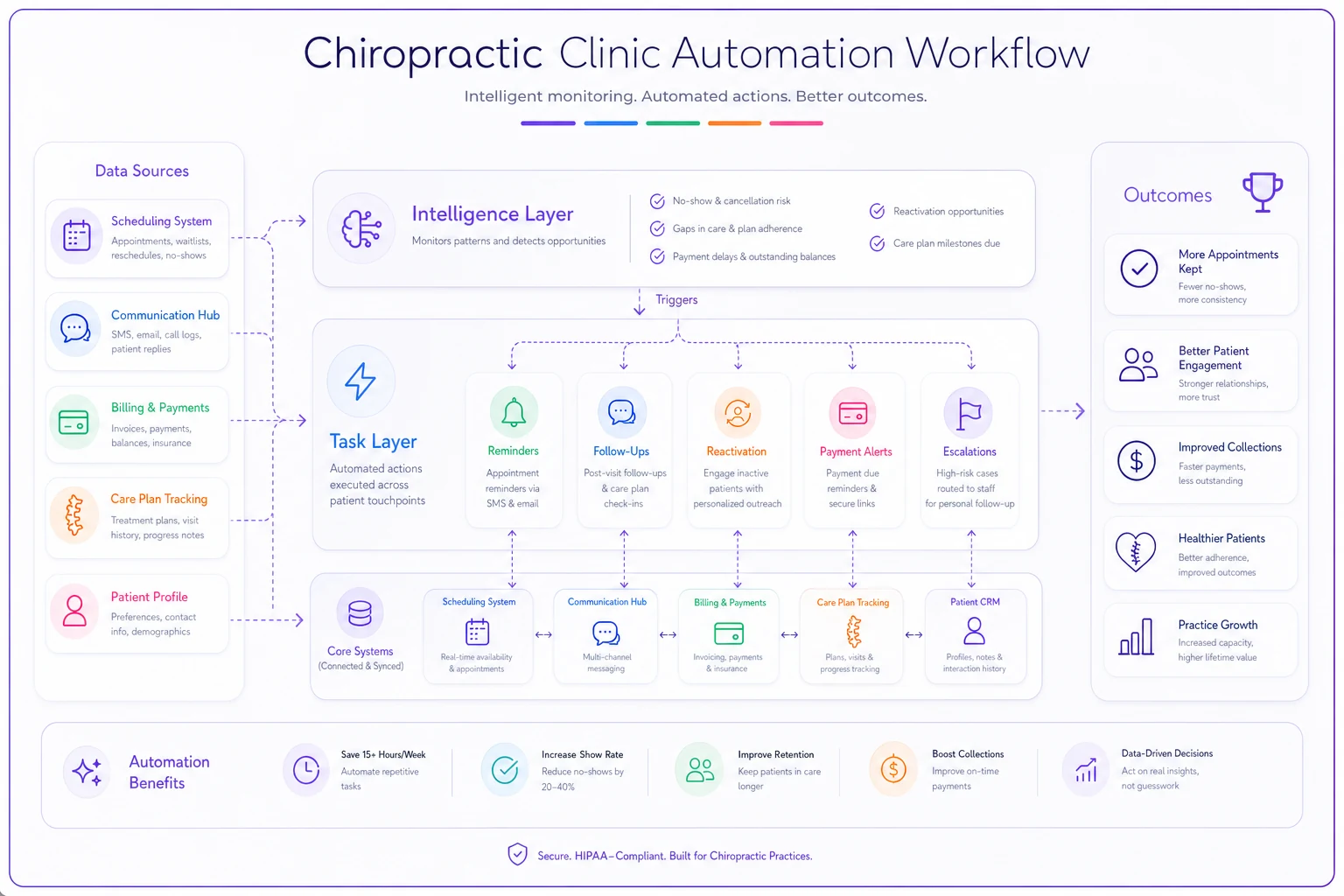
Below is a practical sequencing example for two common automation flows.
-
Day -3
Educational content related to their condition
-
Day -2
Appointment confirmation with parking/logistics reminder
-
Day -1
What to expect tomorrow + direct contact if running late
-
Day 0 (morning)
Final reminder with one-click options to confirm/reschedule
This sequence reduces no-shows, sure. But more importantly, it keeps patients engaged between visits. They're thinking about their care, anticipating improvements, staying connected to the process.
-
Hour 1
Text from the front desk checking if everything's okay
-
Hour 4
If no response, call from the clinical assistant who knows their case
-
Day 1
If still no contact, text from the doctor expressing specific concern about their progress
-
Day 2
Email with easy rescheduling link and note about importance of consistency
-
Day 5
Final outreach with modified treatment options if scheduling is the issue
One clinic tested this protocol against their previous "call when we have time" approach. Patient recovery (those who returned after missing) jumped from around 35% to close to 70%.
Messaging That Moves the Needle
The words matter more than you think. Not marketing fluff, but the specific phrases used at critical moments.
Compare these two messages after a missed visit:
Generic: "You missed your appointment today. Please call to reschedule."
Specific: "Hey Sarah, noticed you couldn't make it in today. Since we're in week 3 of your care plan (the crucial strengthening phase), missing more than one visit can slow your progress. I have openings tomorrow at 2:15 or Thursday at 9:30. Which works better?"
The second acknowledges the person, references their specific situation, explains why it matters, and offers immediate solutions. It gets roughly 3x the response rate.
Condition-Specific Language Stop using "patient" and "treatment." Use their actual situation.
-
For the construction worker with lower back pain
"How's the back holding up with those concrete pours? Need to check if we should adjust your lifting mechanics."
-
For the desk worker with neck issues
"Been noticing any improvement during those long Zoom calls? We're targeting better screen positioning this week."
-
For the runner with hip problems
"Your marathon training starts next month, right? We need these next three visits to ensure your hip stability is ready."
This isn't just personalization—it's demonstrating that you understand their life, not just their spine.
Progress Framing Patients can't feel incremental progress. Your job is to make it visible.
-
Week 1
"The inflammation is starting to calm. You might not feel it yet, but your range of motion improved by 15 degrees."
-
Week 3
"Remember that sharp pain when you turned left? Notice it's more of a dull ache now? That's the nerve irritation settling."
-
Week 6
"You just did that movement without thinking about it. Six weeks ago, you couldn't do it at all."
These observations become proof points that keep patients committed when motivation drops.
Metrics That Predict the Future
Most clinics track backward-looking metrics. Total visits last month. Revenue last quarter. New patients last year. Driving using only the rearview mirror.
Predictive metrics for retention look different:
Visit Interval Creep Track the average days between visits for each patient. When someone scheduled twice-weekly starts stretching to 10 days, then 14, you're about to lose them. Set alerts when intervals increase by more than 40%.
Engagement Touchpoints Count non-appointment interactions: texts responded to, educational emails opened, payment plan discussions, schedule changes requested. Patients averaging less than one touchpoint weekly outside appointments are flight risks.
Question Patterns Document what patients ask about. Questions about cost and time commitment predict different outcomes than questions about exercises and prevention. Build your response protocols accordingly.
Reschedule vs. Cancel Ratio Patients who reschedule are still engaged. Patients who cancel without rebooking are gone. Track this ratio by week of care. If cancellations exceed reschedules after week 4, your danger zone interventions aren't working.
Referral Timing When do satisfied patients refer others? Usually weeks 6-8, after they feel significant improvement but before completing care. If you're not seeing referrals during this window, patients aren't as satisfied as you think.
The Technology Stack That Scales
Small chiropractic clinics don't need enterprise software. They need tools that talk to each other without constant manual intervention.
Start with your practice management system. If it can't export patient data or accept incoming information from other tools, replace it. Modern systems integrate with everything else you'll need.
Communication needs its own platform. Email is basically dead for patient communication—expect 15-20% open rates at best. Text messaging sees around 95% open rates and 45% response rates. But you need HIPAA-compliant platforms that maintain conversation history and integrate with your practice management system.
The gap between these systems is where operational automation platforms earn their keep. Instead of manually checking who needs follow-ups or crafting individual messages, these platforms monitor patient patterns and trigger appropriate communications automatically.
These aren't just fancy reminder systems. They track complex patterns humans miss—the patient who always reschedules when rain is forecast, the connection between specific insurance plans and dropout rates, the correlation between intake question responses and care plan completion.
Payment processing should be invisible to patients. Auto-charging for maintenance plans, payment plan management, failed payment recovery—all of this should happen without front desk intervention. Every payment conversation is a potential retention failure point.
But what matters most: these tools need to share data seamlessly. Your scheduling system should inform your communication platform which should update your billing system which should feed back to your care plan tracker. Disconnected tools create gaps where patients disappear.
A Real Practice Transformation
Let me walk you through what this looked like for a two-doctor practice in the midwest.
When we started, they were seeing around 220 patients weekly but constantly stressed. New patient flow was decent—about 30 monthly—but they couldn't grow beyond their current volume. The senior doctor was burning out from constant new patient exams that led nowhere.
| Month | Actions |
|---|---|
| Month 1: | Implemented online scheduling with next-day availability for new patients. Created pre-appointment education sequences. Built standardized intake that identified patient goals beyond pain relief. First-visit completion jumped to around 85%. |
| Month 2: | Developed the missed-visit protocol with escalating interventions based on care phase. Built progress reporting templates that doctors could complete in 30 seconds but gave patients tangible proof of improvement. Started tracking leading indicators instead of just visit counts. |
| Month 3: | Created condition-specific care paths with clear milestones. Redesigned the acute-to-maintenance transition as a graduation process, not a sales conversation. Added automated check-ins between appointments to maintain engagement. |
| Month 4: | Integrated payment plans with care plans so financial friction couldn't derail treatment. Built reactivation campaigns for different patient segments. Implemented referral requests at optimal timing. |
Six months later, they're seeing around 310 patients weekly. Same hours, same staff, mostly the same patients—just far fewer dropping out. New patient volume actually decreased to about 22 monthly, but revenue increased by roughly $28,000 monthly because patients stay longer and complete care plans.
The senior doctor now spends more time on complex cases and less on constantly replacing churned patients. The junior doctor has consistent patient flow without pressure to oversell. The front desk operates smoothly because systems handle routine communications.
Patient outcomes improved dramatically. When people complete care plans instead of dropping out, they actually get better. That's the part that makes all this operational work worthwhile.
Why Most Clinics Never Build This
Knowledge isn't the barrier. Most chiropractors understand that retention matters. They've heard about patient journeys, automation, engagement strategies. So why do so few actually build working systems?
First, it's operationally overwhelming when you're already drowning in daily practice demands. Every minute spent building systems
That's the part that makes all this operational work worthwhile.
Ready to streamline your chiropractic clinic operations?
Join 1,200+ clinics using Spinesly to save time, reduce scheduling errors, and improve patient care experiences.