

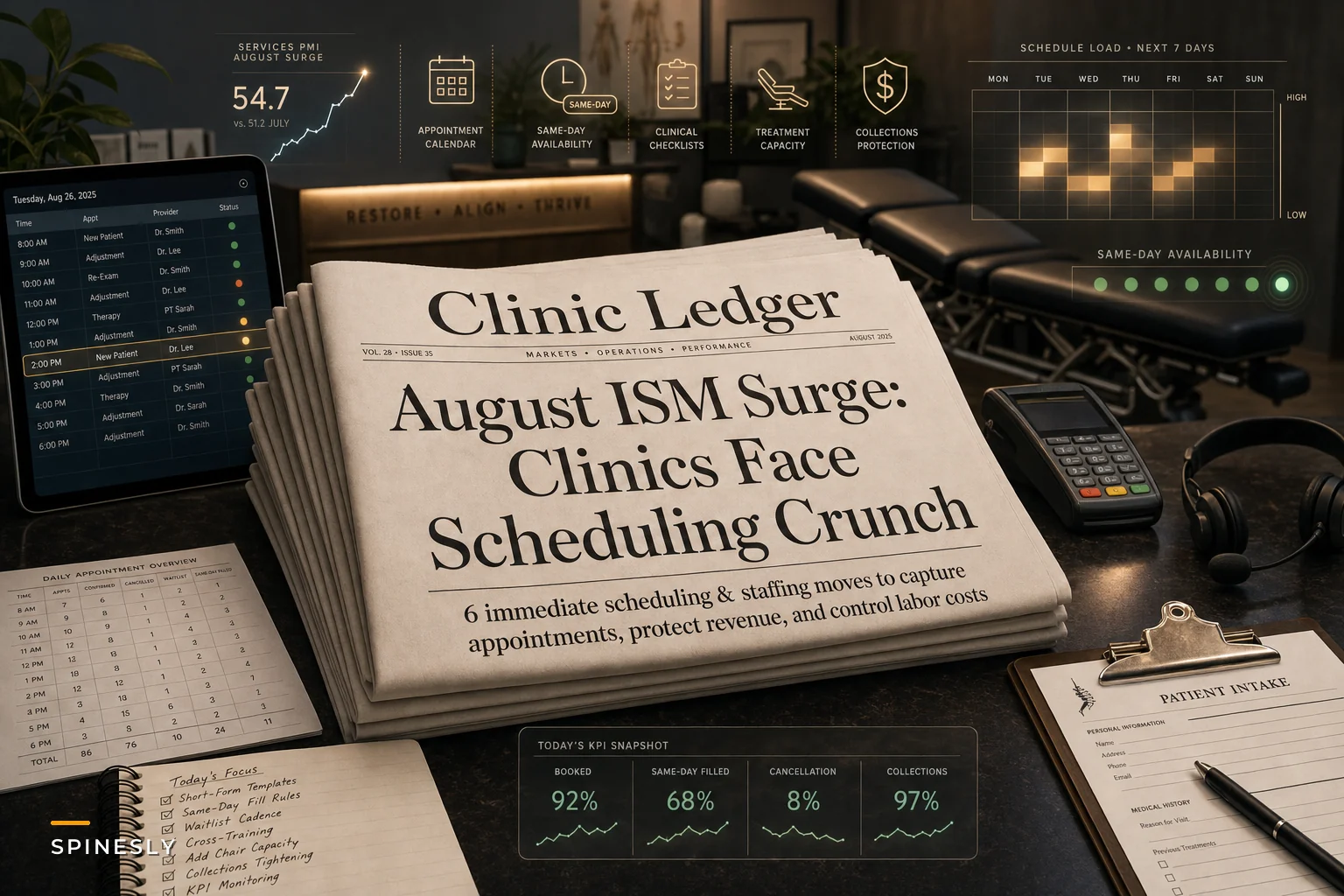

The August 2026 ISM Services PMI came in at 55.4, with new orders hitting 60.9 — the strongest services expansion in about three and a half years. Reuters reported that consumer demand for services accelerated sharply, and the ISM's own August report backed it up with broad-based order growth across sectors.
For most clinic owners, a macro number like that is easy to scroll past. But the practical read is this: when service demand climbs economy-wide, appointment-based businesses feel it — more inbound calls, more walk-ins, more short-notice requests. The clinics that get hurt aren't the ones with too little demand. They're the ones that let demand outrun their schedule and staffing plan, then absorb the cost through overtime, missed collections, and patients who quietly stop rebooking.
This isn't about hiring three new associates next week. It's about pulling more usable capacity out of what you already have, keeping your team from burning out, and not leaving money on the table when the phone starts ringing more than usual. Below are six moves worth making now, ordered roughly by how fast you can implement them.
1. Re-baseline your real capacity before you touch the schedule
Most clinics don't actually know their true capacity. They know how many slots exist on paper, which is a different thing entirely.
The gap shows up fast when demand rises. A provider "booked" for 32 hours a week might only be delivering adjustments for 21 of them once you account for documentation, room turnover, insurance interruptions, and the two patients who ran 15 minutes long. When demand was soft, that slack was invisible. When it spikes, that slack becomes your bottleneck.
Before you add anything, spend a week tracking the difference between scheduled minutes and treated minutes per provider. Across busy multi-provider clinics, that number is almost always worse than the owner expects — often 25–35% of a provider's day gets absorbed by non-treatment tasks. That's your first source of capacity, and it costs nothing to recover.
A quick way to find it:
-
Pull last month's schedule and count total booked slots
-
Compare against actual completed visits (not booked — completed)
-
Note the average overrun on new-patient and re-eval visits
-
Flag the recurring dead slots that never fill (early mornings, late Fridays)
-
Identify which provider consistently runs behind and why
You're not optimizing yet. You're just seeing the real board.
2. Protect fast-access slots instead of letting them get eaten
A mistake that quietly kills conversion during a demand surge: filling every open slot two weeks out, then having nothing left for the person who calls today with acute low-back pain and a credit card ready.
Never miss another patient appointment.
Spinesly helps you schedule, confirm, and manage every patient visit efficiently.
- Unified appointment management
- Automated patient reminders
- Staff and resource scheduling
No credit card required
Same-day and next-day demand rises disproportionately when overall demand rises. People who've been putting off care finally book. Acute patients — the ones most likely to convert into a care plan — almost never want to wait ten days.
The fix is to deliberately hold a small buffer of near-term slots. Not many. Roughly 2–3 protected slots per provider per day, released back to general booking if they're still empty by a cutoff time (say, 4 PM the day before). It feels counterintuitive to leave slots "empty," but a held slot that catches a high-intent acute patient is worth more than one filled by a low-urgency follow-up who would've booked regardless.
When this makes sense: clinics with steady walk-in and acute inflow, or a strong front-desk triage process.
When it's a bad idea: if your no-show rate is high and unmanaged, protected slots just become empty slots. Fix collections and reminders first.
3. Cross-train so demand spikes don't create single points of failure
The hidden fragility in most clinics isn't provider hours — it's the front desk. When call volume jumps 20–30%, the schedule doesn't break at the treatment table. It breaks at intake, verification, and rebooking.
A typical pattern: one strong front-desk person handles everything smoothly at normal volume. Demand rises, they get buried, calls go to voicemail, insurance verification slips, and same-day payment collection gets skipped because there's no bandwidth. The clinic is "busier" but not more profitable.
-
Verify benefits and flag prior-auth needs
-
Run point-of-care collections without hesitation
-
Work the cancellation waitlist and fill open slots
-
Handle the new-patient intake flow end to end
Schedule cross-training during predictable slower windows (e.g., mid-afternoon) so it doesn't disrupt peak operations.
The goal isn't to make everyone interchangeable. It's to make sure that when one bottleneck person is out or slammed, the whole revenue chain doesn't seize up.
4. Rebuild your schedule template around utilization, not habit
Most clinic schedules are historical accidents. They reflect what the founding provider preferred years ago, not what current demand patterns actually require.
A demand surge is the right moment to redesign the grid. The goal isn't just "more slots" — it's matching slot types to real demand distribution. If acute and re-eval visits are climbing but your template is built mostly around 15-minute maintenance blocks, you'll create artificial congestion.
Here's a simple comparison of common template approaches under rising demand:
| Approach | How it handles a surge | Payroll risk | Retention risk |
|---|---|---|---|
| Uniform blocks (all slots equal) | Congests fast; overruns cascade all day | High overtime | Rushed visits, drop-off |
| Tiered blocks (new/re-eval/maintenance sized differently) | Absorbs longer visits without derailing the day | Lower | Steadier experience |
| Protected-access hybrid (tiered + held same-day slots) | Captures acute demand, limits cascade | Lowest | Highest |
If you want a deeper walkthrough of building these grids — including the utilization math and rules for how many slots of each type per provider — the breakdown in Sample Schedules for Multi-Provider Chiropractic Clinics covers the templates in detail. Worth pairing with this piece, because a demand surge is exactly when a sloppy template costs you the most.
The key insight: a well-built template handles scheduling decisions for your front desk automatically, so they're not improvising slot placement under pressure. That's how you keep visit quality stable even when volume isn't.
5. Tighten day-of collections before volume hides the leakage
More visits means more copays, more coinsurance, more chances for money to slip through. When the front desk is slammed, point-of-care collection is the first thing to get skipped — "we'll bill them later" becomes the default.
Later collections cost you. A/R ages, some balances never come in, and staff spend hours chasing what should've been collected at the desk. During a surge, this leakage scales right alongside your visit count, which is why busier months sometimes feel no more profitable than slow ones.
The move here is boring but high-leverage: make same-day collection non-negotiable and structurally easy. Card on file where appropriate, a clear script, and a front desk that isn't so overloaded they abandon the step — which loops back to cross-training.
Real scenario: A three-provider clinic running roughly 330–360 visits a month noticed their copay collection rate sitting around 78% during their busy stretch — meaning about one in five day-of payments got deferred to billing. After enforcing a strict point-of-care SOP and putting cards on file for recurring care-plan patients, collected-at-visit rates moved into the low 90s within about two months. No new patients required. The improvement was purely operational — money they were already owed, just captured on time. On their volume, that recovered several thousand dollars per month that had been drifting into aged A/R.
6. Automate the repetitive coordination so your team can absorb the volume
This is where clinics either scale gracefully or grind their staff into the ground. The tasks that multiply during a demand surge are mostly repetitive: appointment reminders, recall outreach, waitlist filling, verification chasing, rebooking nudges. None of it requires clinical judgment. All of it eats staff hours.
When these workflows are manual, a 25% volume increase can feel like a 50% workload increase for the front desk, because coordination overhead compounds. This is the underlying problem a demand surge exposes: most clinics run their coordination on human memory and sticky notes, and that model doesn't stretch.
AI-assisted operational platforms help here in a fairly unglamorous way — by handling predictable, repetitive coordination so your people focus on the parts that actually need a human. A few practical examples:
-
Automated reminder and confirmation sequences that cut no-shows without a staff member dialing numbers
-
Waitlist and same-day fill automation that texts the next patient the moment a slot opens
-
Recall workflows that trigger on their own instead of relying on someone remembering to run a report
-
Verification and prior-auth flags surfaced automatically before the visit, not discovered at check-in
The point isn't to replace the front desk. It's to stop wasting their time on things a system handles better, so when demand rises they have capacity for the human parts — triage, difficult calls, walk-in conversion, collections — without dropping the ball.
A simple sequence for putting this in place without disrupting your clinic:
-
Automate reminders and confirmations first (biggest, easiest win)
-
Layer in waitlist and same-day fill so cancellations self-recover
-
Add automated recall triggers tied to care-plan gaps
-
Move verification flags upstream so surprises don't hit the front desk at check-in
-
Review weekly for the first month and adjust timing and messaging
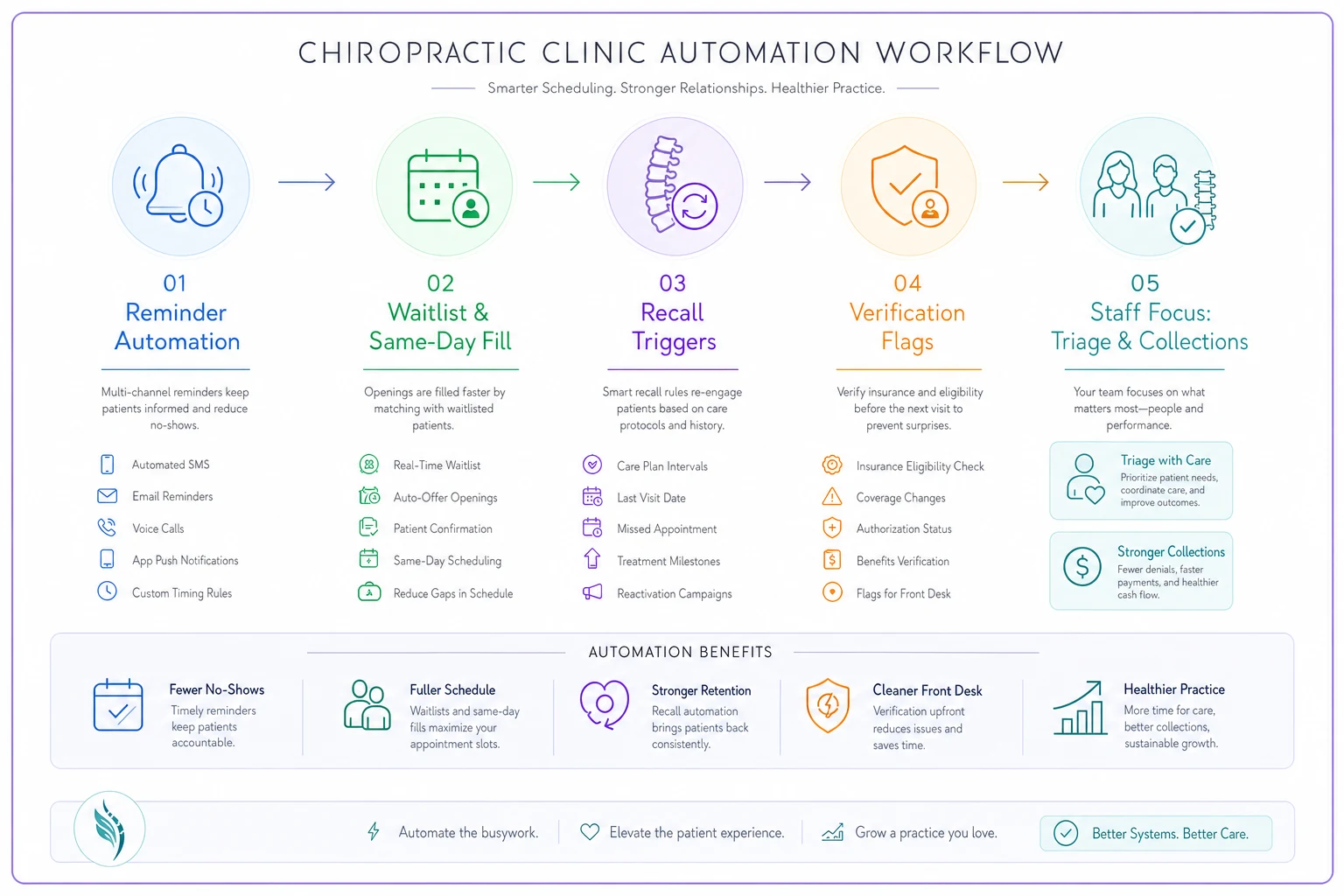
This diagram shows the recommended automation rollout so teams can visualize the sequencing and handoffs.
Who should hold off on all this
Not every clinic should react to a demand signal by expanding. If your retention is already shaky — patients dropping off after three or four visits — pouring more new demand into a leaky system just increases churn and burnout. Fix the patient experience and rebooking flow before chasing volume.
Same goes if your documentation and billing are already behind. More visits will bury you. Get those baseline systems stable first. A surge amplifies whatever's already true about your operation. Strong clinics get stronger. Fragile ones break in more expensive ways.
The real takeaway
A rising demand environment doesn't automatically mean a better year. Plenty of clinics get busier and less profitable at the same time — more overtime, more skipped collections, more rushed visits, a team running on fumes. The difference comes down to whether your scheduling and staffing systems can flex without cracking.
The six moves above are ordered so you can start today: see your real capacity, protect fast-access slots, cross-train the front desk, redesign the template around actual demand, lock down day-of collections, and automate the repetitive coordination that otherwise drowns your staff. None of it requires a hiring spree. Most of it just requires treating a demand surge as a planning problem rather than a firefight — and getting your operation in order before the phone starts ringing more than usual.
Ready to streamline your chiropractic clinic operations?
Join 1,200+ clinics using Spinesly to save time, reduce scheduling errors, and improve patient care experiences.