

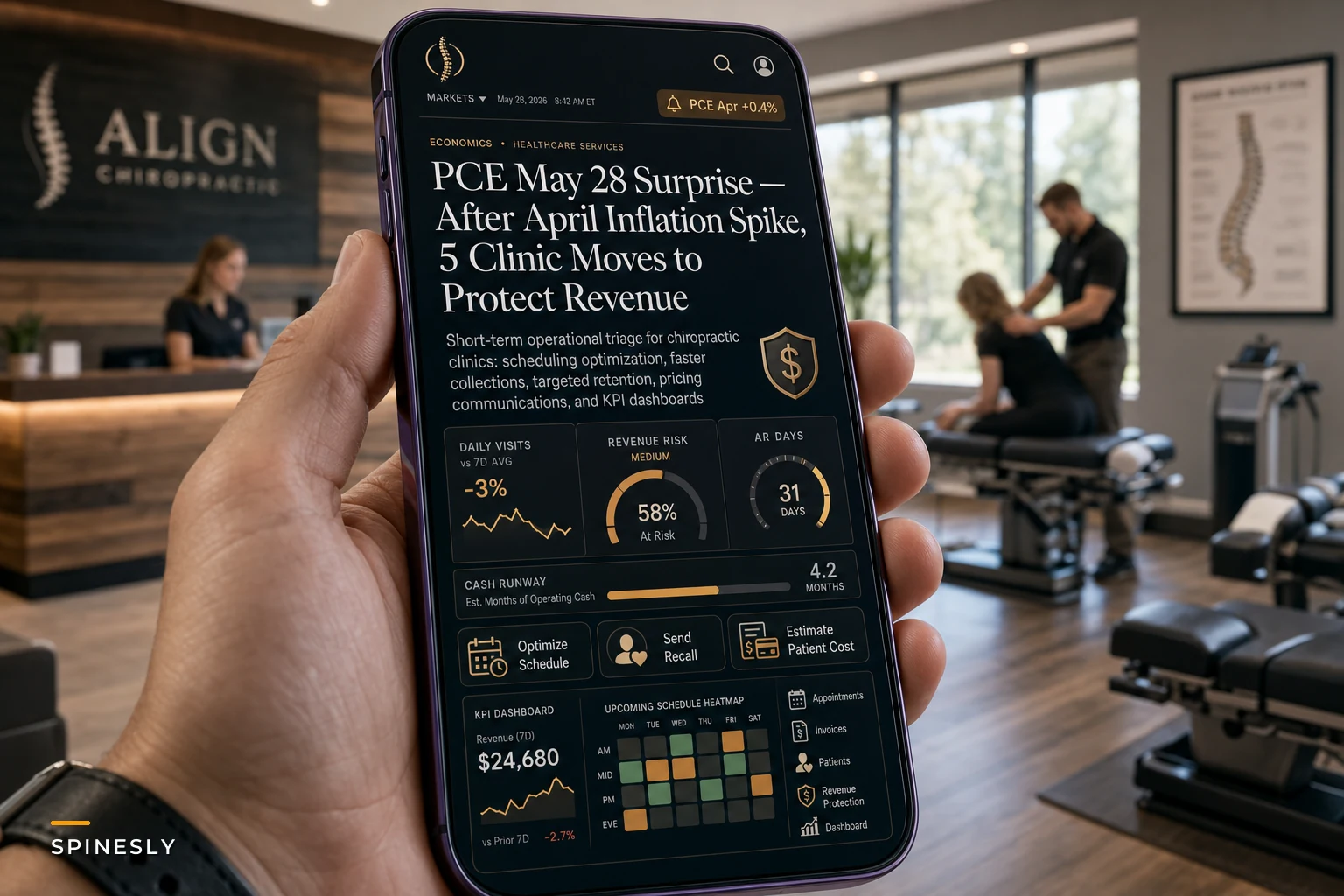

Last week's economic data hit like a spine out of alignment. The PCE inflation numbers for April came in hotter than expected—headline PCE at 3.8% year-over-year, core at 3.3%. For chiropractic clinics already juggling rising supply costs and patients who are cutting back on care, this signals rougher waters ahead.
Inflation doesn't kill practices directly. It exposes operational weaknesses that were always there, hiding under decent cash flow. When patients start spacing out visits from weekly to biweekly, or your gel packs suddenly cost 20% more, those inefficiencies turn into bleeding wounds.
Working with chiropractors over the past few years—especially those transitioning to cash-based models—I've watched inflation cycles separate the operationally tight clinics from those running on momentum. The difference isn't marketing spend or fancy equipment. It's mundane stuff like package pricing, inventory management, scheduling structure, and most critically, how you protect revenue when costs spike.
The Real Cost Squeeze Nobody Talks About
Most chiropractors focus on obvious inflation impacts. Supply costs up 15-25%. Staff wanting raises. Utility bills climbing every quarter. Those are real problems, but they're not what kills practices.
Patient behavior shift is the silent killer. When household budgets tighten, chiropractic care often moves from "essential" to "nice to have." They don't quit entirely—they stretch. That weekly maintenance patient becomes biweekly. The family of four only brings in two kids instead of all four. Package buyers want smaller commitments.
A suburban Atlanta clinic tracked this perfectly. Between March and September, their average patient visit frequency dropped from 2.8 visits per month to 2.1. Multiply that across 400 active patients and you're looking at 280 fewer visits monthly—roughly $14,000 in lost revenue at $50 per visit.
Their overhead stayed exactly the same. Same rent, same staff hours, same insurance. Just less revenue to cover it.
Move #1: Restructure Your Package Pricing Without Looking Desperate
Raising prices during inflation feels necessary but dangerous. Go too high, lose patients. Stay flat, lose margin. Most clinics default to a straight 5-10% increase across the board and hope for the best.
Never miss another patient appointment.
Spinesly helps you schedule, confirm, and manage every patient visit efficiently.
- Unified appointment management
- Automated patient reminders
- Staff and resource scheduling
No credit card required
| Package Type | Old Structure | New Structure | Patient Sees | You Get |
|---|---|---|---|---|
| Maintenance | 12 visits @ $45 = $540 | 6 visits @ $48 = $288 | Lower commitment | Higher per-visit |
| Corrective | 24 visits @ $40 = $960 | 8 visits @ $44 = $352 | More flexibility | Better cash flow |
| Family Plan | 4 people unlimited = $400/mo | 2+2 rotation = $280/mo | Lower monthly | Same visits |
That's backwards thinking.
Smart clinics are restructuring packages to create breathing room without sticker shock. Instead of selling 12-visit packages, shift to 6-visit packages at a slightly higher per-visit rate. Patients see a lower total price even though your per-visit revenue goes up.
A Phoenix clinic made this shift last fall. Package sales increased by 30% because the lower entry point felt manageable. Their per-visit revenue went up $3-5, and cash flow improved because patients were re-purchasing more frequently.
Offer shorter packages at a slightly higher per-visit rate to lower the psychological commitment for new buyers.
The psychological component matters more than the math. When money feels tight, patients want flexibility and control, not long-term commitments that feel like another monthly bill.
Move #2: Turn Your Scheduling System Into a Revenue Protection Tool
Every empty slot on your schedule during inflation is money you'll never recover. Yet most clinics still run scheduling like it's 2015—patients call, front desk checks the book, everyone hopes for the best.
Modern scheduling isn't about convenience. It's about density optimization. You need to know exactly when your profitable hours are and protect them ruthlessly.
Start by mapping your actual revenue per time slot, not just appointments. Tuesday at 10am might have appointments, but if they're all Medicare patients or deep-discount packages, that slot is bleeding money compared to your 5pm cash-patient rush.
Morning slots (7am-11am): Reserve for high-margin cash patients and package holders. These people value convenience over price.
Midday slots (11am-2pm): Insurance patients and new patient exams. Lower margin but consistent.
Afternoon rush (2pm-6pm): Premium pricing zone. Cash patients, families, quick adjustments. No lengthy therapies that eat clock time.
Evening slots (6pm-close): Membership patients who prepaid. They've already committed, so honor their flexibility.
Then implement automated reminders that actually drive behavior. Not just "See you tomorrow at 3pm!" but "Your appointment tomorrow helps maintain your progress from last week's adjustment. Reply YES to confirm you're coming."
That small language change reduced no-shows by about 15% for several clinics. During inflation, when every patient counts, those percentages compound fast.
Move #3: Create a Supply Cost Hedge That Patients Never See
Supply costs are weird in chiropractic. You're not buying massive inventory, but those small recurring expenses—biofreeze, face paper, cleaning supplies—add up to several thousand monthly. When inflation hits, these "minor" costs can suddenly eat an extra $500-800 per month.
Most clinics try to solve this by buying in bulk when they see prices rising. That ties up cash you desperately need liquid during uncertain times.
Better approach: operational substitution. Look at what you're actually using supplies for, then find ways to reduce usage without changing patient experience.
Example: One Illinois clinic was spending $400 monthly on face paper. They switched to washable face cradle covers, invested $200 in a set of 50, and now spend $30 monthly on laundry service. Patients actually preferred the softer feel.
Another substitution goldmine: therapy supplies. Instead of giving every patient a new theraband for home exercises, create a "loaner library" with deposits. Patient pays $20 deposit, gets it back when they return the band. About 40% never return them—pure profit. The rest create a reusable inventory that cuts supply costs by 60%.
The operational software we've built for clinics tracks supply cost per patient visit automatically. Most clinics discover they're spending $3-6 per visit on disposables. Cut that by even $1.50 and you've created meaningful margin protection.
Move #4: Build Financial Breathing Room Through Intelligent Prepayment
Cash flow during inflation becomes everything. You need money today to cover rising costs, not promises of insurance payments in 45 days. But aggressive prepayment pushes feel salesy and desperate.
Create prepayment options that feel like patient wins, not clinic desperation.
The "Price Lock Guarantee": Offer patients the ability to prepay for 6 months of care at today's prices, protecting them from any increases. Frame it as inflation protection for them, not prepayment for you.
The "Reserve Your Slot" Program: Patients prepay for their recurring appointment slot (every Tuesday at 4pm is theirs). If they miss without notice, they lose that week's credit. This creates both prepayment and attendance incentive.
Split Payment Plans: Instead of demanding full package payment upfront, offer 3-payment splits with a small convenience fee. You get immediate cash flow, patient feels less squeezed.
A Denver practice implemented the price lock guarantee last winter. Forty percent of their regular patients took it, generating almost $35,000 in immediate cash flow. They used that buffer to negotiate better terms with suppliers and avoid credit line usage when their own costs spiked.
Never present these as "helping the clinic." Always frame them as protecting the patient from future uncertainty.
Move #5: Automate the Boring Stuff That Bleeds Money Slowly
During inflation, every operational inefficiency costs double—once in actual waste, again in opportunity cost of time spent on low-value tasks. The clinics that thrive are those that ruthlessly automate repetitive workflows.
Start with insurance verification. If your front desk spends 90 minutes daily checking benefits, that's 30 hours monthly of salary going to mind-numbing work. AI-powered verification systems can handle 80% of those checks automatically, freeing staff for revenue-generating activities like recall campaigns or package sales.
Payment posting is another silent killer. Manual posting of insurance payments, matching EOBs, reconciling patient accounts—it's necessary but wasteful. Modern operational platforms can automate payment posting with AI that learns your specific insurance patterns, reducing errors and speeding up cash flow.
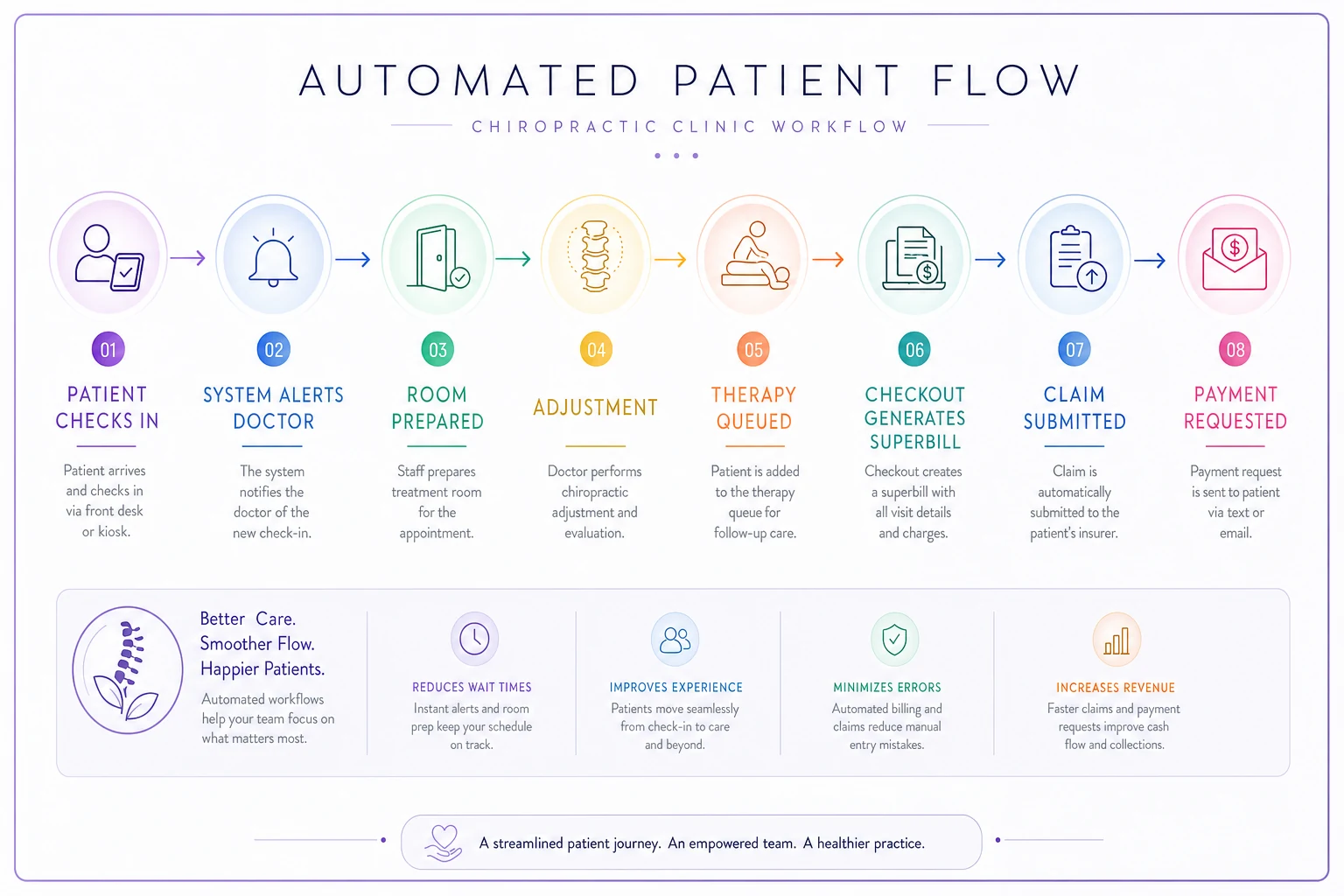
But the biggest win comes from intelligent patient flow automation. Instead of staff manually moving patients through intake, adjustment, therapy, and checkout, implement triggered workflows:
-
Patient checks in → system alerts doctor → prepares room setup based on treatment plan
-
Adjustment complete → automatically queues therapy if needed → schedules follow-up
-
Visit ends → generates superbill → submits claim → requests payment
One California clinic cut their patient processing time from 47 minutes average to 31 minutes just by eliminating the "what's next?" delays between treatment stages. That's 5-6 extra patients per day in capacity without adding hours or staff.
Automation during inflation is a one-time cost that keeps delivering savings. Every month those systems run, you're saving money that can offset rising costs elsewhere.
Here's a simple visualization of the automated patient flow.
Every month those systems run, you're saving money that can offset rising costs elsewhere.
The Reality Check Most Clinics Need
Inflation reveals that most chiropractic clinics run on habit, not systems. When times are good, inefficiency feels manageable. When margins compress, those same inefficiencies become existential threats.
-
$2,000 to no-show and late cancellations
-
$1,500 to supply waste and over-ordering
-
$1,800 to insurance denials from verification errors
-
$1,700 to inefficient scheduling and gaps
A typical 2-doctor clinic I evaluated recently was losing approximately $7,000 monthly to fixable operational issues:
The clinics that survive inflation cycles aren't necessarily the biggest or best marketed. They're the ones that treat operations like a profit center, not a necessary evil. They understand that every workflow, every system, every process either protects revenue or accelerates its erosion.
When to Make These Moves (And When to Wait)
Not every clinic should implement all five moves immediately. The timing depends on your current stability and patient base.
If you're already struggling: Start with Move #2 (scheduling) and Move #4 (prepayment). You need immediate cash flow and revenue optimization.
If you're stable but concerned: Focus on Move #1 (package restructuring) and Move #5 (automation). Build resilience before you need it.
Don't implement these if:
-
You're about to sell your practice (keeps valuations cleaner)
-
You just made major operational changes (avoid change fatigue)
-
Your patient base is primarily Medicare/Medicaid (different rules apply)
If you're growing despite inflation: Implement all five moves systematically. Use your momentum to build operational moats that protect you when growth slows.
The Path Forward
Inflation isn't ending anytime soon. The latest PCE data suggests we're in for sustained pressure through at least mid-2027. For chiropractic clinics, this means the operational choices you make now determine whether you're thriving or just surviving a year from today.
Every operational improvement compounds. Fix scheduling, and suddenly your staff has time for recall campaigns. Automate insurance verification, and your billing becomes cleaner. Restructure packages intelligently, and patient lifetime value increases even with lower visit frequency.
The clinics weathering this best aren't waiting for inflation to end. They're building operations that profit regardless of economic cycles. They're turning the pressure of inflation into the catalyst for overdue improvements.
Most importantly, they're recognizing that protecting revenue during inflation isn't about working harder or marketing more. It's about working smarter through systems that scale.
Your patients need you stable and sustainable, not stressed and scrambling. These five moves aren't just about surviving inflation—they're about building a practice that serves your community for decades, regardless of what economic curveball comes next.
The question isn't whether you can afford to make these operational changes. It's whether you can afford not to.
Want a complete blueprint for building retention systems that weather any economic storm? Check out our deep dive on what separates high-retention clinics from the rest—the patterns we've documented might surprise you.
Ready to streamline your chiropractic clinic operations?
Join 1,200+ clinics using Spinesly to save time, reduce scheduling errors, and improve patient care experiences.