



Most chiropractic clinics don't fail because they're unprofitable on paper. They fail because the owner made three or four decent-sized decisions during a cash-tight stretch — hiring a second associate, financing a new decompression table, pre-paying a marketing campaign — and the timing of those decisions stacked up badly against a slow collections month.
Financial trouble rarely looks like one giant mistake. It looks like a series of reasonable choices made without a rule telling you when a choice is actually allowed. That's what financial governance is for a clinic: a set of pre-committed rules that decide what you're allowed to spend, hire, and finance based on the cash you actually have — not the cash you're hoping shows up next month.
This isn't about building a budget or a forecast. It's about setting triggers that tell you, before emotion gets involved, whether a decision is a go, a wait, or a hard no.
Why clinics lose control of money even when revenue looks fine
A clinic doing $45k–$60k a month in collections, schedule looks full, bank account feels comfortable — and yet decisions keep getting made against the feeling of the balance rather than what that balance actually needs to cover.
The problem is that a clinic's cash position is genuinely misleading at a glance. A $38k checking balance can mean "healthy" or "two weeks from a problem" depending on three things most owners never look at together:
-
How much of next month's revenue is already spoken for (payroll, rent, lease payments)
-
How much of your outstanding revenue is stuck in aging insurance A/R versus actually collectible soon
-
Whether any of that balance is really a liability in disguise — payroll tax, sales tax on retail, pre-collected care-plan money you haven't earned yet
Trouble usually starts when the owner treats the bank balance as spendable without subtracting what's already committed. A clinic sitting on $40k can genuinely have negative true buffer once you net out the next payroll run, a quarterly tax deposit, and the decompression table note.
Governance fixes this by forcing you to look at the net number, consistently, on a schedule — and by attaching that number to decisions you've already agreed to make in advance.
Setting a reserve target that actually means something
The reserve target is the foundation. Everything else — hiring, equipment, marketing spend — gates off of it. If you only build one financial rule this year, build this one.
Never miss another patient appointment.
Spinesly helps you schedule, confirm, and manage every patient visit efficiently.
- Unified appointment management
- Automated patient reminders
- Staff and resource scheduling
No credit card required
The common advice is "keep three to six months of expenses." Fine as a starting frame, but too vague to actually drive decisions. You need three things defined precisely:
1. What counts as "monthly expenses" for your buffer math. Use your fixed and semi-fixed monthly outflow, not your total spend. For most small clinics that's rent, base payroll and payroll taxes, equipment notes, software, insurance, and a realistic owner draw. Variable stuff — supplies tied to volume, variable bonuses — can flex down in a bad month, so don't over-inflate the number.
2. How many months you're targeting. A single-provider clinic with stable cash-pay volume can run leaner — maybe a 3-month buffer. A multi-provider clinic heavy on insurance, where collections lag 30–75 days, should target closer to a 12-month buffer on true fixed costs, or at minimum enough to survive a full payer disruption or a provider leaving suddenly. Insurance-heavy clinics need more buffer because your revenue is effectively "lent out" to payers at any given moment.
3. The floor you never cross. Separate from your target, set an absolute floor — the number where everything discretionary stops. This is the line where you don't hire, don't finance, don't pre-pay anything, until you're back above it.
Use your fixed and semi-fixed monthly outflow, not total spend, when calculating your buffer so you don't overstate how much runway you really have.
A workable structure for a mid-size clinic:
| Reserve zone | Definition | What it allows |
|---|---|---|
| Green | Above 100% of target buffer | Normal decisions allowed per gating rules |
| Yellow | 60–100% of target | Only revenue-protecting spend; new hires/CAPEX paused |
| Red | Below 60% of target (approaching floor) | Freeze all discretionary spend, trigger recovery actions |
The zones matter more than the exact percentages. The point is that you've decided your behavior before you're staring at a scary balance. Clinics that set these lines in advance make far calmer decisions than clinics reacting in real time.
Hire and CAPEX gates: the decisions that do the most damage
Two categories cause the most self-inflicted cash wounds in clinics: adding payroll and buying equipment. Both feel like growth. Both lock you into fixed cost that doesn't care whether next month is slow.
The hiring gate
The mistake isn't hiring. It's hiring off a busy week instead of sustained, measured demand. A clinic feels slammed for two weeks, hires an associate or a second front-desk person, utilization softens — but the salary doesn't.
-
Utilization gate. Existing provider and room utilization has been sustained above your threshold (commonly 80–85%) for a defined stretch — 8–12 weeks, not a few busy days. If you haven't tightened throughput first, you may not need the hire at all. There's a lot of hidden capacity in room-turn and scheduling before a new salary is justified.
-
Reserve gate. You're in the Green zone and you'll remain above your floor through the ramp period, assuming the new hire produces nothing for the first 60–90 days. If a new associate failing to fill their book would push you into Red, you can't afford that hire yet.
-
Contribution gate. You can show, on paper, how the role pays for itself. For a provider, that's the breakeven visit count. For support staff, it's the revenue or capacity they unlock. The real math here connects directly to how your chair hours and payer mix drive profit — the role has to move one of those levers measurably.
The CAPEX gate
Equipment is sneakier because vendors sell on monthly payments, which hides the real commitment. A $24k table "is only $520 a month" — but that's a 48-month obligation that survives every slow quarter in between.
-
Does the purchase protect existing revenue (a failing critical piece of equipment) or create new revenue?
-
If it creates new revenue, is there a tested demand signal — a short pilot, a waitlist, actual patient requests — not just a hopeful assumption?
-
Can you cover the financing out of current cash flow even if the new service produces zero for the first 90 days?
-
Does financing it keep you in Green? If it drops you to Yellow, wait or buy used/smaller.
The pattern worth remembering: finance purchases that protect revenue; pay cash or wait for purchases that speculate on it. Speculative equipment bought on credit in a Yellow month is probably the single most common way clinics turn a slow quarter into a genuine crisis.
How these rules connect — the part most owners miss
This is where governance becomes a system instead of a pile of individual rules. Your reserve zone, your hiring gate, and your CAPEX gate all pull from the same pool of cash, and the whole point is to stop them from stacking.
The real failure chain: collections dip because an insurer slows payments. Your buffer slides from Green into Yellow. Under governance, that one event automatically freezes the associate hire you were considering and pauses the new equipment order and triggers a review of aging A/R. Without governance, those decisions get evaluated in isolation — "well, we already interviewed her" / "we already told the vendor yes" — and you commit fresh fixed costs at exactly the moment your variable revenue is shrinking.
One cash signal should move multiple levers at once. That's what the monthly checklist below enforces. It reads your buffer zone, then tells every other decision what it's allowed to do.
This is also why your financial governance can't live separately from your operating metrics. If your KPI review and your cash review happen on different days with different people, the hiring conversation never gets connected to the utilization number that should gate it. Keeping your owner-focused KPI dashboard and your cash triggers in the same monthly rhythm is what makes the gates actually fire.
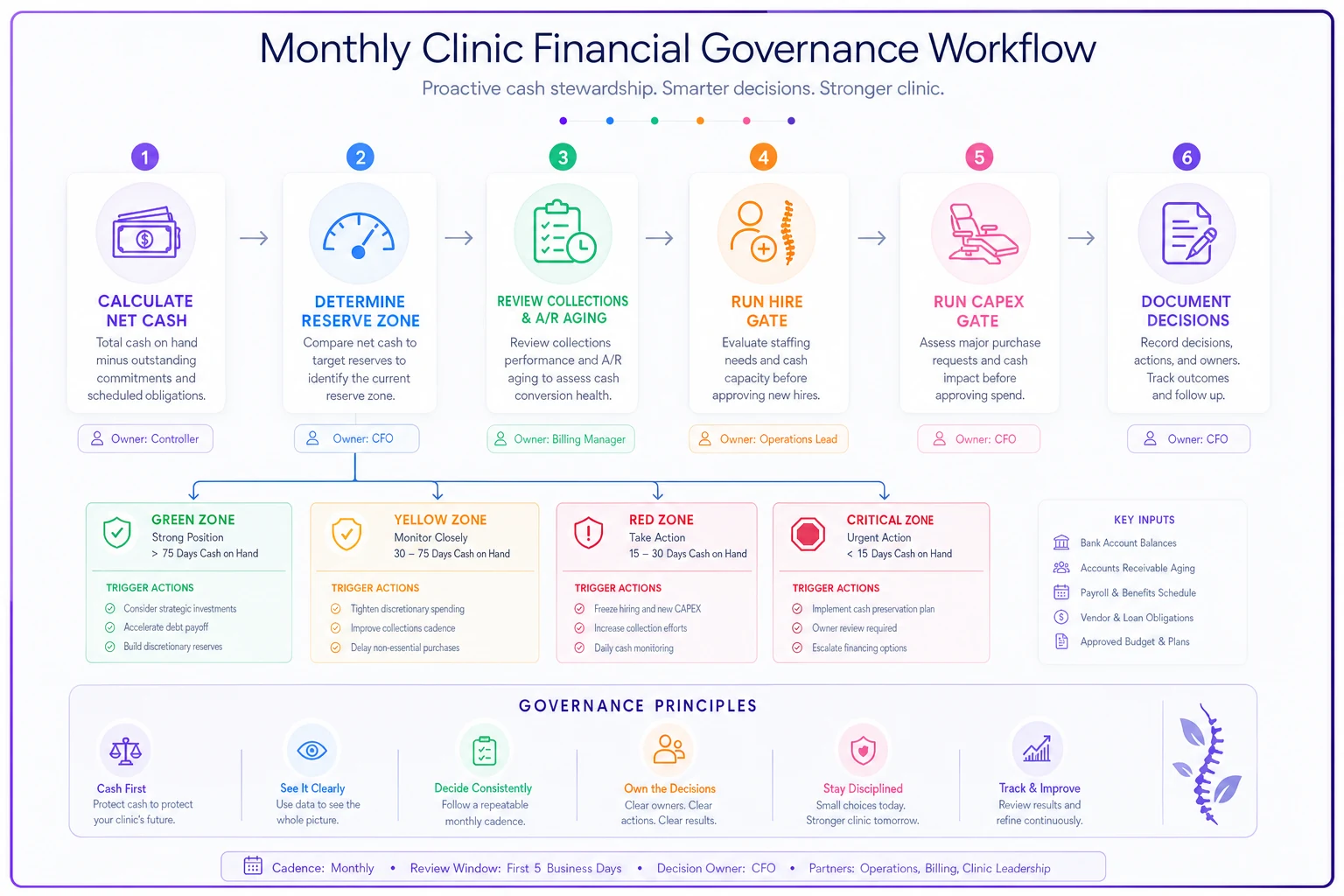
The monthly governance checklist
Run this on the same day every month — ideally right after you've closed the prior month's books enough to trust the numbers. It should take 45–60 minutes.
Step 1 — Calculate true cash position. Bank balance minus committed near-term outflows (next payroll + taxes + all notes and leases due in 30 days) minus liabilities-in-disguise (unearned pre-paid care plans, sales tax owed, payroll tax accrued). This net number is what you measure against your buffer.
Step 2 — Determine your reserve zone. Net cash ÷ monthly fixed-cost target = months of buffer. Mark Green / Yellow / Red.
Step 3 — Review collections health. Check A/R aging. Flag anything moving past 60 and 90 days. A buffer that looks fine but is propped up by collectible-but-uncollected revenue is a yellow flag even in a Green month.
Step 4 — Run the gates against pending decisions. For every open hire or CAPEX request, check it against the gate rules and the current zone. Anything that fails gets explicitly tabled with a date to revisit — not a vague "later."
Step 5 — Trigger zone actions. Based on your zone, execute the pre-agreed response (see the trigger table below). The power is that you don't debate it — you decided already.
Step 6 — Document the decisions. One line per decision: what, why, which gate. Future-you will thank present-you when you're trying to remember why you passed on that table in March.
A quick visual of the monthly checklist workflow.
Cash triggers linked to actions
-
Green + stable collections → Normal operations. Proceed with gated decisions that pass.
-
Green + aging A/R rising → Proceed cautiously; prioritize collections before new commitments.
-
Yellow → Freeze new hires and CAPEX. Protect revenue-generating spend only. Accelerate A/R recovery. Review discretionary vendor costs.
-
Approaching floor / Red → Full discretionary freeze. Owner draw reduced if needed. Urgent A/R push. Renegotiate payment timing with vendors. Revisit any variable staffing.
The power is that you don't debate it — you decided already.
A real scenario: how the rules change behavior
A two-provider clinic running roughly $52k/month in collections — insurance-heavy — had a fixed-cost base around $34k/month. Their stated target was a 6-month buffer (around $200k); in practice they hovered around $70k–$90k in net cash. Solidly Yellow, though they'd always felt Green because the raw bank balance looked fine.
They were planning to do two things in the same quarter: hire a third provider (another $7k–$9k/month fully loaded) and finance a new modality unit (around $600/month for four years). Both felt justified — the schedule was tight and patients were asking about the new service.
When they ran the actual governance math, two things surfaced. First, their true cash was Yellow, not Green, once they netted out a quarterly tax deposit and unearned care-plan money. Second, their provider utilization spike was only about five weeks old — below the sustained threshold the hiring gate required.
Under the rules, both decisions tabled automatically. Instead, they spent the quarter pushing A/R (which had crept — roughly $40k was sitting past 60 days) and tightening scheduling to lift utilization on existing providers. Net cash climbed back into Green over about four months, aging A/R dropped by more than half, and then they revisited the hire — this time with real sustained utilization behind it and a buffer that could absorb a 90-day ramp. The equipment they ended up buying used, in cash, once they were comfortably Green.
Nothing dramatic happened. That's the point. Governance mostly prevents the dramatic thing from happening.
When strict gating is the wrong move
Rules shouldn't be religion.
There are situations where rigidly applying the freeze does more harm than good:
-
Revenue-protecting emergencies. If your only X-ray unit or your primary treatment table dies, that's not a speculative CAPEX decision — it's survival. Protect-revenue purchases can override a Yellow freeze with a documented exception.
-
Genuinely time-boxed opportunities with tested demand. If you've already piloted a service and demand is proven, a short-window deal might justify stretching, as long as it doesn't breach your floor.
-
Very early-stage clinics. A brand-new practice legitimately runs below buffer while it builds. The rule there isn't "maintain 12 months" — it's "know your runway to the month and protect the floor obsessively."
Use documented exceptions sparingly and with accountability so the governance doesn't turn into an easy bypass for poor timing.
Who should not run this system as-is
Heavy, zone-based governance is overkill for a true solo cash-pay clinic with no debt, no employees, and predictable weekly revenue. For that setup, a simple runway number and a spending floor are plenty — adding formal gates just creates friction without preventing real risk.
It's also the wrong fit if your bookkeeping isn't current. Governance runs on trustworthy numbers. If you can't close a month within a week or two, fix that first. Running these rules against stale or unreliable figures gives you false confidence, which is worse than no system at all.
Making the monthly rhythm stick
The reason most owners don't do this isn't that it's hard — it's that pulling the same numbers from three or four places every month creates enough friction to kill the habit by month two. The net-cash calculation, the A/R aging, the utilization figures, the open hire and CAPEX requests — they usually live in the practice management system, the accounting software, and someone's head.
This is where keeping your operational data centralized actually earns its keep. When collections, A/R aging, and utilization numbers surface in one place on a schedule — rather than requiring a manual scavenger hunt every month — the governance review goes from a dreaded two-hour slog to a 45-minute routine. Clinics that use AI-powered operational software to automate the gathering of these numbers, so the review is just reading and deciding, are the ones that actually keep the habit past the first quarter. The decisions stay human; the data assembly doesn't have to be.
Bringing it together
Financial governance for a chiropractic clinic isn't about predicting the future or building elaborate forecasts. It's about deciding your spending and hiring behavior in advance, tying it to a cash signal you can measure honestly every month, and refusing to let reasonable-sounding decisions stack up during the exact weeks your clinic can least afford them.
Set a real reserve target. Define your zones and your floor. Gate every hire and every equipment purchase against both the operational signal and the cash signal. Run the checklist on the same day each month. Do that consistently, and the next slow quarter becomes something you manage calmly instead of something that quietly compounds into a crisis you didn't see coming.
Financial governance for a chiropractic clinic isn't about predicting the future or building elaborate forecasts. It's about deciding your spending and hiring behavior in advance, tying it to a cash signal you can measure honestly every month, and refusing to let reasonable-sounding decisions stack up during the exact weeks your clinic can least afford them.
Ready to streamline your chiropractic clinic operations?
Join 1,200+ clinics using Spinesly to save time, reduce scheduling errors, and improve patient care experiences.