

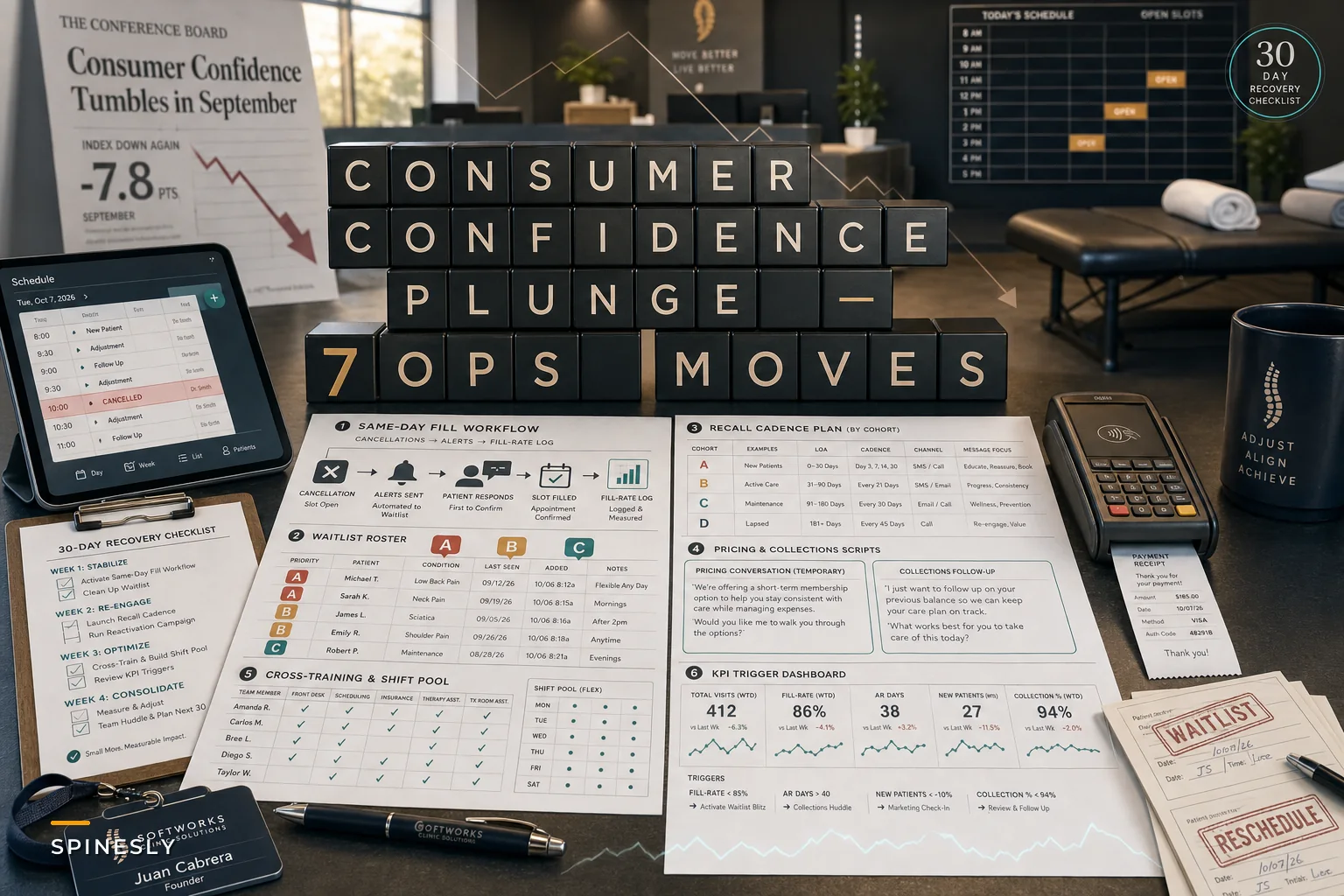

The Conference Board's Consumer Confidence Index dropped to 81.9 in September 2026 — the lowest reading since April 2014. Reuters' coverage of the release noted the sharpest deterioration was in how people view job security and their near-term financial outlook. That second part matters more for clinics than the headline number.
People don't cancel chiropractic care because the pain went away. They cancel because they're suddenly unsure about their paycheck, and discretionary healthcare is one of the easiest line items to "pause for a month." A patient worried about a layoff will quietly stretch a four-week recall to seven weeks. Multiply that across a few hundred active patients and October looks fine — but December falls off a cliff.
This isn't a post about the economy. It's about what happens inside your scheduling system and at your front desk over the next 8–12 weeks, and what you can actually do to keep a soft patch from turning into a cash problem.
The lag is the real problem
Most clinic owners don't feel a demand downturn when it starts. They feel it about six weeks later, when the recalls that quietly didn't rebook turn into empty afternoon blocks.
That delay is dangerous because it hides the problem during the exact window when you could still fix it cheaply. A patient who pushes their visit "a couple weeks" in early October isn't on your radar — this week's schedule still looks healthy. By the time the hole shows up on the books, you've already lost the easy re-engagement window and you're trying to win them back cold.
The clinics that handle downturns well are the ones watching forward indicators instead of backward ones. Not "how full was last week" but "how full is the week four weeks out, compared to where it usually sits by now." That leading gap is your early warning, and it almost always moves before revenue does.
A quick way to think about which signals move first:
| Indicator | How fast it reacts | What it tells you |
|---|---|---|
| New patient inquiries | Fast (1–2 weeks) | Demand at the top of the funnel |
| Recall rebooking rate | Medium (2–4 weeks) | Whether existing patients are stretching intervals |
| Same-day cancellation rate | Fast but noisy | Financial anxiety showing up day-of |
| Average visit interval | Slow (4–8 weeks) | The quiet killer — longer gaps between adjustments |
| Collections / copay capture | Medium | Price sensitivity hitting day-of payments |
If you're only watching collections and deposits, you're reading the last indicator to move. By then the damage is already baked in.
Move 1: Protect your recall intervals before patients stretch them
In a confident economy, a patient on a two-week maintenance cadence mostly stays on it. In a nervous one, that same patient starts self-rationing — "I'll go when it really acts up." That shift from scheduled care to reactive care is the single biggest revenue leak during a downturn, and it's almost invisible because nobody technically cancels.
Never miss another patient appointment.
Spinesly helps you schedule, confirm, and manage every patient visit efficiently.
- Unified appointment management
- Automated patient reminders
- Staff and resource scheduling
No credit card required
The fix is proactive interval protection. Pull your active maintenance patients, sort by how long since their last visit relative to their normal cadence, and reach out to anyone drifting past their usual interval before they fully disengage — not with a generic "we miss you" blast three months later.
Tone matters here. A patient worried about money doesn't want a sales pitch. Practical framing works better: "You were doing really well on your current plan — let's keep that progress instead of starting over." That's a clinical message, not a marketing one, and it converts better because it respects why they'd hesitate.
Move 2: Make same-day fills a reflex, not a scramble
When cancellations tick up, the clinics that bleed are the ones where a canceled 3pm just becomes an empty 3pm. The ones that hold revenue have a waitlist that actually gets worked the moment a slot opens.
The operational reality most front desks run into: they have a waitlist, but filling a same-day cancellation means someone manually texting five people and waiting to hear back. By the time the third person replies "sorry, can't," it's 40 minutes later and nobody's coming. The intent is there; the execution is too slow.
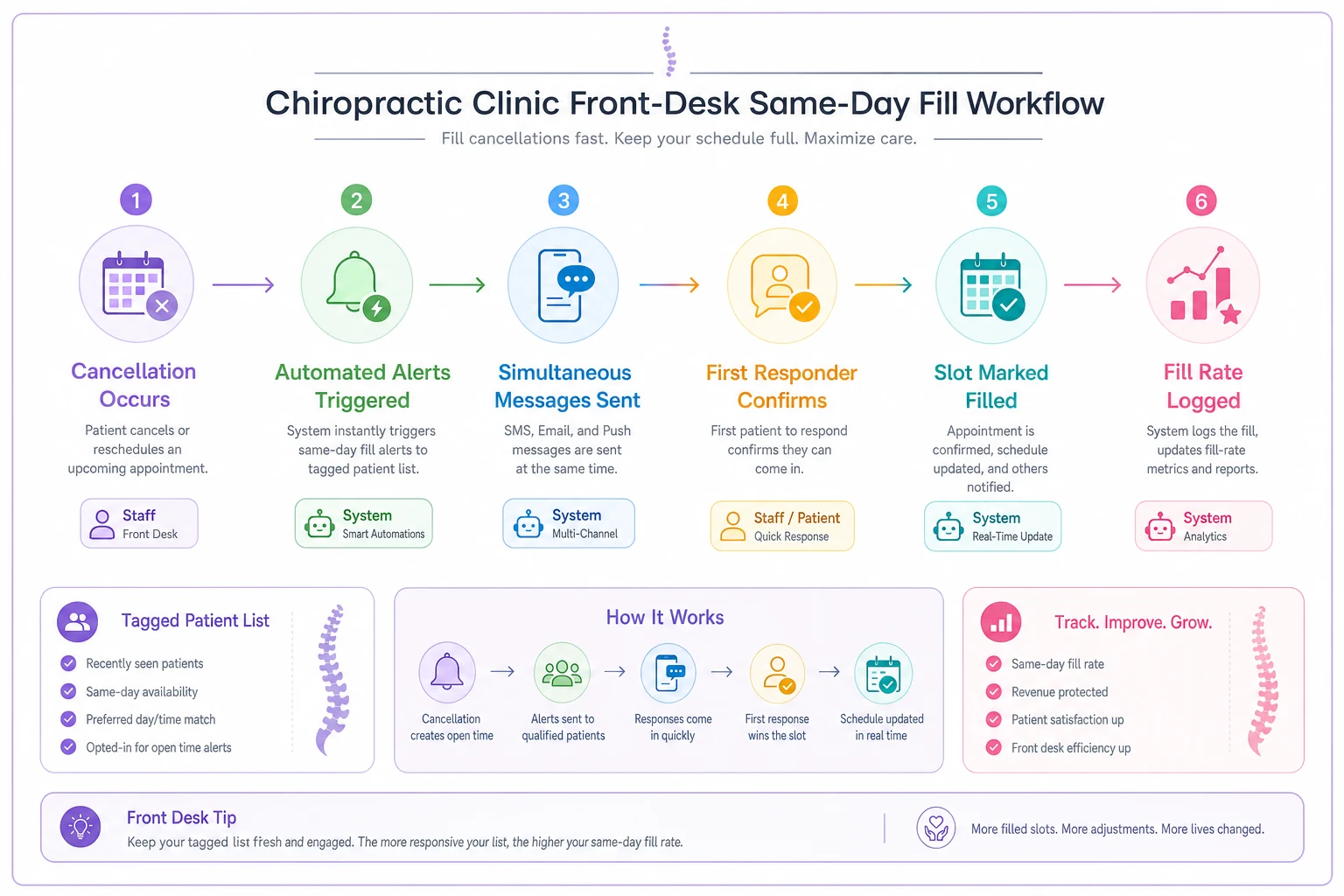
A workable same-day fill process:
-
Tag your fill-ready patients — anyone who's told you "call me if something opens up," plus flexible maintenance patients who live or work nearby.
-
Trigger the moment a cancellation hits, not at the end of the day. Speed is everything with same-day slots.
-
Blast, don't sequence. Offer the slot to several fill-ready patients at once on a first-come basis instead of calling one at a time.
-
Confirm and close the slot the instant someone accepts so you're not double-booking.
-
Log the miss if it stays empty, so you can track your true fill rate over a month.
Here's a simple diagram of how the same-day fill workflow should run in practice.
We go deeper on recovering lost chair time in the Provider Productivity Recovery Toolkit for Low Utilization Events, which covers how to rebuild utilization when the schedule starts softening.
Move 3: Rethink how you talk about price — before someone asks
Price sensitivity spikes during confidence drops. CNBC's coverage of the September data noted that rising prices and job fears were hitting consumer optimism simultaneously (CNBC's breakdown of the sentiment slide). For cash-pay or high-copay patients, that means the "is this worth it this month" conversation is happening in their head whether or not they say it out loud.
The mistake clinics make is waiting for the patient to raise cost, then reacting defensively or discounting on the spot. Reactive discounting trains your best patients to ask for deals, and it quietly penalizes the ones who don't.
A better approach is giving price-sensitive patients a dignified off-ramp that keeps them in care. Options that tend to work:
-
A lower-frequency maintenance plan that keeps them connected without the full weekly cost
-
Prepay bundles that lower per-visit cost for patients who can commit cash now
-
Clear, upfront communication about what's covered so there's no surprise copay anxiety at checkout
When this makes sense: patients who genuinely value care but are temporarily cash-constrained. When it's a bad idea: blanket discounts pushed to your whole list, which erodes margin and signals desperation. Target the off-ramp; don't spray it.
Move 4: Tighten day-of collections without making it feel cold
Softer confidence shows up at checkout as more "can I pay you next time" and more declined cards. Every one of those becomes an A/R chase that costs staff time and often never fully collects.
The clinics that stay clean here handle the money conversation before the visit, not after the adjustment when the patient is already walking toward the door. Card-on-file, upfront copay confirmation, and clear expectations at booking remove the awkward curbside negotiation entirely. It's not about being rigid — it's about not making your front desk play collections agent on every third patient.
Worth watching: clinics that quietly let day-of balances slide during a downturn often don't realize how much is compounding until A/R over 60 days has quietly doubled. The leak feels polite and small in the moment. Over a quarter it's a real number.
Move 5: Cross-train so you can flex capacity down and back up
A downturn isn't permanent, and the clinics that get hurt worst are the ones that overcorrect — cutting hours or staff so aggressively they can't catch demand when it returns.
Cross-training is your flex valve. When your front desk can run recall outreach during slow blocks, when a CA can handle waitlist fills and insurance verification, you can trim without gutting capacity. You keep the people; you just redeploy their hours toward the work that protects revenue instead of idle front-desk time.
Think about what your team actually does during a quiet Tuesday afternoon. In a lot of clinics, the answer is "wait for patients." That's exactly when you should be running interval-protection outreach, cleaning up aging claims, and working the recall list. Slow clinical hours and high-value admin work fit together almost perfectly if someone's set up to pivot.
Move 6: Watch the leading metrics weekly, not monthly
Monthly reviews are too slow for a downturn. By the time you close the books on October, November's damage is already in motion.
Shift to a short weekly scan of the forward indicators from the table above. You don't need a complicated dashboard — just five numbers every Monday:
-
New patient inquiries vs. your typical weekly average
-
Recall rebooking rate (what % of due patients actually rebooked)
-
Same-day cancellation count
-
How full the schedule looks 3–4 weeks out
-
Copay / day-of collection rate
The point isn't the numbers themselves. It's reaction speed. A clinic that spots recall rebooking slipping from around 70% down to the high 50s in week two can intervene while it's still cheap. A clinic that finds out in the monthly review is now doing expensive win-back on patients who've already drifted.
Automate recall alerts so week-to-week drops surface without someone manually pulling reports.
This is where practice management and scheduling software earns its keep — not as a magic fix, but as the thing that surfaces these shifts automatically instead of relying on someone to hand-pull reports they're too busy to run. Automated recall tracking and cancellation alerts turn a Monday morning gut-check into a few glances at real data.
Move 7: Defend your new-patient pipeline, don't just cut spend
The instinct during a scare is to pull back on everything, including new-patient acquisition. Sometimes that's the right call. But cutting your top-of-funnel entirely means nothing is refilling the base while existing patients stretch their intervals — and you come out of the downturn with a smaller active list than you went in with.
A smarter move is shifting how you acquire rather than whether you do. Referral asks from happy existing patients cost almost nothing and convert well. Reactivation of lapsed patients — people who stopped coming six to twelve months ago — is cheaper than net-new acquisition and often works because their problem never actually went away.
Who should stop spending: clinics already running tight cash with no reserve, and a paid-ad channel that wasn't converting well even before the downturn. For them, pausing paid spend and pivoting to referral and reactivation is the right move. Who should keep investing: clinics with healthy margins and a channel that's genuinely profitable — pulling back there just hands market share to competitors who held steady.
A realistic scenario
Picture a two-provider clinic running roughly 320–360 visits a month, with about 60% of revenue coming from maintenance and wellness patients. When confidence dropped, their new-patient inquiries barely moved — but their average visit interval quietly stretched from around every 12 days to closer to every 18.
Nobody canceled dramatically. There was no obvious crisis week. But that interval drift alone pulled monthly maintenance visits down by roughly 15%, which translated to somewhere in the range of $4k–$6k a month in softer revenue — all of it invisible on any single day's schedule.
Once they started watching interval drift weekly and ran proactive outreach to patients slipping past their normal cadence, rebooking recovered most of the way back over about six weeks. Not to a perfect pre-downturn number, but close enough that the quarter landed fine instead of ugly. The fix wasn't dramatic. It was catching the drift early enough to do something about it.
The underlying issue this exposes
A consumer confidence drop doesn't create a new problem for clinics — it exposes one that was already there. Most clinics are built to react to the schedule rather than read it. They staff to today's bookings, review revenue monthly, and chase patients only after they've clearly disappeared.
That works fine when demand is steady. It falls apart the moment demand softens, because every reactive system has a built-in delay, and delay is exactly what you can't afford when patients are quietly stretching their care.
You can track the broader confidence data through the Conference Board's consumer confidence release, but honestly, the national number is just a prompt. The real signal is in your own four-week-out schedule and your recall rebooking rate right now. Watch those closely, act while the gaps are still small, and a soft quarter stays a soft quarter instead of the thing you're still digging out of next spring.
Ready to streamline your chiropractic clinic operations?
Join 1,200+ clinics using Spinesly to save time, reduce scheduling errors, and improve patient care experiences.