

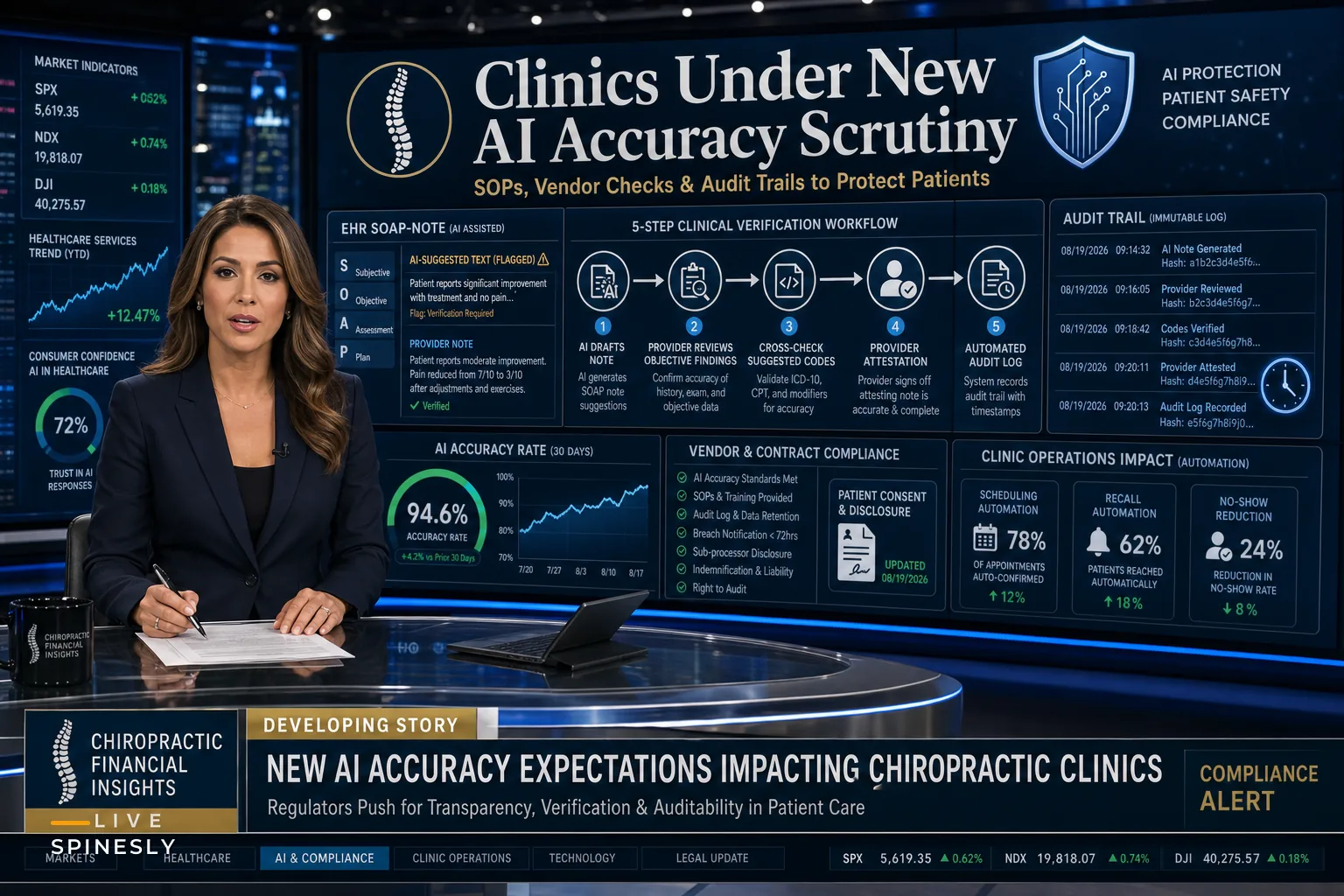

There's a shift happening in how regulators look at AI tools, and it's the kind of thing that's easy to ignore right up until it lands on your desk. A recent Reuters report on AI governance laid out the growing federal interest in how AI systems are governed, along with renewed FTC attention on accuracy claims — basically, whether the software that says it's accurate actually is, and whether the companies selling it can back that up.
For a chiropractic clinic leaning on AI for SOAP notes, coding suggestions, insurance verification, or patient messaging, this isn't abstract policy noise. The vendors you rely on are now under a brighter light. And when a vendor is under scrutiny, the practices using their tools inherit part of that exposure — because the clinical note with your provider's signature on it is yours, regardless of what generated the first draft.
So instead of treating this as a legal story, treat it as an operational one. What does your clinic actually need to have in place so that AI-assisted work holds up if anyone — a payer, an auditor, a patient's attorney — decides to look closely?
The real problem isn't the AI. It's the sign-off gap.
Most clinics that adopted AI documentation tools did it to solve a time problem, not an accuracy problem. The pitch was "spend less time charting," and it delivered. But somewhere in that speed gain, the verification step quietly got thinner.
This usually happens gradually. Month one, the provider reads every AI-drafted note carefully because they don't trust it yet. Month three, the notes look good enough often enough that reading turns into skimming. Month six, the provider is clicking sign on a stack of notes at the end of the day, trusting that the tool "usually gets it right."
That drift is the actual risk. Not that the AI hallucinates a diagnosis once in a while — though it can — but that nobody's workflow is built to catch it when it does. The accuracy scrutiny coming from regulators is really asking a question you should already be asking internally: can you prove a human reviewed and stood behind every AI-influenced clinical or billing decision?
If the honest answer is "sort of," you have work to do. And it's not hard work — it's mostly workflow discipline.
Where AI accuracy compliance actually shows up in a chiropractic practice
People hear "AI accuracy compliance chiropractic" and picture some giant legal project. In practice it breaks into a handful of concrete touchpoints where AI output turns into a real-world action with consequences.
Never miss another patient appointment.
Spinesly helps you schedule, confirm, and manage every patient visit efficiently.
- Unified appointment management
- Automated patient reminders
- Staff and resource scheduling
No credit card required
| Touchpoint | What the AI produces | What goes wrong when unverified | Who owns the fix |
|---|---|---|---|
| SOAP notes | Draft clinical documentation | Copied-forward findings, exam details that didn't happen | Treating provider |
| CPT/ICD coding | Suggested codes | Upcoding, mismatched code-to-note, denial triggers | Provider + billing |
| Insurance verification | Eligibility/benefit summaries | Wrong copay quoted, missing auth requirement | Front desk lead |
| Patient messaging | Recall texts, care instructions | Clinically inaccurate advice sent under clinic name | Practice manager |
| Outcome tracking | Summarized progress data | Misreported functional gains | Provider |
The pattern across all of these: the AI is fine at drafting and terrible at being accountable. Accountability has to sit with a named person and a documented step.
A workable compliance checklist you can run this month
You don't need a consultant for the first pass. Here's a checklist that covers the things most likely to matter if your AI tools — or your use of them — ever get examined.
-
Confirm your vendor keeps audit logs. You want a record of what the AI generated versus what was edited before sign-off. If your vendor can't show this, that's a real gap.
-
Get the accuracy claims in writing. Whatever the sales deck promised, ask for it in the contract or a written statement. The FTC's renewed focus is specifically on claims that can't be substantiated — you don't want to be the clinic quoting a promise the vendor won't stand behind.
-
Add a documented clinical sign-off step. Every AI-drafted note needs an explicit human review checkpoint before it's finalized, and your PM system should timestamp who did it.
-
Update consent and disclosure language. Patients should be informed, in plain terms, that AI assists with documentation. This is quickly becoming a baseline expectation, not a courtesy.
-
Review data-sharing settings. Know exactly what patient data leaves your system, where it goes, and whether it's used to train models. Turn off anything you can't justify.
-
Retrain front desk and providers on verification. Not a memo — an actual short training on what "reviewed" means and what to look for.
-
Spot-check coding suggestions monthly. Pull a small sample and confirm codes match the documentation.
Keep a short rolling log of your monthly spot-checks so you can produce a sample quickly if asked.
Run through that list and you've addressed most of the exposure that the current regulatory attention is pointed at.
A five-step verification workflow that doesn't kill your time savings
The fear every clinic owner has: "If I add all this checking, I lose the efficiency I bought the tool for." Fair concern. But verification done right is fast, because it's targeted. You're not re-doing the AI's work — you're checking the spots where errors have real consequences.
-
AI drafts the note during or right after the encounter. No change here — this is the part that saves time.
-
Provider reviews the objective section first. This is where fabricated or carried-forward exam findings hide. Spend your attention here, not on the boilerplate.
-
Cross-check the suggested codes against what actually happened. Thirty seconds. Does the code match the documented service and region count?
-
Provider signs with an explicit attestation. The sign-off itself is the compliance artifact — it says a human took responsibility.
-
System logs the edit history. You want the before/after preserved automatically, so if anyone ever asks, the record exists.
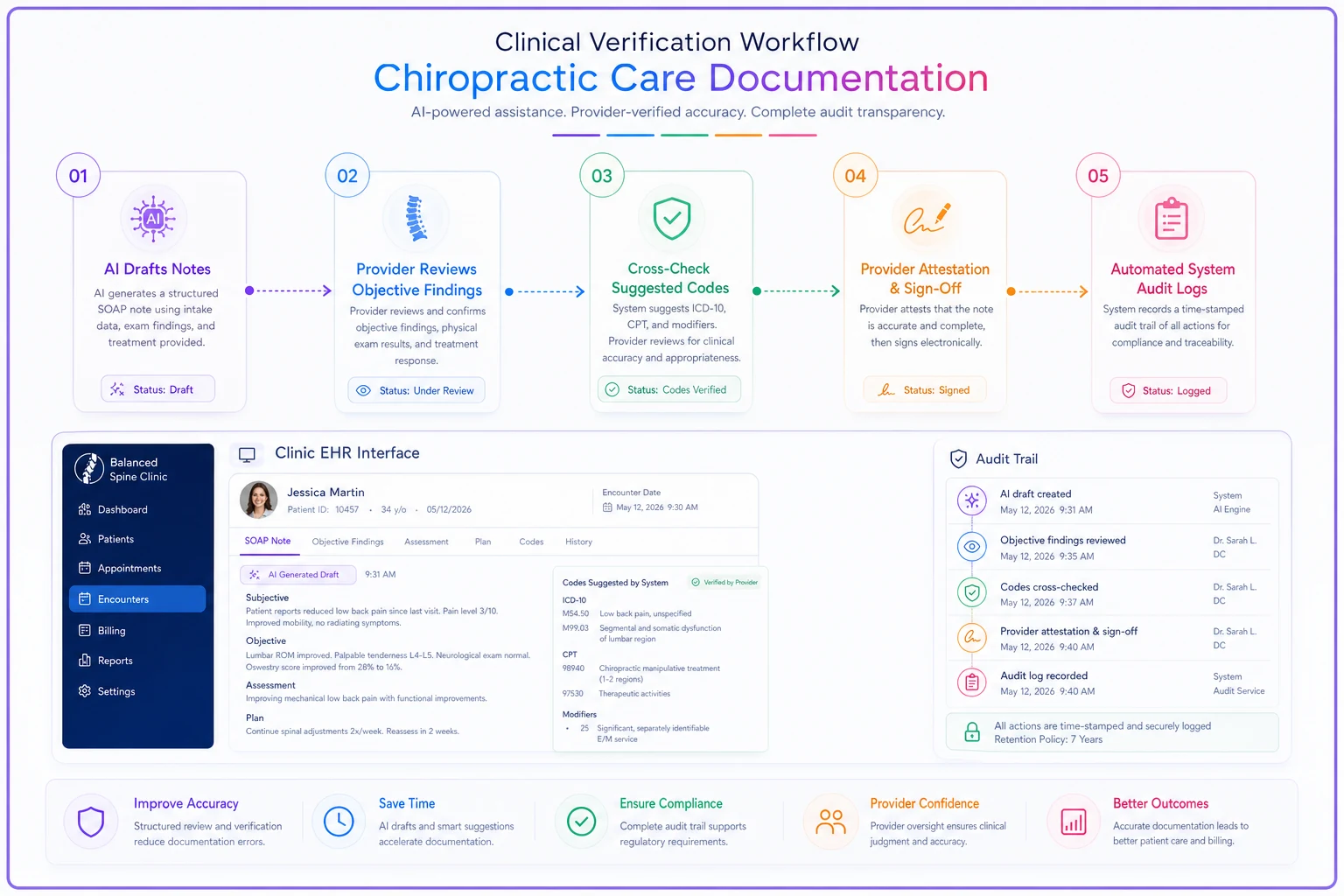
Here's a quick visual of the verification workflow.
If you already built a solid documentation pipeline — the kind covered in Slash Documentation Time: An Operational Workflow to Automate SOAP Notes for Chiropractic Practices — this verification layer bolts right onto it. You're adding a review discipline on top of automation you already trust, not tearing anything out.
A real scenario: where the gap actually bites
Consider a two-provider practice running around 380–420 visits a month, using an AI note tool they adopted about a year in. Charting time dropped from roughly 12 minutes a note to under 4. They were thrilled.
Then a payer audit pulled a batch of their maintenance-care claims. Several notes had nearly identical objective findings across different visit dates — the AI had been carrying forward the prior exam, and the providers had been signing without catching it. On paper, it looked like the exams weren't actually being performed and re-documented. The clinic knew they'd done the work, but the documentation didn't prove it.
The result wasn't catastrophic, but it wasn't cheap either — a chunk of claims got clawed back, and they spent weeks reconstructing notes and building a review process they should have had from the start. Somewhere in the low four figures, plus a lot of stress.
After they added a real sign-off step and monthly coding spot-checks, the carried-forward problem basically went away. They kept most of their time savings — the review added maybe a minute per note — and the notes started actually reflecting individual visits. The lesson wasn't "AI is dangerous." It was "AI without a verification step is a documentation liability wearing an efficiency costume."
When leaning harder on AI still makes sense — and when it doesn't
Not every response to regulatory attention is "use less AI." Sometimes it's "use it more deliberately."
It makes sense to keep expanding AI use when you have a clear human sign-off point, your vendor gives you audit logs, and the tool is handling drafting or summarizing rather than final decisions. In those cases the accuracy scrutiny actually works in your favor — the vendors that survive it will be the disciplined ones, and your workflow is already aligned.
It's a bad idea when you're letting AI generate patient-facing clinical advice with no clinician review, or when it's auto-suggesting codes that get submitted without a human confirming them. That's the exact scenario regulators and payers are most interested in, and it's the hardest to defend after the fact.
Who should slow down entirely: any practice that can't currently answer "who reviewed this and when" for its AI-generated documentation. Fix that first. Everything else is secondary.
The underlying shift worth internalizing
The bigger picture here isn't really about one Reuters story or one FTC posture. It's that AI in clinical settings is moving from "cool efficiency tool" to "system of record that has to hold up under examination." Those are different standards. The first rewards speed. The second rewards traceability.
The clinics that handle this well won't be the ones that panic and rip out their tools, and they won't be the ones that ignore it and hope. They'll be the ones that treat every AI output as a draft that a named human owns — with a timestamp to prove it. That single mental shift covers most of what the new scrutiny is asking for, and it makes your documentation better regardless of what regulators decide to do next.
Get the sign-off step tight, keep your vendor honest about their accuracy claims, and make sure the record shows a human in the loop. Do that, and the regulatory noise becomes background — because you've already built the practice to hold up to it.
Ready to streamline your chiropractic clinic operations?
Join 1,200+ clinics using Spinesly to save time, reduce scheduling errors, and improve patient care experiences.