



Most clinic owners try to solve capacity problems by adding people. More providers, another front desk hire, a floating tech. But if you actually watch how a busy adjusting day flows, the constraint usually isn't headcount. It's the seconds and minutes that leak out between patients — the room sitting empty while a provider walks to grab a form, the table that stays occupied because nobody reset it, the patient waiting in the lobby because two rooms freed up at the exact same minute and neither got filled.
That's throughput. And the frustrating part is that throughput problems are invisible on the schedule. Your calendar can look 90% booked while your rooms sit idle a third of the time. This piece is about the math behind that gap — how to measure it, and how to reclaim chair hours through sequencing instead of hiring. There's spreadsheet-ready math here you can drop into your own numbers.
Why "fully booked" and "running at capacity" are two different things
A schedule measures appointments. Throughput measures how efficiently your physical rooms and provider hands convert into billable, delivered visits. These drift apart fast.
The pattern that shows up constantly in single- and two-provider clinics: the doctor blocks 15-minute slots, which looks like four patients an hour, which looks like 32 patients in an 8-hour day. But the real cycle for each patient — table time plus the provider walking in, reviewing, adjusting, documenting a note, and the room getting reset — runs closer to 18–20 minutes when you actually stopwatch it. So the "32-patient day" quietly becomes a 24–26 patient day, and nobody knows why the schedule feels jammed while collections feel flat.
The gap lives in the transitions. And transitions are where throughput math earns its keep, because that's exactly where you can recover time without asking anyone to work faster or longer.
The core relationship is simple:
Effective throughput = Available room-hours ÷ Real cycle time per visit
Where "real cycle time" includes everything: the value-add clinical time plus the dead time — setup, walking, waiting, documentation, reset. Most of the improvement you're after comes from shrinking the dead time, not the clinical time. You never want to rush the adjustment. You want to eliminate the eight minutes around it that produce nothing.
The four places room-turn throughput leaks
Before the math, it helps to name where the minutes actually go. Across busy clinics, the leaks cluster into four spots:
Never miss another patient appointment.
Spinesly helps you schedule, confirm, and manage every patient visit efficiently.
- Unified appointment management
- Automated patient reminders
- Staff and resource scheduling
No credit card required
-
Provider-to-room dead time — the doctor finishes with one patient, then walks to review the next chart, grab a tool, or answer a quick question. The room they just left sits empty; the room they're heading to sits empty. Two rooms idle at once.
-
Reset lag — patient leaves, but the table isn't wiped, paper isn't changed, and the next person can't be roomed. In clinics without a dedicated turnover person, this falls on whoever notices, which means it often doesn't happen until the provider walks back in.
-
Synchronization collisions — two or three rooms free up in the same 60-second window, so patients pile up in the lobby even though average room usage looks fine on paper. This is a scheduling-shape problem, not a volume problem.
-
Documentation bleed — the provider stays in the room finishing a note before moving on, effectively holding a room hostage for administrative work that could happen elsewhere or later.
None of these require more staff to fix. They require better sequencing.
Measuring your real cycle time (the number everything depends on)
You can't sequence what you haven't measured. For one normal week, capture four timestamps per visit:
-
Patient roomed
-
Provider enters
-
Provider exits
-
Room reset and ready for next patient
From those, you get three numbers that matter:
-
Clinical time = provider exit − provider enter
-
Room-hold time = provider exit − patient roomed (how long the patient occupied the room)
-
Turn time = room ready − provider exit (the reset gap)
Add clinical time + the pre-provider wait + turn time and you have your real cycle time. Almost every clinic that does this exercise is surprised. The clinical work is tight — it's the surrounding minutes that balloon.
A typical example: a solo provider believes he's running 12-minute visits. The week's data shows 3 minutes patient-roomed-to-provider-in, 9 minutes clinical, 6 minutes reset before the next patient could be roomed. Real cycle: 18 minutes. That's the difference between a theoretical 40-patient day and a real 26-patient day. The schedule was lying — not on purpose, just by omission.
Staggered starts: the highest-leverage fix nobody uses
Instead of starting every patient on the top or bottom of the clock (9:00, 9:15, 9:30), you offset room start times so rooms never free up simultaneously.
-
Room A patients start at
00, :18, :36
-
Room B patients start at
09, :27, :45
While the provider works Room A, Room B is being reset and the next patient roomed. By the time the provider walks out of A, B is ready. The provider never waits on a room, and no room sits idle waiting on the provider. You've turned two rooms into a near-continuous pipeline off a single set of hands.
The math: a solo provider bouncing between two properly staggered rooms can sustain roughly a 10-minute effective cycle even when each visit's real cycle is 18 minutes — because the reset happens in parallel, not in series. You're not compressing the work; you're overlapping the dead time with productive time in the other room.
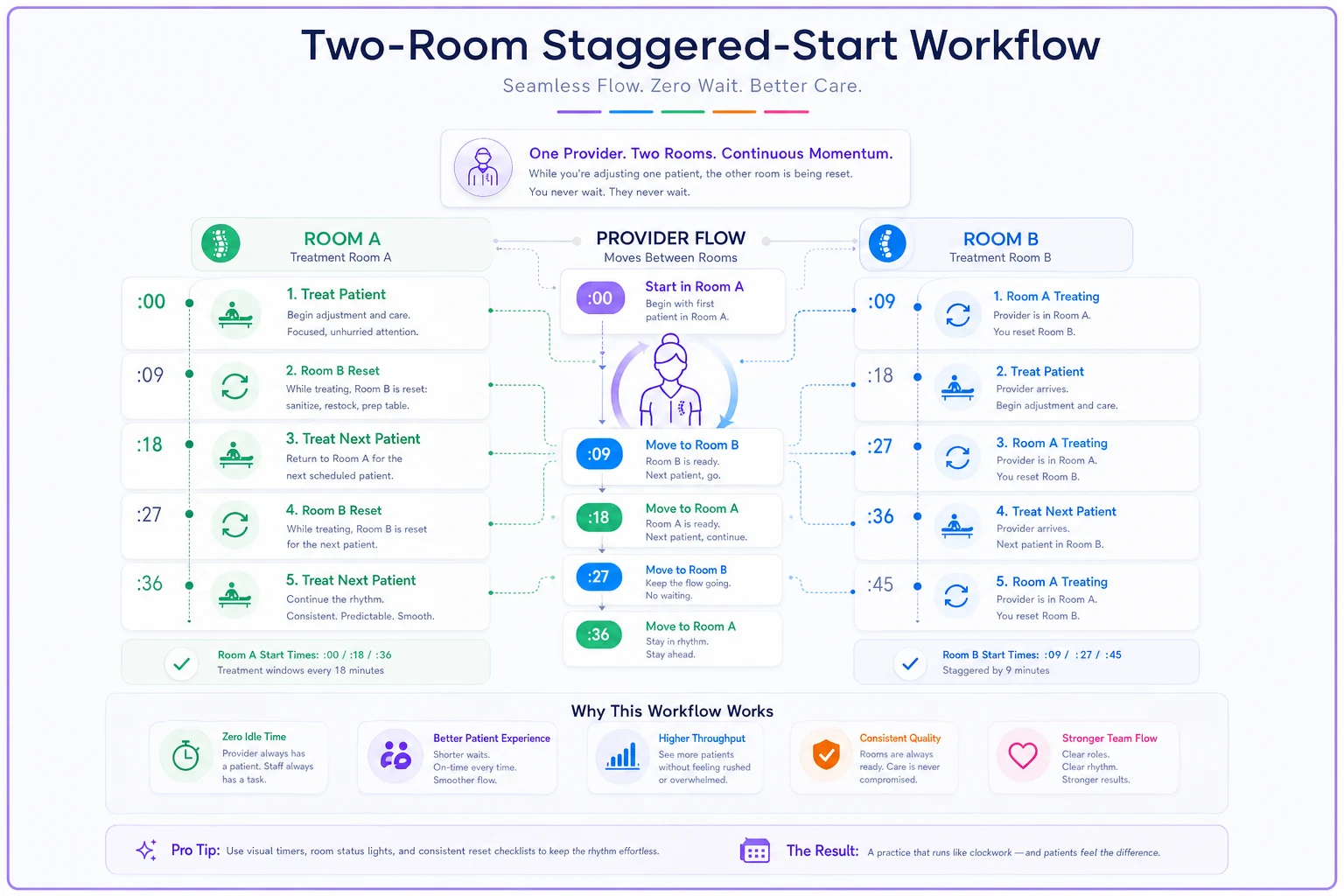
Run the numbers on a full day and the difference is real. At a serial 18-minute cycle over 7 adjusting hours, you get about 23 visits. At a staggered 10–11 minute effective cycle, you get 38–40. Same provider. Same hours. No new hire. The gap is pure sequencing.
Swimlane rooms: stop making every room do everything
The second sequencing lever is dedicating rooms to visit types rather than treating them as interchangeable.
When every room handles new patients, re-exams, quick adjustments, and modalities interchangeably, turn time becomes unpredictable. A new-patient consult that runs 25 minutes with paperwork sits in the same room queue as a 6-minute maintenance adjustment, and the whole rhythm collapses. The fast visits get stuck behind the slow ones.
| Swimlane | Visit types | Real cycle | Turn behavior |
|---|---|---|---|
| Fast lane | Maintenance / quick adjust | 8–11 min | High turn frequency, needs fast reset |
| Standard lane | Regular treatment + modality | 15–20 min | Moderate, predictable rhythm |
| Slow lane | New patients, re-exams, reports | 25–40 min | Low turn, paperwork-heavy, rarely resets |
When cycle times inside a room are consistent, staggered starts actually work — because you can set one stagger interval per lane instead of guessing. Mixing a 40-minute new patient into your fast lane destroys the stagger and jams everything behind it. Keeping the slow lane separate protects the pipeline where most of your daily volume and margin lives.
A practical version for a two-provider clinic: one provider mostly runs the fast and standard lanes with tight staggering, the other absorbs new patients and re-exams in the slow lane where longer, less predictable cycles won't bleed into the flow. Volume goes up on one side without the chaos spilling into the other.
Task delegation: getting the provider out of non-provider work
The third lever is offloading everything in the cycle that doesn't require a licensed set of hands. This is where clinics quietly recover 4–7 minutes per visit.
-
Room the patient and get them positioned → tech/CA
-
Set up modality or apply prep → tech/CA
-
Perform the adjustment / clinical decision → provider only
-
Post-visit instructions and rebooking → front desk or CA
-
Reset the room → dedicated turnover
-
Chart note → provider, but not necessarily in the room
The single biggest recoverable block is documentation bleed. When the provider finishes the note before leaving, the room stays held for admin work. If notes happen at a standing station between rooms — or get dictated on the walk — the room frees up the moment clinical work ends. That alone can pull 3–5 minutes off room-hold time per visit.
Delegation only works if the handoffs are clean. In practice, this usually breaks when the tech doesn't know a room freed up, so the provider ends up doing the reset themselves. The fix isn't more staff — it's a signal. Even a simple light system or a shared board showing room status (occupied / needs reset / ready) removes the guesswork that causes the two-rooms-idle-at-once problem.
When staggered starts and swimlanes are a bad idea
When you're a low-volume clinic. If you're running 12 patients a day, you don't have a throughput problem — you have a demand problem. Squeezing cycle time on an empty schedule just creates a faster empty schedule. Fix the top of the funnel first.
When your care style genuinely needs long, unhurried visits. Some practices are built around 30-minute soft-tissue-heavy sessions and premium pricing. Compressing that model breaks the value proposition. Throughput math is a tool, not a mandate.
When your rooms can't physically support parallel resets. If you have one adjusting table and a shared modality room, staggering just moves the bottleneck. Sequencing assumes you have enough parallel capacity to overlap the dead time. Map that before you rebuild the schedule.
Who should not start here: a clinic drowning in no-shows and same-day cancellations. If a third of your staggered slots evaporate, the pipeline collapses and the empty rooms wipe out every gain. Stabilize attendance first — a tight same-day fill and waitlist workflow protects the throughput you're building before you optimize it.
A real scenario: two rooms, one provider, no new hire
A solo-provider clinic in a mid-size suburb was booked solid on paper — roughly 26 patients a day, four days a week — and the owner assumed she'd maxed out and needed to hire a second DC. Payroll math on a new provider looked ugly, so she measured first.
-
Moved charting to a standing station between the two rooms, dictated rather than typed in-room.
-
Assigned the front CA to reset each room the moment the patient walked out, using a two-light status system on each door.
-
Staggered the two rooms on a 9-minute offset so a room was always ready when she exited the other.
Within about three weeks the day settled into roughly 36–38 patients without extending hours or adding staff. That's an extra 10–12 visits a day the room capacity was always technically capable of — leaking out through transitions the whole time. The second-provider hire got shelved.
What changed the owner's read on the numbers was seeing how those recovered chair hours flowed into collections, which connects directly to the chair-hours and payer-mix profit model. Throughput only matters if the recovered hours land on well-paying visits.
Putting the throughput calculator together
Here's the spreadsheet-ready structure so you can run your own numbers.
Inputs (measure these):
-
Available room-hours per day = number of rooms × adjusting hours
-
Average real cycle time (from your timestamp week)
-
Average reset/turn time
-
No-show / cancel rate
Baseline throughput:
Serial daily visits = adjusting hours ÷ real cycle time (per room, summed)
Staggered throughput:
Effective cycle = real cycle − (reset time overlapped in parallel)
Staggered daily visits = adjusting hours ÷ effective cycle
Recovered chair hours:
(Staggered visits − serial visits) × real cycle time = reclaimed hours/day
Revenue potential:
Reclaimed visits/day × avg collected per visit × days/week × weeks
Then discount the top-line number by your no-show rate, because unattended staggered slots are wasted room parallelism. A clinic with a 15% no-show rate should model roughly 85% of theoretical gain and prioritize attendance fixes before chasing the last few minutes of cycle time.
Run those five blocks and you'll usually find the same thing the suburban clinic did: the capacity you're about to hire for is already sitting inside your building, trapped in transitions. Operational software that tracks room-status signals can help surface where cycle time actually leaks day to day — but the real work is the sequencing decisions, and those are yours to make. Measure one honest week, find your real cycle time, and the math will tell you exactly how many chair hours you've been leaving on the table.
Run those five blocks and you'll usually find the same thing the suburban clinic did: the capacity you're about to hire for is already sitting inside your building, trapped in transitions. Operational software that tracks room-status signals can help surface where cycle time actually leaks day to day — but the real work is the sequencing decisions, and those are yours to make. Measure one honest week, find your real cycle time, and the math will tell you exactly how many chair hours you've been leaving on the table.
Ready to streamline your chiropractic clinic operations?
Join 1,200+ clinics using Spinesly to save time, reduce scheduling errors, and improve patient care experiences.