

Your Wednesday afternoon schedule just fell apart. Three cancellations between 2pm and 5pm, including that high-value corrective care patient who books double slots. Your front desk scrambles through sticky notes trying to remember who mentioned wanting earlier appointments. By the time they manually call four patients from memory, two don't answer, one can't make it today, and the last one arrives to find you've already filled the slot with a walk-in.
This exact scenario destroys roughly $2,800 to $3,600 in monthly revenue for the average chiropractic clinic. Not because patients don't want those slots—they absolutely do—but because the operational workflow to connect cancelled appointments with waiting patients barely exists in most practices.
The Real Cost of Empty Adjustment Tables
Empty slots hurt differently in chiropractic than other healthcare practices. Your overhead stays fixed whether you see 35 or 45 patients that day. The adjustment table doesn't cost less when it's empty. Your CA still gets paid for those dead hours.
Unlike a dental cleaning or physical therapy session, chiropractic adjustments often run just 10-15 minutes, meaning a single two-hour gap could represent four to eight lost patient visits.
Most clinics handle cancellations with whatever system their front desk person invented three years ago:
-
A paper list somewhere near the phone
-
Mental notes about patient preferences
-
Texting patients they personally remember wanting different times
-
Calling the same five "flexible" patients repeatedly
A 20% cancellation rate across 40 daily appointments means eight empty slots. If you only fill two of those (25% fill rate), you're losing six visits daily. At $65 per adjustment, that's nearly $8,000 monthly in pure lost revenue—not counting the downstream effects on care plan completion and patient retention.
Why Traditional Waitlists Fail in Chiropractic Settings
Standard medical waitlists assume patients have significant schedule flexibility and high urgency for care. Neither assumption works for maintenance chiropractic patients.
Never miss another patient appointment.
Spinesly helps you schedule, confirm, and manage every patient visit efficiently.
- Unified appointment management
- Automated patient reminders
- Staff and resource scheduling
No credit card required
Your typical twice-weekly adjustment patient has a carefully planned routine. They come Tuesdays at lunch and Fridays after work because that's what fits their life. They want earlier appointments, sure, but only specific earlier appointments on specific days.
Morning rush reality: Everyone wants 7am-9am slots. You could have 40 patients on a "morning waitlist," but when that 7:30am Tuesday cancellation happens at 7:15am, maybe three of those 40 could actually make it.
Care plan stages matter: A patient in acute care might drop everything for a same-day opening. Someone in month three of maintenance care probably won't rearrange their workday for a slightly earlier time.
The proximity problem: Unlike primary care where patients might drive 20 minutes for their monthly visit, chiropractic patients coming twice weekly usually live or work within 10 minutes. That 4pm cancellation won't help someone whose office is 25 minutes away.
Paper waitlists become worthless within weeks. Names pile up with no context. "Johnson - wants mornings" tells you nothing about which mornings, how flexible they are, or if they even still need different times after three months on the list.
Digital calendars and basic practice management waitlist features barely improve things. They'll capture names and preferred times, but still require manual matching when cancellations occur. Your front desk has to remember to check the list, figure out who matches the cancelled slot, then start calling or texting one by one.
Building a Prioritization Algorithm That Actually Works
Not all cancellations or waitlist patients are equal. A same-day opening at 3pm on Wednesday has completely different fill potential than one at 8am on Monday. Similarly, a patient who mentioned wanting "any morning slot" six months ago ranks differently than someone who specifically asked about Tuesday mornings last week.
The prioritization framework needs multiple weighted factors:
Recency of request weighs heavily because patient needs change. Someone who wanted morning appointments in January might have changed jobs by June. Fresh requests from the past two weeks indicate current, active schedule needs.
Specificity match determines likelihood of acceptance. A patient requesting "Tuesday mornings" exactly matches your Tuesday 8am cancellation. Someone wanting "any morning" ranks lower. "Whenever available" ranks last.
Historical response rate predicts future behavior. Track who actually accepts same-day offers. That patient who's accepted three of four previous offers ranks higher than someone who's declined repeatedly despite being on the waitlist.
Care plan urgency affects both need and flexibility. New patients in acute care phase might rearrange anything for relief. Maintenance patients need more specific convenience. PRN (as-needed) patients often have the most flexibility since they're not locked into a routine.
Geographic proximity becomes critical for truly same-day fills. Patients who work downtown can't make it to your suburban clinic with two hours notice at 2pm on a workday. But retired patients or work-from-home professionals within five minutes might easily fill that slot.
The scoring breaks down like this:
| Factor | Weight | Scoring Logic |
|---|---|---|
| Request recency | 35% | Past 7 days = 100pts, Past 14 days = 75pts, Past 30 days = 50pts, Older = 25pts |
| Schedule match | 30% | Exact match = 100pts, Day match = 70pts, Time match = 40pts, General = 20pts |
| Response history | 20% | >75% acceptance = 100pts, 50-75% = 70pts, 25-50% = 40pts, <25% = 10pts |
| Care urgency | 10% | Acute care = 100pts, Corrective = 70pts, Maintenance = 40pts, PRN = 60pts |
| Distance/time | 5% | <5 minutes = 100pts, 5-10min = 70pts, 10-15min = 40pts, >15min = 20pts |
Log each same-day offer outcome immediately so the response history stays accurate.
This framework handles the Tuesday 8am cancellation by immediately identifying the five patients most likely to accept, ranked by probability. Instead of randomly calling through an alphabetical list, your outreach targets the patients who actually want and can use that specific slot.
Multi-Channel Outreach Sequencing and Fallback Rules
Getting the prioritization right means nothing if your communication workflow fails. Most clinics default to phone calls because "that's what we've always done," not realizing they're using the least efficient channel for time-sensitive outreach.
The contact sequence needs to match both urgency and patient communication preferences. A cancellation at 7am for an 8am slot requires different tactics than one at noon for a 4pm slot.
Immediate fills (less than 2 hours): Start with SMS to your top five matches simultaneously. The message needs to be scannable in two seconds: "8am opening TODAY (Tues) - reply YES to claim." No explanations about who cancelled or why. No "would you possibly be interested" language. Clear, actionable, time-bound. After 10 minutes without response, trigger push notifications if patients have your app. Push often gets seen faster than SMS when people are actively using their phones. Twenty minutes in, automated voice calls start to the top three matches. Not lengthy voicemails—those won't get checked in time—but brief interactive voice response: "Press 1 to claim today's 8am appointment, press 2 to remain on the waitlist."
Short-notice fills (2-4 hours): Begin with SMS but extend the response window to 20 minutes before escalating. Include slightly more context: "Dr. Smith has a 2pm opening today due to cancellation. Your next scheduled visit is Thursday. Reply YES to move to today." Push notifications follow at the 20-minute mark, then emails to anyone who historically responds better to email than text. Some older patients check email constantly but rarely notice texts. Voice calls become personal here, not automated. Your CA can provide context and handle the schedule shuffle if patients need to move existing appointments.
Same-day fills (4+ hours notice): Cast a wider net immediately. SMS your top 10 matches, not just five. The message can be less urgent: "Opening available today at 4pm. Reply if interested and we'll confirm." This softer approach works because you have time for back-and-forth. Email becomes viable as a primary channel here. Some patients can't receive personal texts at work but constantly monitor email.
-
Never contact the same patient about the same slot through multiple channels within 10 minutes
-
Cap individual patient same-day offers at two per week regardless of match score
-
Exclude patients who've declined three consecutive offers for 30 days
-
Auto-remove patients from waitlist after successfully filling for them twice
The fallback rules prevent communication fatigue while maximizing fill probability:
Channel Performance Benchmarks from Real Clinics
The variation in channel effectiveness is pretty dramatic. Your patient demographic massively influences which channels work.
SMS dominates for working professionals: Clinics in business districts see 40-45% response rates on SMS within 30 minutes. These patients live on their phones but can't take calls during meetings. Keep messages under 160 characters that display fully in notification previews.
Voice calls win with retirees: Practices with older demographics might see just 20% SMS response but 55% phone answer rates during business hours. These patients keep their phones on loud and actually answer unknown numbers.
Push notifications for established patients: Only works if patients have your app, but response rates hit 60% for patients who've been with you over six months. New patients rarely download practice apps immediately.
Email struggles everywhere: Across the board, email same-day fill rates stay below 15%. The exception—corporate wellness clients who live in Outlook might hit 25%.
Track these metrics for your specific practice:
-
Response rate by channel (opened/answered ÷ sent)
-
Acceptance rate by channel (confirmed fills ÷ responses)
-
Time to response by channel
-
Patient preference distribution
-
Channel cost per successful fill
One clinic discovered their SMS responses peaked at 11:47am and 1:15pm—right before and after lunch. They adjusted their outreach timing and improved fill rates by about 20% without changing anything else.
Operational Workflow Implementation
Your CA can't be simultaneously checking for cancellations, running the prioritization logic, sending messages, handling responses, and updating schedules. The workflow needs defined triggers and automation support.
Morning prep (before opening):
-
Review overnight cancellations
-
Run prioritization for any same-day openings
-
Queue outreach for slots more than 4 hours out
-
Flag urgent fills (next 2 hours) for immediate action
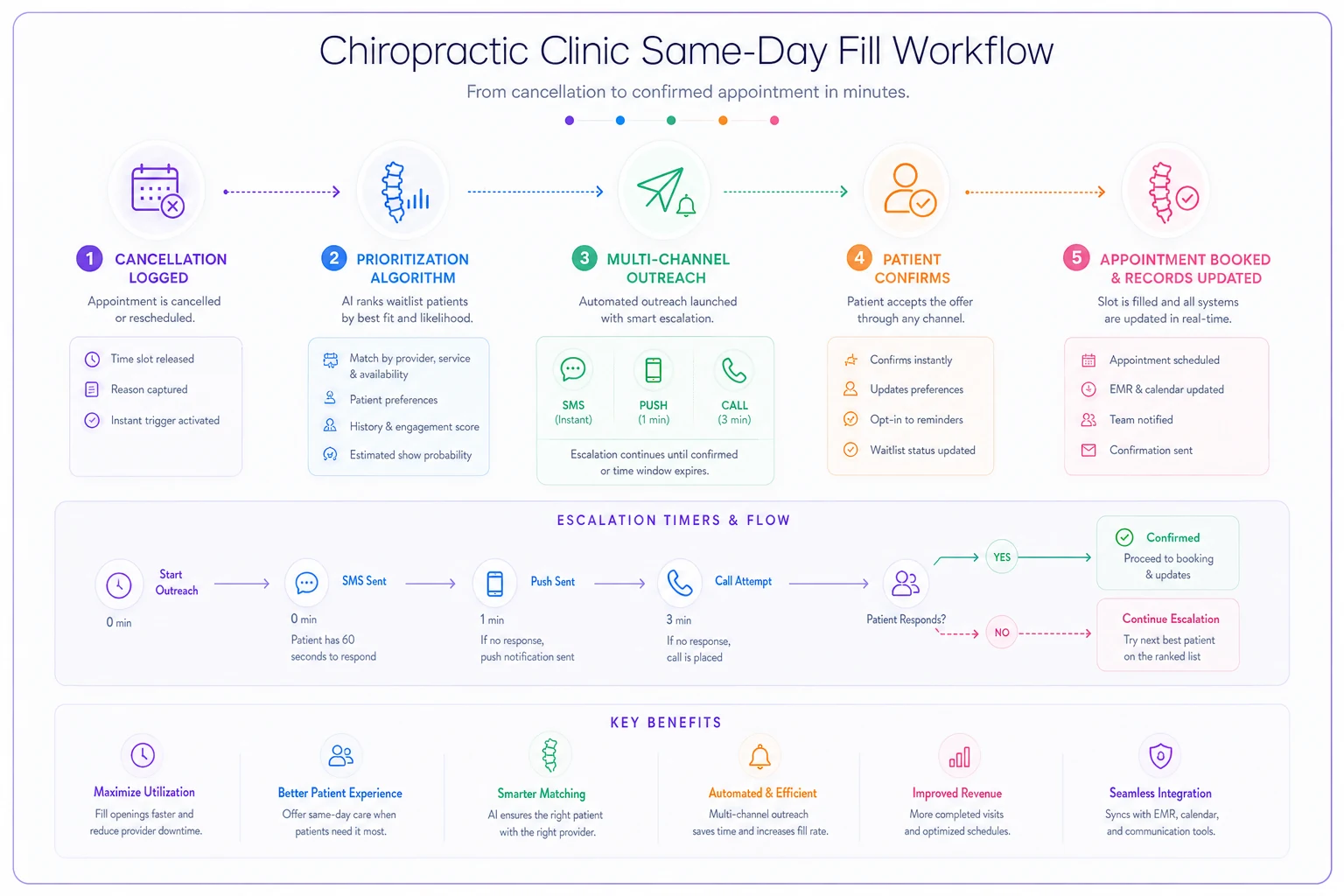
Cancellation received:
-
Log cancellation with reason code
-
System automatically runs prioritization algorithm
-
Generates outreach list based on time until slot
-
Triggers first channel (usually SMS) to top matches
-
Sets escalation timers for fallback channels
Here's a simple visual of that workflow.
Response handling:
-
"YES" responses immediately receive confirmation with time and any parking/entry instructions
-
"NO" responses trigger next-ranked patient outreach
-
No response follows escalation timeline
-
Partially filled slots (like 2 of 3 consecutive openings) re-run prioritization for remaining time
This workflow runs parallel to normal operations, not instead of them. Your front desk maintains normal check-in and scheduling duties. The same-day fill system operates as an overlay that activates when cancellations occur.
When Automation Makes the Difference
Manual same-day fill processes fail because they require perfect execution during the exact moments your staff is busiest. A cancellation call at 8:45am for a 10am slot happens while your CA handles the morning patient rush. By the time they can focus on filling that slot, it's 9:30am and the window has shrunk dramatically.
AI-powered operational software handles the entire prioritization-to-confirmation workflow without human intervention until a patient accepts. The platform maintains your waitlist with full context, runs the prioritization algorithm instantly upon cancellation, triggers multi-channel outreach based on your configured rules, and updates both the schedule and patient records automatically.
The operational improvements compound:
-
Response time to cancellation drops from 15-20 minutes to under 60 seconds
-
Outreach touches 5-10 qualified patients simultaneously instead of one-by-one calling
-
Your CA focuses on present patients instead of phone tag with potential fills
-
The system learns which patients respond to which channels at what times
Automation also enables strategies impossible with manual processes. You can test different message phrasings to see what drives higher acceptance. The system can predict likely cancellations based on patterns and pre-emptively identify fill candidates. Complex rules like "only offer to patients who haven't had an adjustment in 5+ days" become trivial to implement.
Real Results from a 45-Patient-Per-Day Practice
A family chiropractic clinic in suburban Phoenix struggled with 18-22% cancellation rates and barely 20% same-day fills. Dr. Martinez served mostly working parents and maintenance care patients—people with rigid schedules who genuinely wanted different appointment times but couldn't respond to random mid-day phone calls.
Their previous "system" was a spiral notebook where Maria, the front desk manager, wrote patient names and vague preferences. "Smith - wants earlier" could mean Monday mornings or Friday mornings or any morning. Maria would try calling through the list when cancellations occurred, usually reaching voicemail after voicemail.
Week 1-2: Captured true preferences for about 180 patients. Not just "mornings" but "Tuesday/Thursday before 9am" or "any lunch hour slot." Built response history by tracking who answered texts versus calls.
Week 3-4: Same-day fill rate jumped to 45%. The multi-channel outreach meant catching working parents via text when calls would have failed. Early morning cancellations that previously stayed empty started filling because the system contacted matches at 6:30am automatically.
Week 5-8: Fill rate stabilized around 55-60%. They discovered patterns—Wednesday afternoon cancellations filled easily, Monday mornings rarely did. Adjusted their scheduling templates to reduce Monday morning appointments for chronic cancellers.
Month 3: Revenue increased by roughly $4,200 monthly from filled slots alone. Patient satisfaction scores improved because people finally got the appointment times they'd wanted for months. Their maintenance care completion rates increased about 15% as patients could better maintain their recommended frequency with more convenient scheduling.
Dr. Martinez said something interesting: "We always knew patients wanted those cancelled slots. We just couldn't operationally connect the supply with demand fast enough. Now it happens automatically while we focus on the patients actually in the office."
Common Implementation Mistakes to Avoid
Over-communicating: Clinics get excited about filling slots and blast every cancellation to their entire waitlist. Patients quickly tune out when they receive three "appointment available!" messages daily that don't match their needs. Precision beats volume.
Ignoring preference evolution: That patient who desperately wanted morning appointments in winter might prefer afternoons once their kids are in summer camps. Preferences need regular updating, not one-time capture.
Channel spamming: Sending SMS, calling, and emailing about the same slot within minutes annoys patients. They'll respond if interested—give them reasonable time before escalating.
Pricing confusion: Be crystal clear whether the same-day appointment maintains their existing care plan rate or requires a different fee. Nothing kills goodwill faster than surprise pricing at checkout.
Forgetting the human element: Automation handles logistics, but patients still want to feel valued. When someone accepts a same-day fill, thank them. Note it in their record. Mention it at their visit. "Thanks for being flexible and taking that last-minute slot yesterday" goes surprisingly far.
Measuring Success Beyond Fill Rates
Same-day fill rate is the obvious metric, but it doesn't tell the complete story. A 70% fill rate might seem excellent until you realize you're only attempting to fill the easy slots and ignoring the challenging ones.
Track these operational metrics:
-
Attempt rate
What percentage of cancellations trigger fill attempts? Some clinics skip trying to fill certain slots, assuming they won't work. You might surprise yourself.
-
Channel efficiency
Cost per successful fill by channel. SMS might cost $0.10 per message but fill 40% of attempts. Calls might be free but require 5 minutes of staff time and only fill 25%. Do the math.
-
Patient lifetime value impact
Do patients who successfully get same-day fills stay longer? Often yes—they feel the practice is responsive to their needs.
-
Cancellation pattern changes
As fill rates improve, some chronic cancellers might cancel less, knowing their slot will immediately go to someone else.
-
Staff time recovery
How many hours of front desk time does automation return to actual patient care? This soft benefit often exceeds the direct revenue impact.
Some of our patient retention strategies work well alongside these same-day fill workflows. And if you're dealing with high no-show rates, check out our no-show reduction checklist which complements the cancellation recovery process.
Making the Shift from Reactive to Proactive
Most chiropractic clinics
Ready to streamline your chiropractic clinic operations?
Join 1,200+ clinics using Spinesly to save time, reduce scheduling errors, and improve patient care experiences.