



Most clinics don't add ancillary services after careful math. They add them because a rep gave a good demo, because a competitor down the road put "spinal decompression" on their sign, or because a slow quarter made a $40k laser machine feel like a lifeline. Then eighteen months later the equipment sits in a back room getting used three times a week, and nobody wants to admit it was a mistake because the loan payment is still hitting the account.
The question of ancillary services chiropractic profitability isn't really about whether a service can make money. Almost anything can, in theory. The real question is whether it fits your patient volume, your chair time, your staffing, and your existing bottlenecks — and whether you can prove that with a small test before committing real capital. That's what this piece covers: a way to decide, a way to test cheaply, and a way to model the margin honestly before you sign anything.
Why most ancillary decisions go sideways
The core mistake is treating a new service as a revenue line instead of an operational load. Adding decompression isn't just adding a billing code. It's adding a room, a piece of equipment, a scheduling constraint, staff training, a new consent workflow, and a marketing story you have to tell every new patient. Each of those things touches something that's already running near capacity.
A common pattern: a two-doctor practice doing around 300 visits a week brings in a rehab and active-care program. On paper it looks great — higher per-visit value, better outcomes, stickier patients. In practice, the adjusting schedule was already full, so rehab sessions started competing with adjustments for the same rooms and the same front-desk attention. The clinic ended up cannibalizing its highest-margin service to prop up a lower-margin one. Revenue barely moved, but everyone was busier and more stressed.
That's the dynamic worth internalizing: a new service that competes with your existing bottleneck rarely adds net profit. It just reshuffles the workload. The services that actually work are the ones that absorb spare capacity — an empty room, a slow afternoon, a staff member who isn't fully utilized, or patients who are already walking out the door because you had nothing else to offer them.
The Go/No‑Go checklist (run this before you price anything)
Before you build a margin model, screen the idea. Most ideas should die here, and that's the point — the checklist saves you from modeling things that were never going to fit.
Never miss another patient appointment.
Spinesly helps you schedule, confirm, and manage every patient visit efficiently.
- Unified appointment management
- Automated patient reminders
- Staff and resource scheduling
No credit card required
-
Do you have unused capacity to deliver it? Empty rooms, slow blocks, or underused staff. If your bottleneck is chair time, most add-ons make things worse, not better.
-
Does existing patient demand already exist? Are patients asking for this, or leaving to get it elsewhere? If you're inventing demand from scratch, budget for a long, expensive ramp.
-
Can a non-DC deliver most of it? Services a tech, CA, or LMT can run free up doctor time. Services that require doctor hours compete with your highest-value activity.
-
Is the cash conversion clean? Cash-pay or simple superbill is far easier than a service buried in payer contracts and prior auths. Check your denial exposure before assuming reimbursement.
-
Does it shorten or lengthen the front-desk workflow? New consents, new scheduling rules, and new billing codes all add friction that compounds at volume.
-
What's the walk-away cost if it fails? A month-to-month rental or a supplement inventory you can return is a very different risk than a 60-month equipment lease.
If you can't get clean "yes" answers on capacity, demand, and walk-away cost, stop. You're not ready to test, let alone buy.
Run a cheap pilot before you commit capital
Clinics that get this right almost never buy first. They rent, borrow, refer out, or run a manual version of the service for 60–90 days to see whether the demand and the delivery actually hold up under their real schedule.
-
Define the pilot offer narrowly. One service, one target patient segment, one clear price. "Active-care package for post-acute low-back patients, cash, $X per block of six." Not a menu — a single testable thing.
-
Set a delivery method that costs almost nothing. Rent the equipment month-to-month, bring in a contractor LMT one day a week, or run rehab out of an existing room during a slow block. No leases.
-
Cap it at 60–90 days with a hard review date on the calendar. Open-ended pilots never end; they just quietly become permanent bad decisions.
-
Track four numbers only number of patients who bought, delivered hours, direct cost per delivered hour, and net cash collected. Ignore everything else during the pilot.
-
Watch what breaks operationally. Did the front desk struggle to schedule it? Did it push adjustment wait times up? Did documentation balloon? Those friction points are the real cost, and they won't show up in a spreadsheet.
-
Decide against pre-set gating criteria (below), not against how you feel about it at the end.
The pilot is where you find out whether the service uses spare capacity or steals from your core. That single insight is worth more than any vendor ROI sheet.
Gating criteria: what "yes" actually looks like
Vague success criteria are how failing services survive. You need numbers written down before the pilot starts, so you're not rationalizing afterward. These are reasonable starting thresholds for a small clinic — adjust to your own economics:
| Gate | Kill (No‑Go) | Watch | Go |
|---|---|---|---|
| Utilization of offered slots | under ~35% | ~35–60% | over ~60% |
| Contribution margin per delivered hour | below your adjusting margin | roughly equal | above adjusting margin |
| Impact on core (adjustment) volume | measurable drop | flat | flat or up |
| Front-desk / admin load | clearly heavier, no fix in sight | heavier but fixable | neutral or lighter |
| New-patient or retention lift | none | mild | clear pull-through |
The two gates people consistently ignore are impact on core volume and admin load. A service can clear its own margin gate and still be a net loss because it quietly dragged down adjustments or buried your CAs in scheduling exceptions. If you only measure the new service in isolation, you'll approve things that hurt the whole system. This is the same reasoning behind treating the clinic as a set of connected systems rather than a pile of separate profit lines — something worth reading more on in Map the Four Operational Systems That Let Chiropractic Clinics Scale.
Building an honest margin model
Vendor math is almost always gross revenue math. "See 20 patients a week at $75 — that's $78k a year!" That number is fiction because it ignores delivery cost, no-shows, room time, staff time, and the reality that you won't hit 20 sessions a week for months.
Contribution per unit = collected revenue per unit − direct variable cost per unit
Then judge it against the margin of the chair time it consumes. A realistic worked example for spinal decompression:
-
Equipment rental
roughly $600–$800/month while piloting
-
Realistic starting volume
about 25–35 sessions/month (not the vendor's 80)
-
Collected per session (cash)
around $60
-
Monthly collected
roughly $1,500–$2,100
-
Direct cost of the room + tech time per session
about $18–$22
-
Contribution after tech and room
roughly $1,000–$1,300/month
-
Minus rental
net around $300–$650/month during pilot
That's a thin, honest margin — and it only works because a tech delivers it in an otherwise-empty room. Move that same service into doctor hours during a full schedule and the contribution can go negative, because every decompression session displaces an adjustment worth more per minute. This displacement logic is exactly the kind of thing worth modeling against your actual chair hours and payer mix; the framework in Turn Chair Hours and Payer Mix into Profit gives you the per-hour baseline you're comparing every ancillary service against.
The key discipline: never evaluate an ancillary margin in a vacuum. Always compare it to the margin of whatever it displaces.
Staffing and scheduling: the hidden cost that sinks most add-ons
The spreadsheet almost never captures the coordination cost. A new service adds scheduling rules ("decompression only in 30-minute blocks, only in Room 3, only when a tech is on"), new intake steps, new consents, and new billing paths. At low volume that's manageable manually. At scale, it's where things quietly fall apart.
A patient wants both an adjustment and a rehab session same-day. The front desk now has to coordinate two rooms, two providers, and two documentation flows in one visit. Multiply that across 30–40 patients a day and mistakes start happening — double-booked rooms, patients waiting, sessions that never got charged. The service didn't fail clinically; it failed at the scheduling layer.
Before launching anything, walk out the new patient's path end to end. How they book it, who checks them in, which room, who delivers it, how it's documented, how it's charged, and how the follow-up gets scheduled. If that walkthrough has more than a couple of new manual handoffs, fix the workflow before you launch — not after patients are already falling through it.
Here's a quick visual to make the handoffs and bottlenecks obvious.
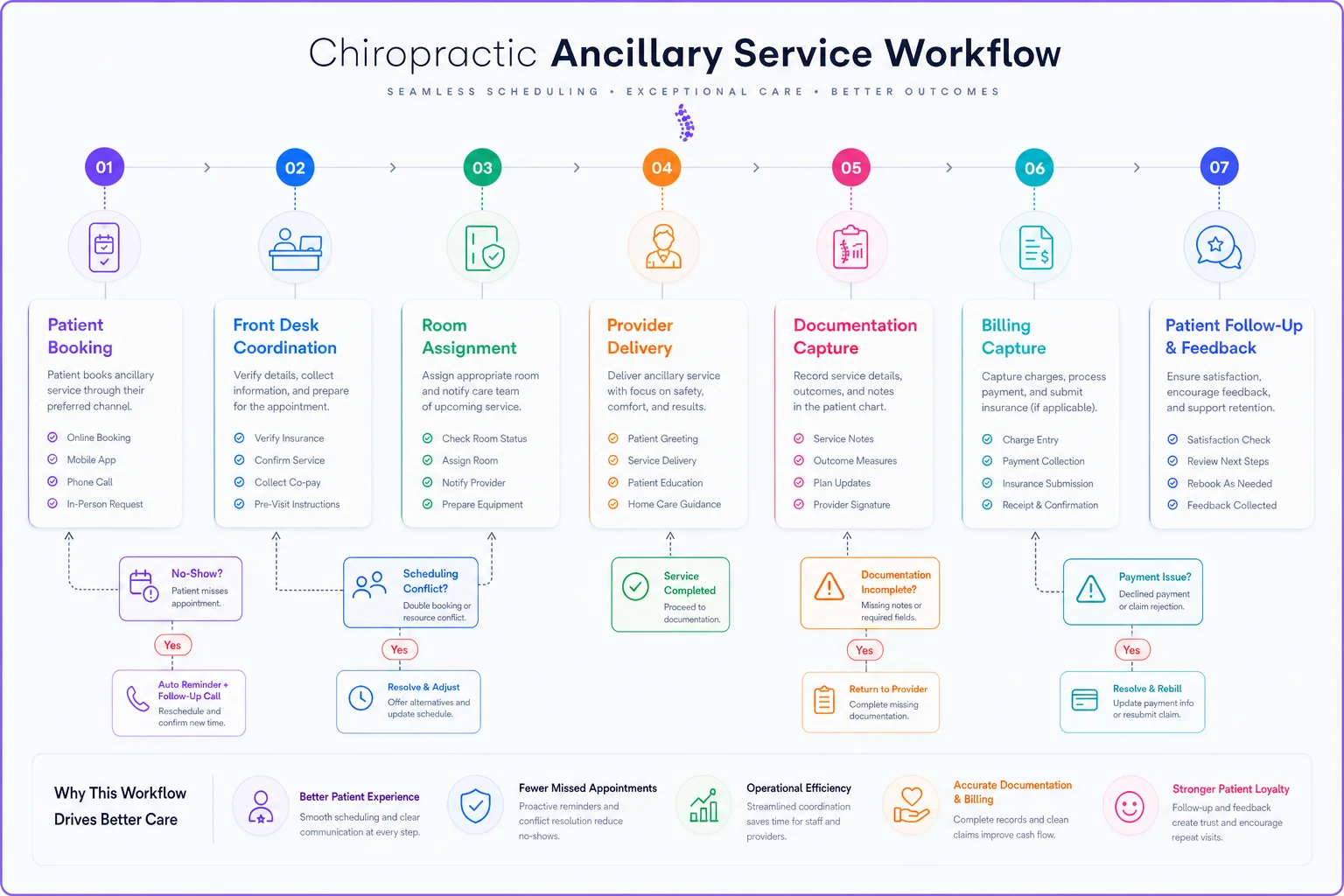
This is where centralizing scheduling logic, intake, and documentation into one platform actually earns its keep. AI-powered operational software that enforces room and provider rules automatically, flags visits missing a signed consent, and ensures delivered ancillary sessions get captured for billing removes a lot of the coordination load that compounds as volume grows. The biggest ancillary-service failures usually aren't clinical or financial — they're coordination failures, and coordination is exactly what breaks first when you add complexity to a busy front desk.
Sample launch plans by service type
Different ancillary services carry completely different risk profiles. Matching your launch approach to the risk level is most of the battle.
| Service | Capital risk | Delivered by | Best pilot approach |
|---|---|---|---|
| Nutritional / supplements | Low (returnable inventory) | CA / DC | Stock a small SKU set, sell to existing patients 60 days |
| Rehab / active care | Low–medium | Rehab tech / DC | Run in slow blocks with existing staff, one segment |
| Massage therapy | Low (contractor) | Contract LMT | 1 day/week contractor, cash packages |
| Spinal decompression | High (lease/equipment) | Tech | Month-to-month rental only, never lease during pilot |
| Class IV laser | High (equipment) | Tech / DC | Rent or demo unit, cash add-on, 90-day gate |
Low-capital, contractor- or inventory-based services are where you experiment freely, because a failed pilot costs almost nothing. The high-capital equipment plays demand a real pilot and hard gating criteria, because the walk-away cost is brutal if you buy first. The single most common expensive mistake in this whole category is signing an equipment lease before proving demand. Reversing that order fixes most of the risk.
The pattern across all of these is consistent: the sequence matters more than the service itself. Screen it, pilot it cheap, gate on real numbers, then decide.
A real scenario
A solo-doc clinic in a mid-size suburb, running about 260 visits a week, kept losing post-acute patients who wanted more from their recovery and went elsewhere for rehab. Instead of buying a rehab setup, the owner ran a 90-day pilot: an active-care package delivered by an existing CA who got trained up, using a room that sat empty most mornings, priced as a cash package.
Starting volume was slow — around 8 patients in month one. By month three it settled near 18–22 active-care patients per month, with contribution landing somewhere around $1,800–$2,400 monthly after the CA's time. More importantly, adjustment volume didn't drop, because it ran in previously dead morning hours. A handful of those patients extended their care plans rather than dropping off. The owner only committed to dedicated equipment after the pilot cleared the gates. Had they bought first, they'd have been servicing a lease on 8 patients a month for the first quarter.
The lesson wasn't "rehab is profitable." It was that the sequence — screen, pilot cheap, gate on real numbers, then commit — turned a coin-flip into an actual decision.
When adding a service actually makes sense
These aren't universal rules, but they hold up consistently across clinic sizes and markets:
-
You have genuine spare capacity — rooms, slow blocks, underused staff — that the service can absorb without touching your core schedule.
-
Patients are already asking for it or leaving to get it elsewhere. Demand exists; you're not manufacturing it.
-
A non-doctor can deliver most of it, so it doesn't compete with your highest-value hours.
-
You can pilot it with little or no capital commitment and walk away cleanly if the numbers don't materialize.
All four together is a strong signal. One or two without the others usually isn't enough.
When it's a bad idea
Your bottleneck is chair time and the new service consumes the same rooms or doctor hours.
-
You're buying equipment on a multi-year lease before proving a single month of real demand.
-
The service depends on complicated reimbursement you don't already handle well.
-
You're adding it mainly to match a competitor, with no evidence your own patients want it.
-
Any one of these should give you pause. More than one and the answer is almost certainly no.
Any one of these should give you pause. More than one and the answer is almost certainly no.
Who should not do this right now
If your core operations are already shaky — front desk overwhelmed, documentation behind, denials piling up, retention leaking — adding a new service won't diversify revenue. It multiplies the number of things breaking at once.
Ancillary services reward clinics that already run tightly, because they have the spare capacity and the workflow discipline to absorb added complexity. Get the base system solid first, then use the checklist, the cheap pilot, and honest margin math to decide what's worth adding — and, just as often, what isn't.
Ancillary services reward clinics that already run tightly, because they have the spare capacity and the workflow discipline to absorb added complexity. Get the base system solid first, then use the checklist, the cheap pilot, and honest margin math to decide what's worth adding — and, just as often, what isn't.
Ready to streamline your chiropractic clinic operations?
Join 1,200+ clinics using Spinesly to save time, reduce scheduling errors, and improve patient care experiences.