



Most chiropractic clinics didn't decide to offer telehealth. They backed into it. A patient asked if they could do their re-exam over video because they were traveling, someone said yes, and now there's a loose habit of "we do virtual sometimes" with zero written rules behind it. That's fine until a payer audits a claim, or a new front desk hire schedules a virtual manipulation visit that legally cannot happen.
The problem with hybrid care in a manual-therapy practice isn't the technology. It's that telehealth introduces a second set of rules that sit on top of your normal scheduling and billing logic, and almost nobody writes those rules down. The knowledge ends up living in one person's head, decisions get made inconsistently, and the mistakes only surface weeks later on an EOB.
This is a build guide for a single SOP that maps visit type → scheduling rule → consent step → documentation requirement → billing guidance, all in one place. The goal is that anyone at your front desk can look at it and know exactly what to do without asking the doctor.
Why hybrid care breaks a chiropractic clinic specifically
General telehealth advice assumes a specialty where the visit is the conversation — psych, primary care, dermatology photos. Chiropractic is different because the core revenue procedure, spinal manipulation (CMT), requires hands. You physically cannot deliver 98940–98942 over video. So the moment you go hybrid, your visit types split into "can be virtual" and "cannot be virtual," and that split doesn't map cleanly onto how patients think about their appointments.
That's where the confusion starts. A patient calls and says "I just want a quick check-in, I don't need to come in." To them, a check-in is a check-in. But operationally that could be:
-
A re-evaluation (billable, documentable, sometimes virtual-eligible)
-
A progress discussion about home exercises (virtual-friendly)
-
An actual treatment visit they're trying to skip the drive for (not virtual-eligible)
If your front desk can't tell those apart in real time, they either say "sure, we'll set up a video visit" for something that can't be billed virtually, or they push everything back in-person and lose the flexibility that made patients happy in the first place.
The second layer of trouble: state rules and payer rules for telehealth in chiropractic are genuinely inconsistent. Some states restrict what a DC can do virtually. Some payers reimburse a telehealth E/M for an established patient and some don't. Your SOP has to encode your answers to those questions once, so the front desk isn't guessing every time.
Start with a visit-type matrix, not a policy
The mistake most clinics make is writing a paragraph of policy ("We offer telehealth for appropriate follow-up visits at the doctor's discretion"). That sentence is useless at the front desk at 8:40am. Discretion doesn't schedule appointments.
Never miss another patient appointment.
Spinesly helps you schedule, confirm, and manage every patient visit efficiently.
- Unified appointment management
- Automated patient reminders
- Staff and resource scheduling
No credit card required
Build a matrix instead. Every visit type your clinic offers gets a row, and the columns force a decision for each one. Here's the structure that actually gets used:
| Visit type | Virtual allowed? | Consent needed | Key documentation | Billing note |
|---|---|---|---|---|
| New patient exam | No (hands-on exam required) | Standard intake | Full history + exam findings | Bill as in-person E/M |
| Established treatment (CMT) | No | N/A | Standard SOAP | 98940–98942, in-person only |
| Re-evaluation | Sometimes* | Telehealth consent | Updated outcomes, functional changes | Verify payer allows virtual re-eval |
| Home-exercise / rehab progress check | Yes | Telehealth consent | Exercise compliance, symptom log | Time-based E/M or non-billable per policy |
| Post-visit results review | Yes | Telehealth consent | Imaging/lab discussion notes | Often bundled — check |
| Acute triage ("should I come in?") | Yes | Telehealth consent | Symptom screen, disposition decision | Frequently non-billable; document anyway |
*The asterisk on re-evaluation is doing a lot of work. That's exactly the row where you write your clinic's specific answer based on your top payers, so the front desk never has to decide.
The point of the matrix isn't to be exhaustive. It's to remove judgment calls from the scheduling moment. When someone is on the phone, they find the row, read across, and know what to do. If a visit type isn't on the matrix, that's the signal to ask the doctor — and then add the answer as a new row so it's never a question again.
Scheduling rules that live inside the booking flow
A matrix on a wall doesn't stop the wrong appointment from getting booked. The scheduling rules have to be enforced at the point of booking, which means your calendar or booking system needs to know the difference between a virtual and in-person slot.
-
Virtual and in-person visit types are separate appointment types in the system, not a checkbox on one generic "follow-up." If "virtual re-eval" and "in-person re-eval" are distinct types, the wrong one is harder to book by accident.
-
Virtual-eligible types are locked to the visit types your matrix approved. If manipulation can't be virtual, there should be no way to attach a video link to a CMT appointment.
-
Every virtual booking auto-triggers the consent step before the appointment is considered confirmed. No consent on file, the slot stays in a pending state.
-
A pre-visit tech check goes out the day before — a link the patient clicks to confirm their camera and audio work. The number one killer of virtual visit revenue is the first three minutes lost to "I can't hear you, can you see me?"
Clinics that skip step 1 end up with the worst of both worlds: staff manually remembering which follow-ups are okay to do on video, and a monthly cleanup where someone finds a virtual visit that should've been in-person. The system should make the wrong booking impossible, not just discouraged.
This is also where AI-assisted scheduling tools earn their keep quietly. A booking platform that reads the requested visit type and automatically applies the right rules — blocks CMT from going virtual, attaches the consent form, sends the tech check — removes the human memory step entirely. The front desk isn't the safeguard anymore; the workflow is.
Here's a visual workflow for enforcing scheduling rules at the point of booking.
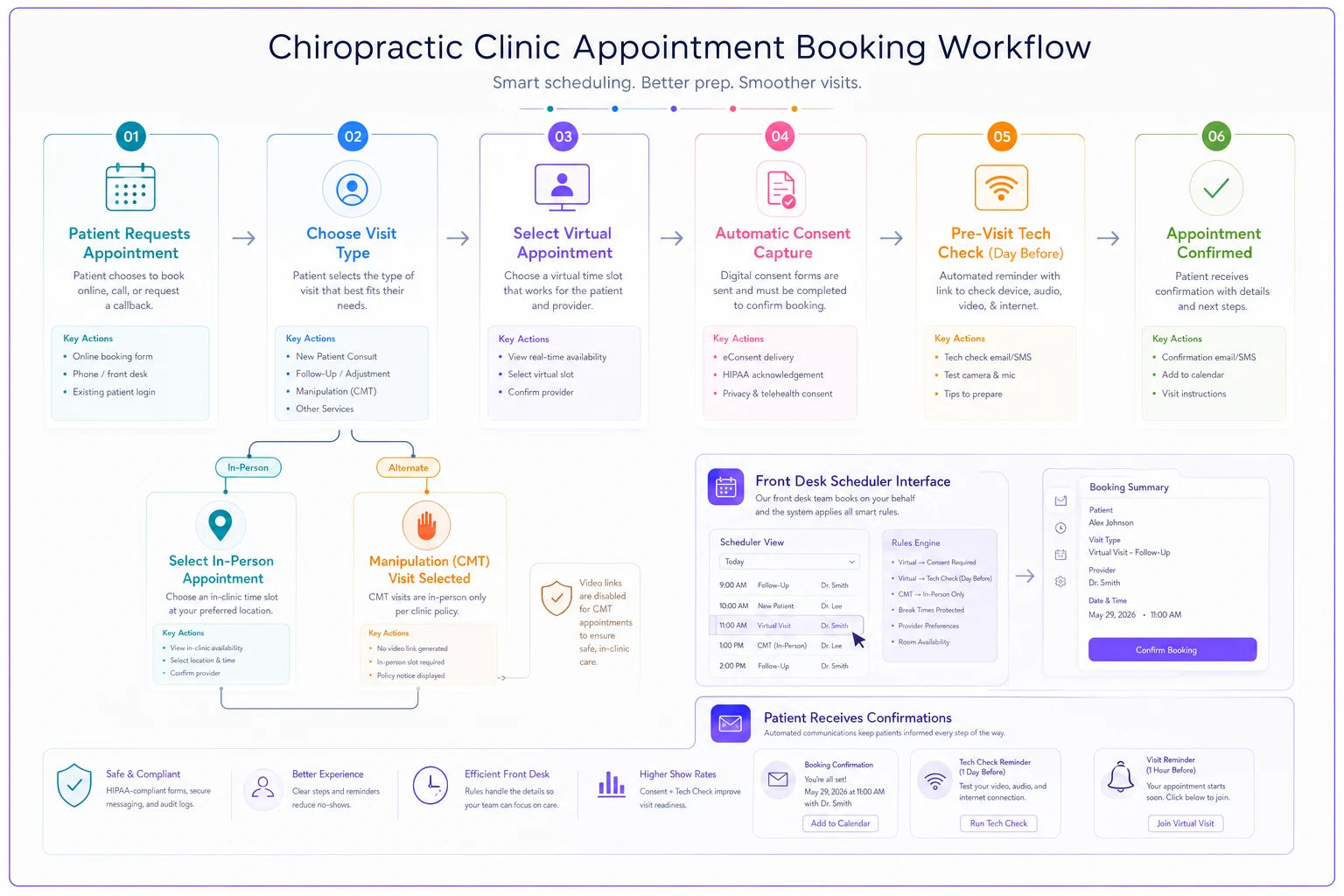
The system should make the wrong booking impossible, not just discouraged.
Consent capture: the step that quietly protects you
Telehealth consent is the piece everyone under-does, because nothing bad happens for a long time — until it does. Verbal consent scribbled as "pt agreed to video" in a note is not the same as a documented, timestamped consent record, and in an audit that difference matters.
Your SOP needs consent to be a required field, not a courtesy. What good consent capture includes:
-
Patient acknowledges the visit is being conducted via telehealth
-
Confirmation of the patient's physical location during the visit (this affects licensure and, sometimes, which state's rules apply)
-
Acknowledgment of the limits of virtual care (that a physical exam or manipulation isn't part of this visit)
-
A timestamp and a record of how consent was captured (portal click, signed form, documented verbal)
The location field is the one people forget and the one that bites hardest. If your DC is licensed in one state and the patient took the video call from a relative's house across a state line, you may have a licensure problem you don't even know about. Making "confirm patient location" a mandatory step turns a real legal risk into a five-second question.
Make "confirm patient location" a mandatory field in the scheduler so it's captured before the visit is confirmed.
The cleanest setup captures consent once per patient with a re-confirmation prompt at each virtual visit, rather than a full form every time. Patients tolerate a one-time setup; they resent re-signing the same document weekly.
Documentation: match the note to the visit, not the habit
Chiropractic teams have deeply ingrained SOAP habits built around in-person treatment visits. When they do a virtual visit, they either over-document (writing exam findings that didn't happen because the template prompted them) or under-document (a two-line note that won't survive review).
A virtual visit needs its own note template. It should not contain palpation findings, range-of-motion measurements you didn't take, or anything that implies hands-on care. What it should contain:
-
Confirmation of telehealth modality and patient location
-
Chief concern and any change since last visit
-
Functional/outcome discussion (what the patient reports)
-
The clinical decision made and next steps
-
Total time if you're billing a time-based code
If your documentation workflow is already tightened up, this is a small addition rather than a rebuild. Clinics that have worked through an operational workflow to automate their SOAP notes usually just need a parallel virtual-visit template so the wrong fields don't show up on the wrong visit type. The failure mode to avoid is one universal template that quietly invites you to document a physical exam you couldn't have performed.
The billing column is where SOPs pay for themselves
Everything above exists to make this part correct. Billing a hybrid visit wrong isn't just a denial — it can look like documenting a service that wasn't delivered, which is a worse category of problem entirely.
First, never let a virtual visit inherit a CMT code. If your billing logic auto-suggests 98941 based on the patient's usual visit, a virtual appointment has to break that assumption. This is the most common serious error — a manipulation code attached to a visit where no manipulation happened.
Second, get your modifiers and place-of-service right per payer. Telehealth E/M codes for established patients, the correct place-of-service code, and the modifier requirements all vary. Your matrix should carry your verified answer for your top three or four payers so the biller isn't researching it live during claim submission.
Denials from telehealth tend to cluster around a few predictable causes — wrong place of service, missing modifier, a code the payer doesn't reimburse virtually for chiropractic. If you've already tightened your coding discipline, the same principles from choosing correct CPT codes and avoiding documentation mistakes apply here, just with an added telehealth layer. The SOP's job is to make sure that layer is never forgotten.
When hybrid care actually makes sense — and when it doesn't
Not every visit should be virtual-eligible, and pretending otherwise creates more mess than it solves.
Hybrid makes sense for:
-
Re-evaluations where the outcome measures are patient-reported anyway
-
Home-exercise progress checks and rehab compliance
-
Results/imaging review conversations
-
Acute triage — deciding whether someone needs to come in
Hybrid is a bad idea for:
-
Anything requiring hands (all manipulation, obviously)
-
New patient exams that need a physical assessment
-
Patients whose payer flatly won't reimburse virtual chiropractic — offering it just creates an unbillable habit
-
Situations where the state's scope-of-practice rules restrict virtual DC care
Who should probably not build this yet: a solo clinic doing a handful of virtual visits a month, where the doctor makes every decision anyway. At that volume the SOP overhead outweighs the benefit. It earns its keep once virtual visits are being scheduled by front desk staff who aren't clinicians — because that's when consistent, encoded rules replace fragile human memory.
A quick real scenario
A two-DC clinic in a suburban market started doing virtual re-evals and rehab check-ins during a stretch when a lot of patients were traveling for work. No SOP — just "we'll do video for people who ask." Over roughly two months they racked up a handful of denials: a couple of visits billed with a place-of-service that one payer rejected, one visit where a manipulation code got auto-populated onto a video appointment, and several rehab check-ins that were never billable to begin with but ate real doctor time.
The fix wasn't complicated. They built a one-page visit-type matrix, split virtual and in-person appointment types in their scheduler, made telehealth consent a required field, and wrote a separate virtual note template. Telehealth denials basically stopped within the next billing cycle, and the front desk stopped pinging the doctor with "can we do this one on video?" questions. The back-end cleanup work — the part nobody bills for — dropped noticeably. The visits didn't generate a fortune, maybe a few hundred dollars a month in properly captured E/M, but the real win was that the doctors stopped losing time to preventable errors.
Build it as one document, keep it living
The temptation is to turn this into a binder with a telehealth policy, a separate consent procedure, a billing reference, and a scheduling guide. Don't. The whole value is that it's one matrix a non-clinical staffer can read across in ten seconds during a phone call. Split it into four documents and it becomes four things nobody opens.
Treat the matrix as a living row-set. Every time a new visit type or a new payer question comes up, answer it once and add the row. Over a few months you'll have encoded every real decision your clinic makes about hybrid care, and the "wait, can we do this over video?" interruptions drop close to zero.
Hybrid care in a chiropractic practice fails when the rules live in someone's head and get re-decided on every phone call. A single, enforced SOP — where the scheduling system won't let the wrong booking happen, consent is a required field, the note template matches the modality, and the billing answer is already written down — turns telehealth from a quiet source of denials into a normal, boring part of your operations. Boring is exactly what you want here.
Ready to streamline your chiropractic clinic operations?
Join 1,200+ clinics using Spinesly to save time, reduce scheduling errors, and improve patient care experiences.