
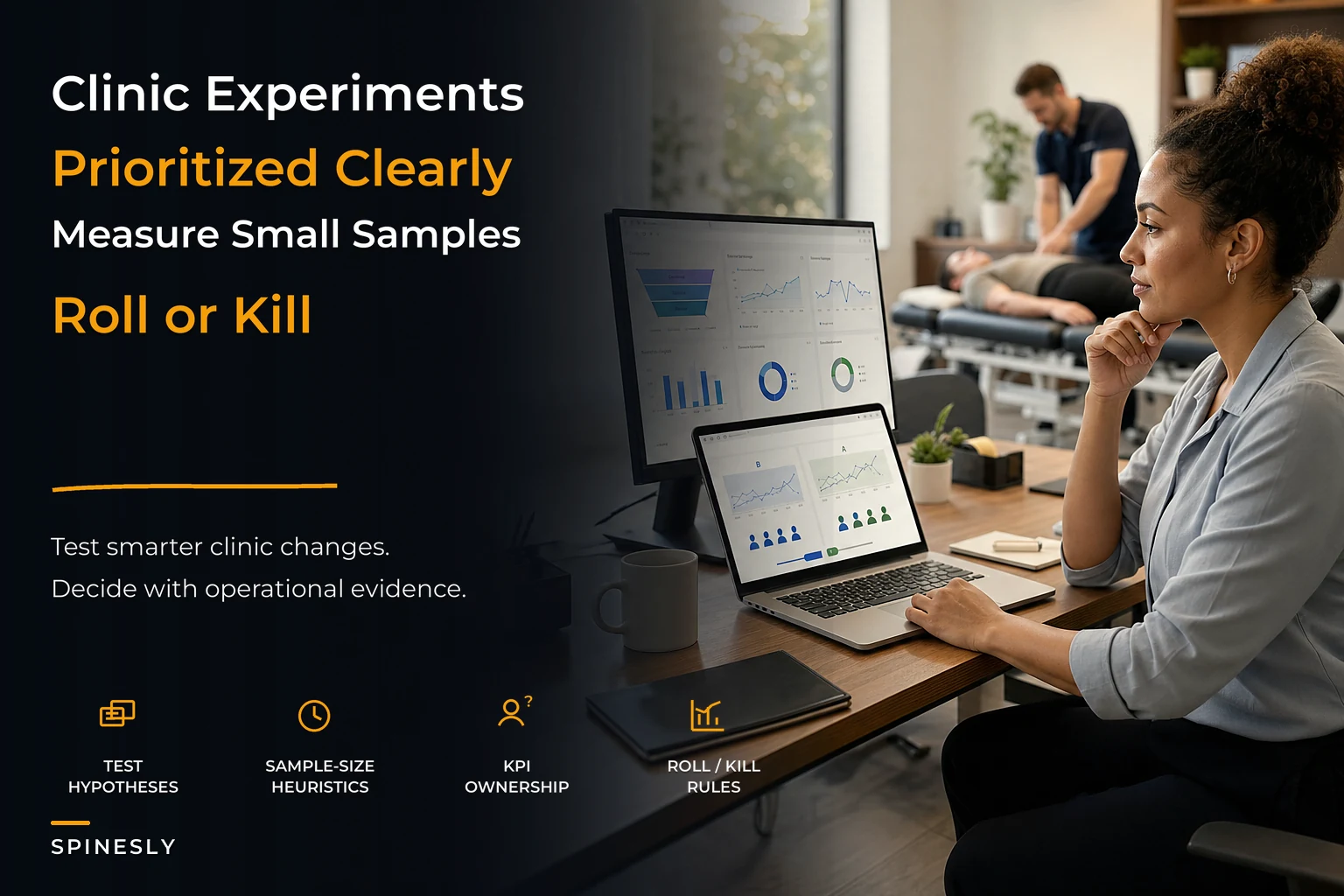

Most clinic changes never get tested. Someone reads about a new intake form, a different reminder cadence, or a fresh way to present care plans, and it just gets rolled out. Three weeks later nobody can say whether it helped, hurt, or did nothing at all. The front desk swears the new script feels better. The billing person thinks collections dipped. The owner is left guessing.
The problem isn't a lack of ideas. Small clinics have plenty of those. The problem is there's no engine that turns "let's try this" into a measured decision with a clear roll-or-kill outcome. Without that, changes pile up on top of each other, you can't tell which one moved the needle, and the whole operation runs on gut feel.
An experiment framework for clinic A/B testing isn't about statistical purity. In a practice seeing 200–400 visits a week, you'll almost never hit textbook significance anyway. What you actually need is a lightweight, repeatable way to prioritize what to test, run it cleanly, and know in advance what result would make you keep it or kill it.
Why clinic experiments usually fail before they start
The failure almost always happens at setup, not analysis.
Someone changes two or three things at once. The new patient welcome email gets rewritten and the reminder timing shifts and the front desk starts offering a different first-visit package. Conversion goes up 6%. Which change did it? No idea. You've now got three "wins" you can't separate and can't replicate.
Or the opposite: the test runs, but nobody defined what success looked like beforehand. So when the numbers come back murky — a little better on rebookings, a little worse on no-shows — the decision gets made by whoever argues loudest in the Monday meeting. That's not experimentation. That's politics with a spreadsheet.
The third failure mode is measuring metrics too far downstream. If you change your intake form and measure "patient lifetime value," you'll be waiting a year for a signal, and by then forty other things have changed. Good clinic experiments measure the nearest operational KPI the change is supposed to affect — first-visit conversion, reschedule rate, day-of collection rate — not the revenue number three steps down the chain.
The clinics that test well aren't smarter about statistics. They're just disciplined about three things: picking fewer tests, defining the outcome before they start, and tying every test to one measurable KPI that moves within a few weeks.
Prioritize before you test: the effort-vs-impact filter
You can't test everything, and you shouldn't. A small clinic can realistically run one, maybe two experiments at a time before the noise between them makes results useless. So prioritization is the real work.
Never miss another patient appointment.
Spinesly helps you schedule, confirm, and manage every patient visit efficiently.
- Unified appointment management
- Automated patient reminders
- Staff and resource scheduling
No credit card required
The trap is treating all ideas as equal. A new hold-music message and a redesigned care-plan presentation are not the same size of bet and don't deserve the same slot in your testing queue. You want to spend limited testing capacity on changes that are cheap to run and plausibly move a KPI you actually care about.
A simple scoring approach that holds up in practice: rate each candidate test on three dimensions, 1 to 5.
-
Impact — if it works, how much does it move a KPI that matters (revenue, retention, no-shows)?
-
Confidence — how sure are you it'll work, based on what you already know about your patients?
-
Ease — how little effort, staff disruption, and system change does it require?
Add them up. The high scorers go first.
| Test idea | Impact | Confidence | Ease | Score | Priority |
|---|---|---|---|---|---|
| Two-text reminder sequence vs one | 4 | 4 | 5 | 13 | Run first |
| New care-plan presentation script | 5 | 3 | 3 | 11 | Run second |
| Online booking flow redesign | 4 | 2 | 2 | 8 | Later |
| Rewriting the welcome email subject line | 2 | 3 | 5 | 10 | Cheap filler |
| Adding a self-check-in kiosk | 3 | 2 | 1 | 6 | Not now |
The subject-line rewrite is worth flagging separately. Low impact, but so easy it's almost free to run — these become useful filler tests you slot in when you don't have a bigger experiment going. The kiosk scores low on ease and confidence, so despite feeling exciting, it doesn't belong near the front of the queue.
One pattern worth naming: owners consistently overrate confidence on ideas they personally came up with, and underrate ease on anything that touches the front desk. Have someone else score the same list independently and compare. The gaps tell you where the bias is sitting.
Have someone else score the same list independently and compare.
The gaps tell you where the bias is sitting.
Sample-size heuristics when you'll never hit "significance"
This is where most clinic testing advice falls apart, because it assumes you have thousands of data points. You don't. A busy solo practice might see 60–90 new patients a month. If your experiment is about new-patient conversion, you're not running a proper A/B test with a p-value — you're running a directional test and making a judgment call.
So the goal shifts. Instead of "is this statistically significant," you ask "is this difference big enough, and consistent enough, that I'd bet on it." Here are heuristics that actually work at clinic scale.
Match the sample to the base rate, not to a formula. If the KPI you're moving happens often — like appointment reminders where every patient is exposed — you accumulate data fast and can decide in two or three weeks. If it's rare, like a specific insurance-verification edge case, you may need two or three months, and that's usually a sign the test isn't worth running at all.
Use the "count to 30 events" rule of thumb. Not 30 patients — 30 outcomes of the thing you care about. If you're testing whether a new script improves care-plan acceptance, you want roughly 30 acceptances (and a similar count of declines) in each group before the difference means much. Below that, one or two patients swing the whole result.
Watch effect size, not just direction. A change from 62% to 64% rebooking on 80 patients is noise. A change from 62% to 74% on the same 80 is worth a serious look. As a working rule, if the gap is under about 5 percentage points at small volume, treat it as inconclusive no matter how promising it feels.
Run in whole weeks. Clinic behavior is weekly — Mondays and Fridays don't look like Wednesdays. Always run experiments in full 7-day blocks so you're not comparing a test week that included a holiday against a normal control week.
The honest reality: at small volume, plenty of experiments come back inconclusive, and that's a legitimate result. "We couldn't tell" means the change probably isn't big enough to matter, which is itself useful information. The mistake is forcing a decision out of noise because you feel like you're supposed to have learned something.
Roll or kill: deciding before you see the data
The single most important habit in clinic experimentation is writing down the decision rule before the test runs. Not after. Once you see the numbers, your brain will find reasons to keep the change you were emotionally attached to.
A roll/kill rule is one sentence: "If [KPI] improves by at least [X] over the control across [N weeks / N events], we roll it out. Otherwise we kill it and go back to the old way." You commit to it up front, and you honor it when the data lands.
-
No-show / reschedule rate — roll if it drops 3+ points and holds for three full weeks. Kill if flat or worse. (Reminders and confirmation flows live here — worth pairing this with a structured checklist like the one in Cut New‑Patient No‑Shows: A Testable Checklist to Protect First‑Visit Conversions.)
-
First-visit conversion — roll if it improves 5+ points across ~30 new patients per arm. This one needs patience because volume is low.
-
Rebooking / recall response rate — roll if the segmented approach beats the old blast by a meaningful margin over ~4 weeks. The segment logic itself is covered in Turn Recalls into Revenue: Segment‑Based Rebooking Workflows That Boost Chiropractic Retention.
-
Day-of collection rate — roll if collections climb 4+ points with no rise in front-desk complaints or check-out times.
Notice each rule includes a guardrail — a second thing you're watching to make sure the win didn't come at a cost somewhere else. A script that boosts collections but doubles check-out time isn't a win; it just moved the problem down the line. Always pair the primary KPI with a guardrail metric.
A three-tier decision structure
-
Clear roll — beat the threshold and the guardrail is fine. Roll it out, document the new standard, move on.
-
Clear kill — missed the threshold or tripped the guardrail. Revert cleanly and log why, so nobody re-tests the same losing idea six months later.
-
Inconclusive — landed inside the noise band. Either extend the run for a couple more weeks if it's cheap to do so, or shelve it. Do not roll an inconclusive result just because it's slightly positive.
Each outcome has a clean next step, and none of them involve a long debate in the staff meeting. That's the point of writing the rule beforehand.
A measurement template you can actually reuse
The reason experiments don't repeat in most clinics is there's no template — every test gets designed from scratch, badly, in a hurry. A one-page structure fixes this. Fill it out before every experiment:
-
Hypothesis "We believe [change] will improve [KPI] because [reason]."
-
Primary KPI the single number this test moves.
-
Guardrail KPI the thing that must not get worse.
-
Groups control (current process) vs variant (new process). Who's in each and how they're split.
-
Duration in whole weeks, plus the target event count.
-
Roll/kill rule the pre-written threshold sentence.
-
Owner the one person accountable for reading the result and calling it.
That last line matters more than people expect. Experiments die when they're everyone's job. Assign a single owner who runs the numbers on a set date and makes the call against the pre-written rule. Without that, the review date slips, the data gets stale, and the test just quietly disappears.
A real scenario: reminder timing at a two-provider clinic
A two-provider practice was running roughly 330 visits a week with a no-show rate hovering around 11%. They'd always sent a single reminder text the morning of the appointment. Someone suggested a two-touch sequence — one text 48 hours out asking for confirmation, one the morning of.
Instead of just switching everyone over, they split it. New bookings were alternated between the old single-text flow and the new two-touch flow. Primary KPI: no-show rate. Guardrail: patient complaints about too many texts and opt-outs. Roll/kill rule, written before launch: roll if no-shows drop at least 3 points over three full weeks with no rise in opt-outs.
> Experiment flow: New booking → alternated into control (single morning text) or variant (48-hour text + morning text) → tracked separately for 3 full weeks → compared against pre-written roll/kill threshold.
After three weeks — roughly 130 appointments per arm — the two-touch group came in around 7.5% no-shows versus about 10.5% on the single text. Opt-outs barely moved. That cleared the threshold and the guardrail, so they rolled it.
The interesting part: their gut had told them the 48-hour text was annoying and wouldn't help. The data said the opposite. Without a pre-committed rule, they'd probably have killed a change that was quietly working.
Rough math: three fewer no-shows per hundred appointments, across ~330 weekly visits, at their average visit value, came out to somewhere in the low four figures of recovered revenue per month. Not life-changing, but real, and now baked into the standard flow instead of forgotten.
Where software makes this sustainable
You can run all of this on a whiteboard and a spreadsheet, and plenty of clinics start there. The friction shows up in the tracking — pulling no-show rates by group, keeping the control and variant clean, remembering to check results on the right date. That manual reconciliation is where experiments quietly die, because nobody has time to do it every week while also running a practice.
This is the practical spot where an AI-assisted operational platform earns its keep. When scheduling, reminders, and KPI tracking live in one system, splitting a test group and measuring the outcome stops being a data project. The platform tags which patients got which flow, tracks the KPI automatically, and surfaces the comparison on your review date. Some of the routine monitoring — flagging when a test hits its event count, or when a guardrail metric starts drifting — can run in the background so the owner just reviews the result and makes the roll/kill call. The point isn't automation for its own sake; it's removing the manual data-wrangling that stops small clinics from testing consistently in the first place.
Here's a simple workflow image that maps the tagging, automated tracking, event counting, guardrail checks, and owner review.
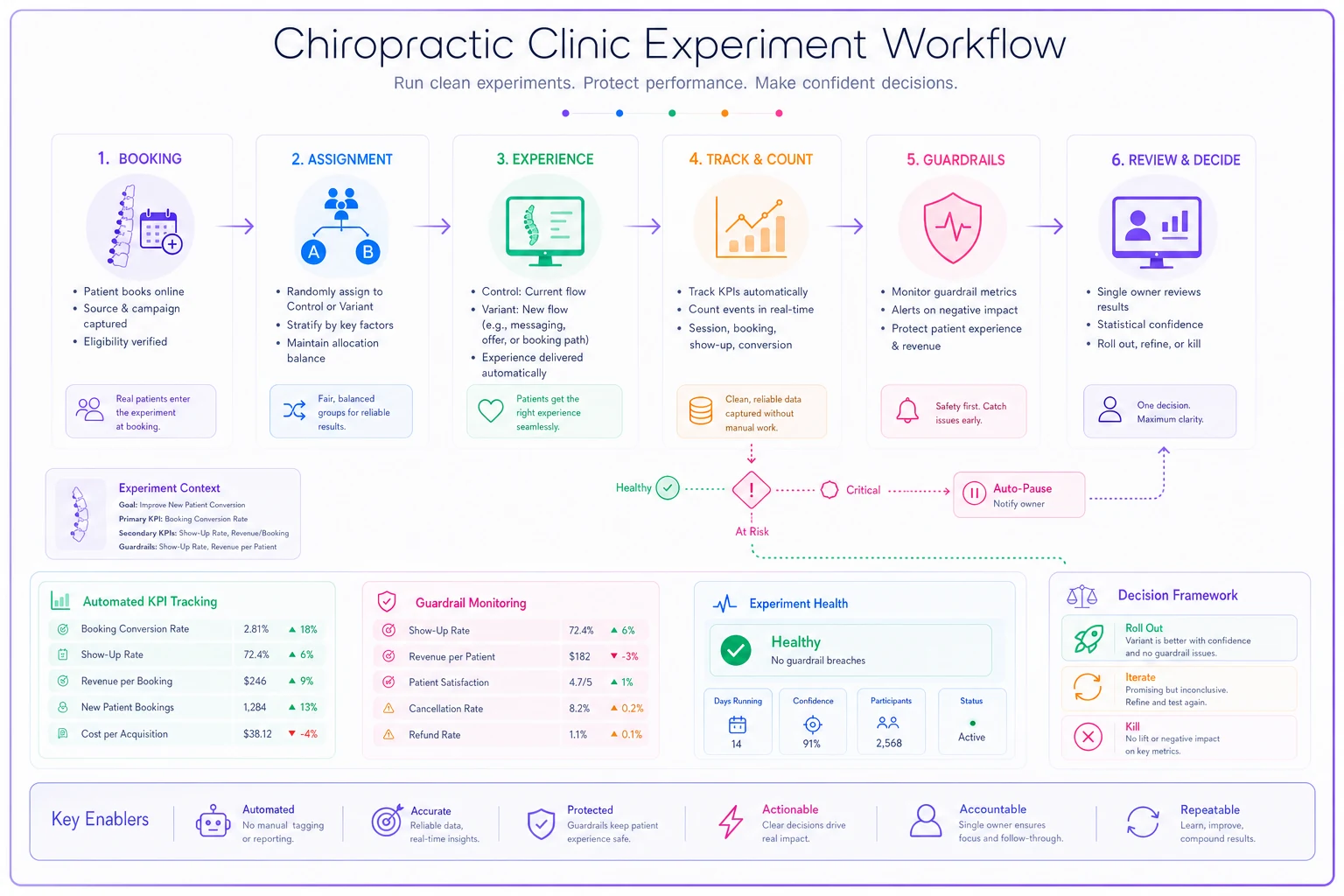
When those pieces live together, experiments stop being a weekly data chore and become a predictable operational rhythm the practice can sustain.
When experimentation is worth it — and when it isn't
When it makes sense: you have a recurring, measurable KPI (no-shows, conversion, collections, rebookings), enough weekly volume to accumulate roughly 30 events in a reasonable window, and a change that's cheap to reverse. That's the sweet spot.
When it's a bad idea: the change is a one-way door (you can't undo a new practice-management system by A/B test), the volume is so low you'd wait months for any signal, or the "test" is really about clinical protocol — where the right answer is evidence-based care, not conversion optimization. Don't A/B test things that shouldn't be decided by conversion at all.
Who should skip formal testing for now: a brand-new practice with a handful of visits a week. You don't have the volume, and your time is better spent building base workflows. Come back to structured experimentation once you're consistently seeing enough patients that a few outcomes won't swing the whole picture.
Bringing it together
The clinics that improve steadily aren't the ones with the most ideas — they're the ones that turn ideas into measured decisions and then actually honor the decision. Prioritize ruthlessly so you're only ever running one or two tests at a time. Size your samples to reality, not to a formula built for e-commerce traffic. Write the roll/kill rule before you launch, pair every primary KPI with a guardrail, and give each experiment a single owner who calls it on a set date.
Do that consistently and something changes in how the practice operates. Decisions stop being arguments and start being outcomes. The changes that survive are the ones that earned their place. Over a year, a clinic that ships four or five proven improvements will pull away from one that shipped twenty guesses and can't tell you which ones worked.
Do that consistently and something changes in how the practice operates. Decisions stop being arguments and start being outcomes. The changes that survive are the ones that earned their place. Over a year, a clinic that ships four or five proven improvements will pull away from one that shipped twenty guesses and can't tell you which ones worked.
Ready to streamline your chiropractic clinic operations?
Join 1,200+ clinics using Spinesly to save time, reduce scheduling errors, and improve patient care experiences.