

Most chiropractic clinics don't fail ADA compliance because the owner doesn't care. They fail because compliance gets treated like a one-time inspection instead of an ongoing operational system — and systems that nobody owns tend to rot quietly until a complaint, a demand letter, or a frustrated patient forces the issue.
"ADA compliance" isn't one thing, either. It's physical access (your ramp, your door width, your bathroom grab bars), it's communication access (how you handle a patient who's deaf or low-vision), and increasingly it's digital access (your website and online booking). A clinic can nail the ramp and completely whiff on the website. Another can have a gorgeous accessible entrance and zero process for a patient who needs an interpreter.
So instead of handing you a flat list of "do these 40 things," this is built as a remediation ladder: quick fixes you can knock out this week, medium fixes that need a little budget and planning, and the patient-facing accommodation request process that keeps you out of trouble when something you can't instantly fix comes up. Plus the documentation logs that actually matter if anyone ever asks "what did you do about it?"
Why ADA problems hide until they're expensive
The pattern across small clinics is pretty consistent: the access gap exists for years, nobody complains, so everyone assumes it's fine. Then one of three things happens.
A patient with a mobility device can't get through your treatment room doorway and leaves embarrassed. A serial ADA plaintiff's firm runs an automated scan on your booking page and finds it fails screen-reader standards. Or a long-time patient develops a disability and suddenly your clinic doesn't work for them anymore.
The reason this stays hidden is structural. Front-desk staff aren't trained to recognize an accommodation request unless someone literally says "I need an accommodation." Patients rarely use that language — they say things like "Is there an elevator?" or "Can someone help me with the forms?" Those are accommodation moments, but without a process, they get handled ad hoc and never logged. No log means no proof you responded reasonably, which is pretty much the entire ballgame if a complaint lands.
The deeper issue is coordination. A second provider joins, you add a Saturday shift with different staff, you move to a bigger space — and suddenly the informal knowledge about "oh, we help wheelchair patients through the side entrance" doesn't transfer to anyone new. The gap reopens without anyone noticing. Your clinic ADA compliance checklist probably lives in someone's head, or in a binder from 2019, or nowhere at all.
The three-rung remediation ladder
Think of remediation in tiers based on cost, effort, and how fast you can close the gap. The mistake owners make is trying to solve everything at the top of the ladder — big renovations — and never touching the bottom rung, where 60–70% of real-world access problems actually get fixed cheaply.
Never miss another patient appointment.
Spinesly helps you schedule, confirm, and manage every patient visit efficiently.
- Unified appointment management
- Automated patient reminders
- Staff and resource scheduling
No credit card required
| Tier | Timeframe | Typical cost | Example fixes | Who handles it |
|---|---|---|---|---|
| Quick fixes | 1–7 days | $0–$300 | Rearrange waiting room for clear 36" paths, add doorbell at inaccessible entry, large-print intake forms, lower a reception counter section with a clipboard | Office manager / you |
| Medium fixes | 2–12 weeks | $300–$5k | Grab bars, lever door handles, portable ramp, signage, website remediation, automatic door opener | Contractor + staff |
| Structural / patient-facing | Ongoing or 3–12 months | Varies widely | Bathroom reconfiguration, parking regrading, formal accommodation process, interpreter contracts | You + professional assessment |
The point of the ladder isn't to rank things by importance — it's to stop good-enough fixes from being blocked by big ones. You don't need to wait for a bathroom remodel to start offering large-print forms tomorrow.
Rung one: quick fixes you can do this week
These are the embarrassingly cheap changes that resolve a surprising share of actual patient friction. None of them require a contractor.
-
Clear the paths. Measure your main routes — reception to waiting area to treatment rooms. You want roughly 36 inches of clear width. In most clinics the problem isn't the building, it's the extra chair, the retail display, or the box of supplies narrowing the hallway.
-
Fix the counter problem. If your reception counter is too high for a seated patient, you don't need to rebuild it. A lowered section, or just a clipboard and a staff habit of coming around the desk, solves it.
-
Large-print and plain-language forms. Keep a 16–18pt version of every intake form at the front desk. Costs nothing but printer ink.
-
Entry access signal. If your accessible entrance isn't the main one, add a doorbell or a clearly posted phone number so a patient isn't stuck outside.
-
Train the "hidden request" response. Make sure every front-desk person knows that "Is there a ramp?" or "I can't read this small print" triggers the accommodation workflow — not a shrug.
That last one is the real unlock. The physical fixes are easy. Getting staff to recognize access requests — that's what actually changes outcomes, because it turns silent walkaways into documented, handled interactions.
Rung two: medium fixes that need planning
Once the free stuff is done, you move to things that cost real money but aren't renovations. The sequencing mistake here is doing these by whatever's cheapest instead of by what resolves the most patient-blocking issues.
A reasonable order:
-
Door hardware. Swap round knobs for lever handles. Cheap, fast, and removes a barrier for anyone with limited hand strength — not just disabled patients.
-
Grab bars and bathroom basics. If a full ADA bathroom is out of budget, grab bars and clear floor space are a strong interim step. Document it as interim.
-
Portable or modular ramp. For a small rise at an entrance, a modular ramp is a fraction of the cost of regrading and can go in within days.
-
Website and booking remediation. This is the fastest-growing complaint category and the one most clinics ignore. Run your booking page through a screen-reader test. Fix alt text, color contrast, keyboard navigation, and form labels.
-
Signage. Directional and accessible-feature signage so patients aren't guessing where to go.
Website remediation deserves its own mention because it's the gap owners are most blind to. Your physical clinic can be flawless while your online scheduler is completely unusable for a blind patient. Unlike a building, your website gets scanned by automated tools constantly. The fix is boring but manageable: get your developer or booking platform to meet WCAG 2.1 AA, then re-test after any site change.
Rung three: the patient-facing accommodation process
This is the rung that protects you legally, and it's the one almost nobody has written down. You can't instantly fix every structural barrier — but you can always have a process for responding to a request reasonably. That process, documented, is often the difference between "we handled it" and "we ignored a disabled patient."
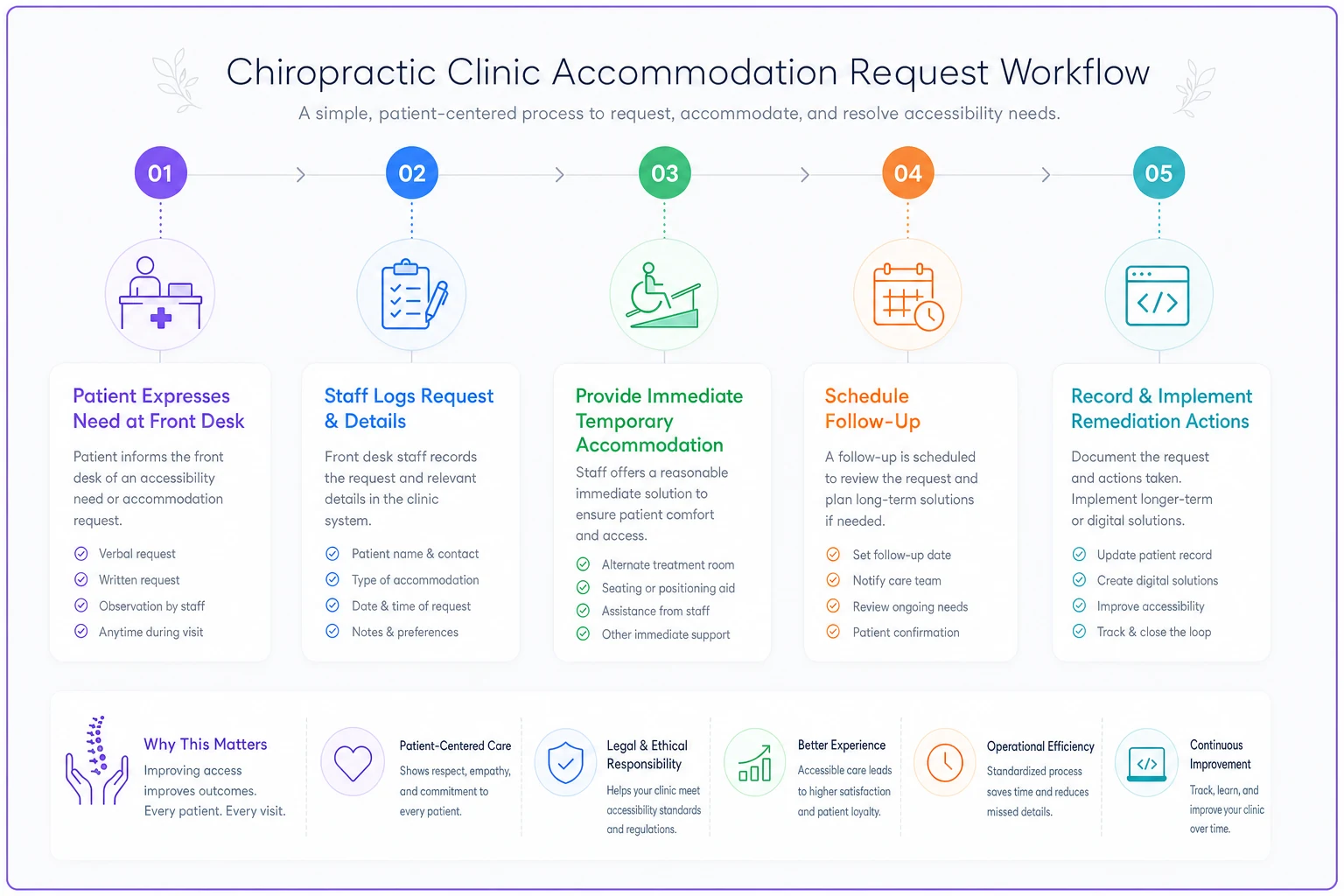
Accommodation request template (what to capture)
-
Date and who received it
-
Patient name and contact
-
What was requested (in their words)
-
The nature of the barrier
-
What you offered or did in response
-
If you couldn't fully accommodate, what alternative you provided
-
Follow-up date and resolution status
Here's a simple workflow for handling accommodation requests.
A simple patient-facing script
> "Thanks for letting me know — we want to make this work for you. Let me note down exactly what you need and what we can do today, and I'll make sure we follow up."
That sentence does three things: it validates the patient, it triggers your log, and it buys time to offer an alternative if the permanent fix isn't ready. The alternative matters. If a treatment room isn't accessible yet, can you move that patient to a ground-floor room, or a different provider's room that is? Reasonable alternatives, documented, count.
The documentation log that actually protects you
In a dispute, what you did matters less than what you can show you did. A clinic that made good-faith progress with dated records is in a far stronger position than one that fixed more but logged nothing.
-
Remediation log — every fix, dated, with cost and before/after notes. This shows ongoing effort, which is exactly what a good-faith compliance posture looks like.
-
Accommodation request log — every patient request and how it was resolved.
-
Assessment log — dates of self-audits and any professional accessibility assessments, plus the findings and your response plan.
Export monthly CSV snapshots of your logs and store them with your remediation records so you can show dated evidence of ongoing work.
This is the same operational discipline that makes other parts of a clinic defensible. If you've already built structured tracking for things like outcomes and patient experience — the kind of approach covered in measuring what actually matters in a clinical outcomes system — the muscle is the same. You're applying cadence and logging to access instead of outcomes. And if you've set up any real governance for patient experience with sampling cadence and root-cause fixes, ADA remediation slots right into that same review rhythm rather than becoming a separate orphan project nobody owns.
A 30/90-day remediation plan
Owners stall because the whole thing feels infinite. It isn't. Here's a realistic phased plan.
Days 1–30 — See and stop the bleeding
-
Walk your space with the quick-fix checklist. Fix everything on rung one.
-
Stand up all three logs (even a shared spreadsheet is fine to start).
-
Train front desk on the hidden-request script.
-
Run one screen-reader test on your booking page and list what breaks.
-
Draft your accommodation request template.
Days 31–90 — Fund and sequence the medium fixes
-
Prioritize rung-two items by how many patients each unblocks.
-
Get contractor quotes for door hardware, grab bars, and ramps.
-
Begin website remediation with your developer or platform.
-
Schedule a professional accessibility assessment for anything structural.
-
Review your accommodation log monthly — patterns in requests tell you what to fix next.
After 90 days, this becomes a quarterly review item, not a crisis. The remediation log keeps growing, the accommodation log tells you where real patients are hitting walls, and the whole thing runs as a standing operational system instead of a fire drill every time someone flags something.
A realistic scenario
A two-provider clinic in a strip-mall unit had a round-knob front door, a reception counter around 42 inches high, intake forms in 10pt font, and a booking page that failed basic screen-reader checks. No logs, no process.
They didn't renovate anything. Over about six weeks they swapped to lever handles (roughly $180), added a lowered clipboard station and a staff habit of coming around the desk, printed large-print forms, fixed the booking page's form labels and contrast with their platform's help docs, and wrote a one-page accommodation process with a shared log.
Total spend was somewhere around $600 plus a few hours of developer time. The real change wasn't the money — it was that two accommodation requests in the following quarter got logged and handled calmly instead of turning into awkward walkaways. One was a low-vision patient who became a steady long-term patient specifically because the front desk "actually knew what to do." That's the quiet payoff: access done right isn't just defensive, it retains patients other clinics lose at the door.
When to escalate to a professional assessment
Rungs one and two you can run yourself. Certain situations, though, mean you should bring in a specialist rather than guess:
-
Anything involving parking slope, regrading, or structural bathroom changes
-
A formal complaint or demand letter (loop in counsel too)
-
A lease renewal or buildout — fold accessibility into the plans now, when it's cheapest
-
Repeated accommodation requests about the same barrier you can't resolve with workarounds
Trying to DIY structural ADA work usually costs more in the end. A redo that doesn't actually meet spec gives you zero protection and you're back to square one.
The bottom rung does more than the top
Compliance is an operating system, not a project. The clinics that stay out of trouble aren't the ones that spent the most — they're the ones that fixed the cheap stuff fast, wrote down what they did, and gave staff a simple way to respond when a patient needs something.
Start at the bottom of the ladder this week. Fix the paths, the forms, the door hardware, the script. Stand up the logs. Then work upward on a 30/90-day plan with the harder items. Do that, and the next time a patient asks "is there a ramp?" your clinic has an answer — and a record of it.
Start at the bottom of the ladder this week. Fix the paths, the forms, the door hardware, the script. Stand up the logs. Then work upward on a 30/90-day plan with the harder items. Do that, and the next time a patient asks "is there a ramp?" your clinic has an answer — and a record of it.
Ready to streamline your chiropractic clinic operations?
Join 1,200+ clinics using Spinesly to save time, reduce scheduling errors, and improve patient care experiences.