


Most clinics collect feedback. Very few govern it. There's a real difference between those two things.
Collecting means you send an NPS survey after visits, watch a few Google reviews trickle in, and maybe glance at the numbers on a slow afternoon. Governing means you've decided which signals you trust, how often you sample them, what threshold triggers action, and who owns the fix. Without that loop, feedback becomes noise you feel vaguely bad about rather than something you act on.
The clinics that do this well aren't running fancier software. They've closed the gap between "a patient was unhappy" and "we changed the thing that made them unhappy." That gap is where patient experience governance lives or dies.
This post covers the whole system: what to measure, how often, how to trace complaints back to their operational source, and how to figure out whether a fix is actually worth doing.
Why "we do surveys" isn't governance
A clinic sends a satisfaction survey, gets a 4.6 average, and files it away. Then retention slips over two quarters and nobody connects the two. The survey wasn't wrong — it was measuring the wrong thing, at the wrong cadence, with no trigger attached to the result.
The failure isn't laziness. Patient experience is a distributed signal. It leaks through no‑shows, unfilled recall slots, billing disputes, front‑desk friction, and one‑star reviews mentioning a 40‑minute wait. Each of those lives in a different system, owned by a different person, and none of them talk to each other. So the owner sees fragments and never the pattern.
At small scale, one person holds the whole picture in their head. The lead DC notices Mrs. Alvarez seemed rushed, mentions it to the front desk, and it gets handled informally. That works up to maybe two providers and a few hundred visits a month. Past that, the informal memory breaks. Nobody can hold 800 monthly interactions in their head, and the "we just know our patients" instinct quietly stops working.
That's the moment governance stops being optional.
Step one: choosing instruments that map to decisions
The most common mistake is measuring everything and deciding nothing. A clinic will run NPS, a 10‑question CSAT survey, review monitoring, and a post‑visit text — and have no rule for what any score actually means.
Never miss another patient appointment.
Spinesly helps you schedule, confirm, and manage every patient visit efficiently.
- Unified appointment management
- Automated patient reminders
- Staff and resource scheduling
No credit card required
| Instrument | Best signal for | Cadence | Weakness to watch |
|---|---|---|---|
| Post‑visit CSAT (1–2 questions) | Front‑desk flow, wait time, individual visit friction | Every visit, sampled | Fatigue if too long or too frequent |
| NPS (relationship‑level) | Overall loyalty, referral likelihood | Quarterly | Lags real problems by weeks |
| Google/online reviews | Public reputation, acquisition | Continuous monitoring | Skews to extremes |
| Retention/recall gap data | Whether experience actually changes behavior | Monthly | Not opinion — it's outcome |
| Structured churn call (why they left) | Root cause of departures | On trigger | Small sample, high signal |
The instrument most clinics skip is the last one — actually calling patients who dropped off. Ten honest exit conversations will tell you more than a thousand automated survey responses. A survey captures who bothered to answer. A churn call captures who left and why.
Worth internalizing: opinion instruments (CSAT, NPS) and behavior instruments (retention, recall fill rate) should always be read together. A high CSAT with falling retention means patients are being polite and leaving anyway. That contradiction is one of the more useful diagnostics you can build into a governance loop, and it connects directly to how recall behavior works — something we covered in Turn Recalls into Revenue: Segment‑Based Rebooking Workflows That Boost Chiropractic Retention.
Step two: sampling cadence — how often is enough
Over‑surveying is its own problem. Send a form after every single visit for a care plan patient coming three times a week, and by week two they've tuned it out completely. Data quality drops right when you'd most want to catch dissatisfaction in a long treatment arc.
-
New patients — short CSAT after visit 1 and visit 3. First impressions and early friction are where most drop‑off happens.
-
Active care plan patients — one light pulse survey every 3–4 weeks, not every visit.
-
Maintenance patients — a relationship check (NPS style) once a quarter.
-
Departed patients — a churn touch within 2 weeks of a missed recall, ideally a call, not a form.
-
Continuous — review monitoring always on, no cadence needed.
The principle: sample often enough to catch a problem while it's still fixable, but rarely enough that responses stay honest. Most clinics err toward too frequent and too shallow. A shorter survey sent less often, tied to an actual decision, beats a long one nobody finishes.
Automate routing rules so each patient segment gets the right pulse without manual tracking from the front desk.
This is also where automation earns its place quietly. Manually tracking which patient gets which survey at which stage across a few hundred people is exactly the kind of thing that falls apart by Thursday. Workflow platforms with AI‑assisted triggers can watch the schedule and route the right instrument at the right time without the front desk babysitting it. Consistent cadence is nearly impossible to sustain by hand, and inconsistent cadence produces data you can't trust.
Step three: root‑cause mapping — the part everyone skips
A low score isn't a problem. It's a symptom. Governance means tracing it back to the operational cause, because the fix lives at the cause, not the symptom.
Say post‑visit CSAT dips and free‑text comments cluster around "felt rushed" and "wait was long." The lazy read is "we need to be nicer." The operational read asks: why is the visit rushed? Usually it comes back to one of a handful of upstream causes — schedule templates packing too many new patients into the same block, documentation eating provider time between patients, front desk double‑booking to offset no‑show risk, or one provider consistently running behind and cascading it through the rest of the day.
Each of those is a different fix with a different cost. "Felt rushed" caused by scheduling density is a template change. The same complaint caused by documentation drag is a workflow fix. Same symptom, completely different intervention. If you don't map it, you'll spend time coaching bedside manner when the actual problem was that the 10:30 slot was structurally impossible to run on time.
-
Cluster complaints by theme, not by score
-
Ask "why" twice for each cluster until you hit a process, a person, or a policy
-
Assign an owner — the person who controls that process
-
Name the specific change, not a vibe ("shorten new‑patient blocks to X" not "improve flow")
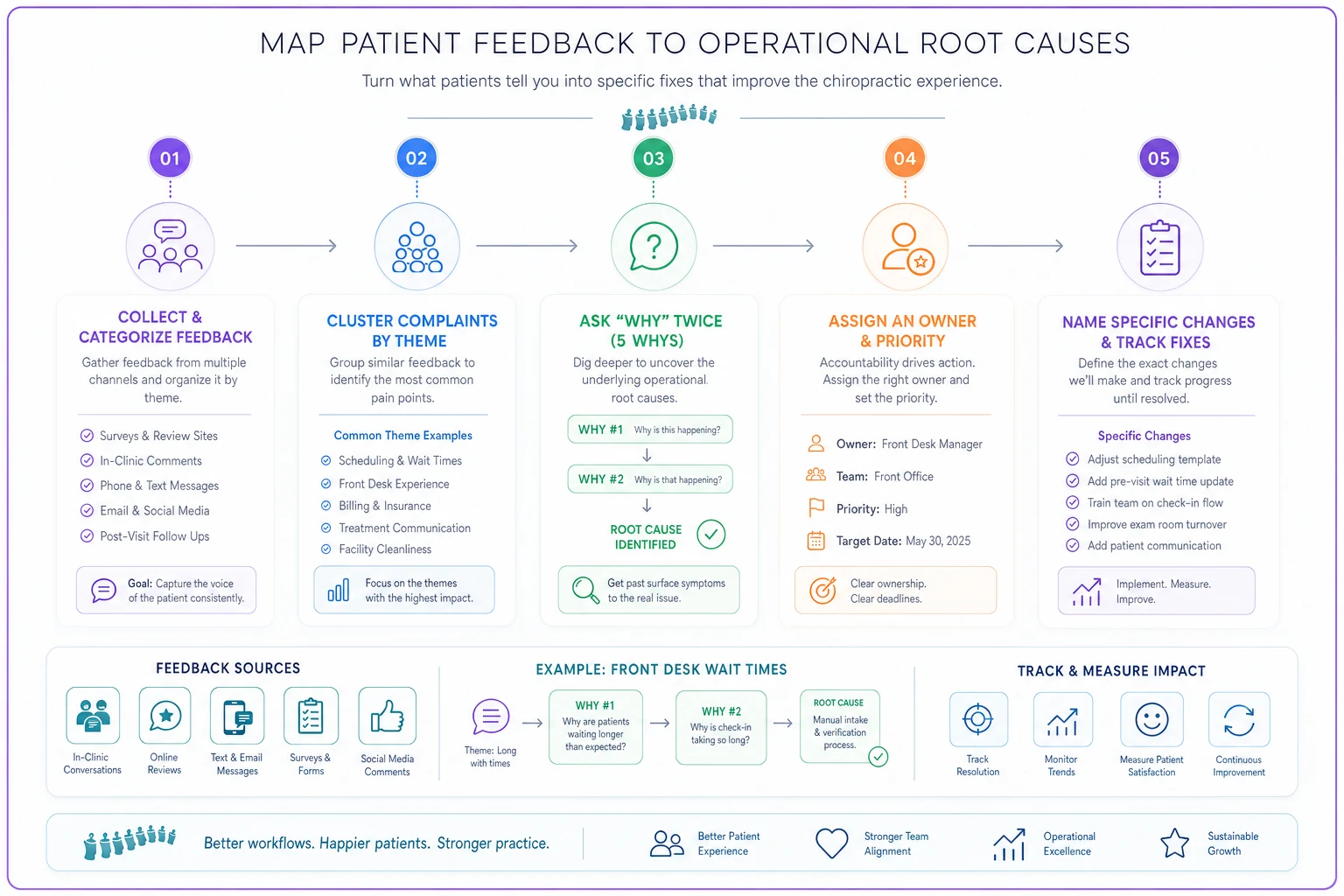
A quick visual of the mapping steps helps teams run the discipline consistently.
The clinics that get real lift here treat each recurring complaint theme as a hypothesis about a broken workflow, then test the workflow — not the mood of the room.
Step four: estimating ROI before you fix anything
Not every fix is worth doing. Once you've mapped a root cause, put a rough number on both the cost of the problem and the cost of the fix.
Cost of the problem = (patients affected per month) × (their value) × (estimated share who leave or don't rebook because of it)
Value of the fix = recovered revenue − cost to implement and maintain
A rough worked example on the "felt rushed / long wait" theme:
-
Roughly 40 new patients a month hit the over‑packed block
-
Around 8–10 of them don't convert to a care plan when the first visit feels rushed
-
Average care plan value somewhere in the $900–$1,200 range
-
Even at the low end, that's close to $7k–$10k in monthly plan value at risk
-
The fix — restructuring the new‑patient block and moving documentation out of the exam room — costs mostly reconfiguration time, not new spend
You don't need exact numbers to see that fix ranks near the top. Compare it to adding a second coffee option in the waiting room that touched maybe two complaints a month with near‑zero retention impact. Same feedback bucket, wildly different ROI. Governance is what lets you tell those apart instead of fixing whatever complaint came in most recently.
A quick ROI ranking checklist
-
Is the root cause a process, or just a bad day? (Only fix processes systematically.)
-
How many patients per month does it actually touch?
-
Does it affect conversion or retention, or just sentiment?
-
What's the one‑time cost vs. the ongoing cost?
-
Can we measure whether the fix worked within 60–90 days?
-
Is there a cheaper fix that captures 80% of the value?
If a proposed fix can't answer "how will we know it worked," it isn't ready to implement.
When this level of governance actually makes sense
Solo practitioner seeing 150 visits a month? You probably don't need a formal loop. You are the loop. A light post‑visit pulse and paying attention is enough, and building elaborate cadence rules would be overhead you'll resent.
This system starts paying off around the time you add a second provider, cross roughly 400–500 monthly visits, or open a second location. That's when the informal memory breaks and no single person can see the full picture anymore. Multi‑provider clinics especially need it — "felt rushed" might be a one‑provider problem hiding inside a clinic‑wide average that looks fine on paper.
Who should hold off: clinics in the middle of a systems migration, a staffing crisis, or a billing cleanup. Governance layers on top of stable operations. If the underlying workflows are chaotic, you'll just be measuring chaos more precisely.
A real scenario
A two‑provider clinic running around 620 visits a month had solid CSAT — roughly 4.5 — but new‑patient retention had quietly drifted down over about five months without anyone noticing the exact turning point.
Running the loop surfaced the contradiction quickly: opinion scores fine, behavior sliding. A dozen churn calls kept landing on the same thing — the first visit felt like an assembly line. Root‑cause mapping traced it to a new‑patient block stacking four intakes back‑to‑back while the lead provider was still finishing notes from the prior patient.
The fix wasn't customer‑service training. They spread the new‑patient intakes, moved documentation out of the exam room, and added a single post‑visit‑3 pulse survey to catch early drop‑off. New‑patient conversion climbed back over the following quarter, worth somewhere in the low five figures annually once you added up recovered plans. Total cost: schedule reconfiguration and about an hour of workflow setup.
The experience score barely moved. The behavior did. That's the point — governance caught what a static survey average was hiding.
Where this connects to the rest of the clinic
Patient experience governance isn't a standalone program. It sits on top of scheduling, documentation, recall, and front‑desk flow, and feeds back into all of them. A CSAT dip is often really a scheduling problem. A retention slide is often a recall problem. A review complaint is often a billing‑clarity issue wearing a different costume.
That's why the loop works best when it's wired into the systems you already run rather than bolted on as a separate survey tool. The clinics that treat experience as an output of good operations — not something you can patch with nicer emails — are the ones that hold retention as they scale. We walk through how those pieces fit into the full patient lifecycle in What Separates High‑Retention Chiropractic Clinics: An End‑to‑End Patient Journey & Automation Blueprint.
Measure fewer things, more deliberately. Trace every recurring complaint back to a real process. Only fix what the numbers say is worth fixing. Do that consistently and patient experience stops being a soft metric and becomes one of the more reliable levers you have on retention and revenue.
Ready to streamline your chiropractic clinic operations?
Join 1,200+ clinics using Spinesly to save time, reduce scheduling errors, and improve patient care experiences.