

Most chiropractic clinics track pain scores because insurance companies require it. They collect Oswestry forms, file them away, and never look at them again until audit time. The outcomes data just sits there, completely disconnected from treatment decisions, patient conversations, and care plan adjustments.
This pattern plays out in practice after practice. Clinics gather mountains of outcome data that never influences a single clinical decision. Patients plateau without anyone noticing, insurance reviews get delayed because progress documentation is scattered everywhere, and care plans keep running unchanged even when the numbers clearly suggest something needs to shift.
The disconnect happens because most clinics treat outcomes measurement as a compliance checkbox. They pick whatever instrument Medicare recommends, collect it whenever they remember, and store it wherever's convenient. There's no system connecting measured changes to actual clinic workflows.
The Real Cost of Disconnected Outcomes Tracking
When outcomes data doesn't flow into operational decisions, clinics miss critical intervention points. A patient's pain scores might be stagnating for three weeks, but nobody notices because the data lives in a filing cabinet. By the time someone reviews it—usually during a re-exam or insurance review—the patient has already mentally checked out.
One clinic's patient files told a pretty clear story: close to 40% of discontinued care plans had warning signs in their outcome scores weeks before the patient stopped showing up. Pain scores flatlined. Function scores barely budged. But those signals never triggered any intervention because there was no system in place for monitoring trends or linking measurements to actions.
The operational fallout compounds fast. Without systematic outcomes tracking, clinics can't justify care extensions to insurance. They can't demonstrate value to cash patients. They miss the window to modify treatment before patients lose confidence in the process. And when Medicare audits show up, they're scrambling to reconstruct progress narratives from scattered data points.
A proper chiropractic outcomes measurement system does three things most clinics never pull off: it captures the right data at the right intervals, surfaces meaningful trends without you having to hunt for them, and triggers specific operational responses when patterns emerge. This isn't about compliance—it's about building a feedback loop between what you measure and what you actually do.
Choosing Instruments That Balance Clinical Value with Operational Reality
Instrument selection determines whether your outcomes system becomes a clinical asset or just another administrative headache. Too complex, and staff won't collect it consistently. Too simple, and the data won't justify clinical decisions or satisfy payer requirements.
Never miss another patient appointment.
Spinesly helps you schedule, confirm, and manage every patient visit efficiently.
- Unified appointment management
- Automated patient reminders
- Staff and resource scheduling
No credit card required
Three instruments consistently deliver the best balance of clinical utility and operational feasibility for small chiropractic practices:
The Oswestry Disability Index (ODI) remains the gold standard for lower back patients—roughly 60-70% of most chiropractic caseloads. Patients take about 3-4 minutes to complete it, it generates a clear percentage score that insurance companies understand, and it tracks functional improvement in ways that actually resonate with patients. The 10-question format covers pain intensity through social functioning without overwhelming anyone.
The Neck Disability Index (NDI) is essentially the cervical spine equivalent, following nearly identical structure and scoring. Together with the ODI, these two instruments cover approximately 85-90% of typical chiropractic presentations. Both have decades of validation research, established minimal clinically important difference thresholds, and widespread payer acceptance.
The Patient-Specific Functional Scale (PSFS) fills the gaps where standardized instruments fall short. Patients identify three to five activities they can't do because of their condition, then rate their ability on each. This captures unique functional goals—playing with grandkids, getting back to CrossFit, sleeping through the night—that generic questionnaires miss entirely. Under two minutes to administer, and it creates real motivation when patients see their specific goals improving.
| Instrument | Notes |
|---|---|
| ODI | Remains the gold standard for lower back patients; 10-question format; 3-4 minutes to complete; generates a clear percentage score. |
| NDI | Cervical equivalent to ODI; similar structure and scoring; together with ODI covers ~85-90% of presentations. |
| PSFS | Patient-specific activities; 3-5 activities rated; under two minutes to administer; captures unique functional goals. |
Some clinics try implementing comprehensive batteries with five or six different instruments. It always fails operationally. Staff get overwhelmed, patients get survey fatigue, and data quality falls apart. Three instruments cover your clinical bases while staying manageable in daily practice.
Setting Collection Cadence That Captures Change Without Creating Burden
Timing determines whether you catch meaningful changes or just create paperwork. Measure too often and you won't see real change between points. Too sparse and you miss the decisions that actually matter.
Most clinics default to collecting outcomes at initial visit, re-exams, and discharge. This schedule misses the entire middle of care—where most clinical decisions happen. Patients plateau, improve rapidly, or develop compensations, all invisible until the next scheduled re-exam weeks later.
A more effective cadence follows clinical reality rather than administrative convenience:
-
Initial Visit
Full battery (ODI/NDI plus PSFS) establishes baseline. This happens during intake paperwork, before the exam, so you have objective data to reference during the consultation.
-
Visit 4-6
First check-in measurement, primary instrument only. Most patients show initial response to care within two weeks. This early measurement catches non-responders before they've invested significant time or money.
-
Visit 12
Complete reassessment with full battery. By visit 12, you should see meaningful change in both pain and function scores. This timing typically aligns with the four-week mark where insurance companies expect progress documentation.
-
Every 12 visits thereafter
Continuing measurement maintains tracking without burying operations in data collection. This creates natural four-week review cycles that align with typical insurance authorization periods.
-
Flare-ups or plan changes
Ad-hoc measurement when clinical presentation shifts significantly. If a patient reports new symptoms or sudden worsening, immediate measurement documents the change.
-
Discharge or 90-day mark
Final complete assessment for outcomes reporting and case closure.
Measuring the primary instrument at visit 4-6 is a lightweight way to catch non-responders early without overwhelming staff.
This generates roughly four to six data points across a typical 12-week care plan—enough to show trends without drowning in collection. The key is weaving collection into existing workflows rather than creating separate "outcomes days" that disrupt patient flow.
Building an Outcomes Dashboard That Surfaces Actionable Patterns
Raw outcome scores mean nothing without context. A 45% ODI score might represent dramatic improvement for one patient and total stagnation for another. The dashboard has to transform individual measurements into something clinically actionable.
An effective outcomes dashboard organizes data into four operational views:
A quick visual of the dashboard workflow helps clarify how these views connect to alerts and provider actions.
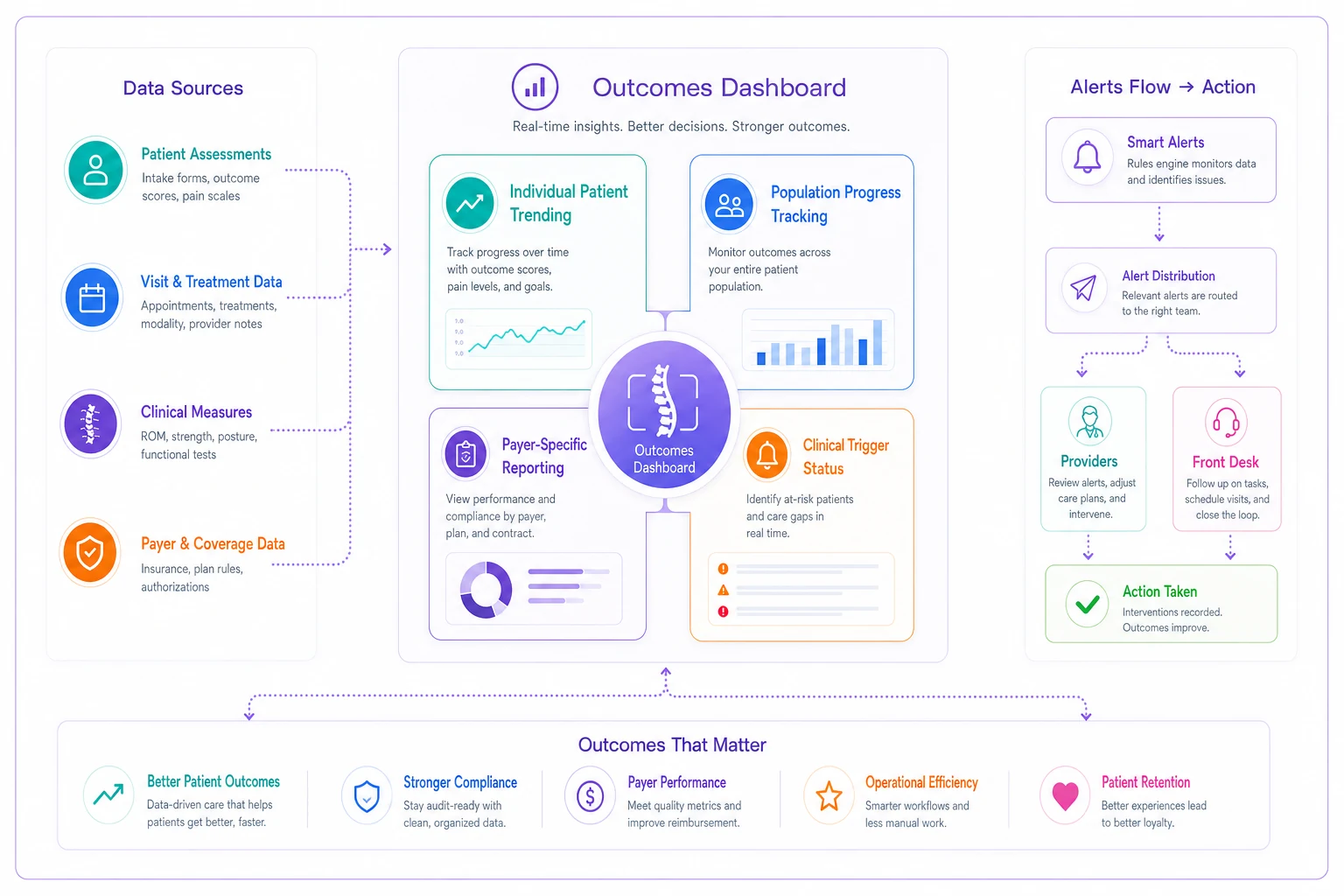
Individual Patient Trending shows each patient's trajectory across all collected measures. Simple line graphs reveal whether patients are improving, plateauing, or regressing. Color coding highlights concerning patterns—red for worsening scores, yellow for no change, green for improvement. This view should be accessible from the patient's main record, not buried in a separate reporting system.
Population Progress Tracking aggregates outcomes across your active caseload. You can quickly see what percentage of patients are improving, how many have stagnant scores, and whether specific providers or treatment approaches yield better results. One clinic I looked at discovered their newest DC had significantly more patients with stagnant scores—turned out he was too conservative with manual adjustments.
Payer-Specific Reporting filters outcomes by insurance type to surface documentation requirements and authorization patterns. Medicare patients might need 15% ODI improvement for continued coverage, while workers' comp cases require functional capacity measures. This view prevents authorization delays by flagging patients approaching payer thresholds.
Clinical Trigger Status displays which patients have hit predetermined thresholds requiring action. Rather than manually reviewing every patient's scores, this surfaces only those requiring intervention—scores worsening by 10%, no improvement after eight visits, approaching insurance limits without adequate progress.
The dashboard doesn't need complex analytics software. A well-structured spreadsheet with automated calculations handles most small clinic needs. The critical thing is making data visible and actionable, not building elaborate visualization systems.
Operational Triggers That Convert Measurements into Clinical Actions
This is where most outcomes systems fall apart—they measure change but don't specify what to do about it. Without clear trigger points and response protocols, outcomes data becomes interesting but never actionable.
Effective operational triggers follow an if-then structure linking specific measurement patterns to required actions:
Plateau Triggers
If a patient shows less than 5% improvement between any two consecutive measurements:
-
Then provider reviews treatment plan within 48 hours
-
Schedule a focused re-evaluation appointment
-
Document modification rationale in notes
-
Consider adding modalities or changing adjustment technique
If a patient shows no improvement after eight visits:
-
Then mandatory case conference with senior provider
-
Review imaging for missed findings
-
Consider referral for concurrent care
-
Discuss realistic expectations with patient
Rapid Improvement Triggers
If a patient achieves 50% improvement in under six visits:
-
Then immediately adjust visit frequency
-
Transition to maintenance phase earlier
-
Document exceptional response for marketing testimonials
-
Flag for possible case study
If a patient reaches maximum improvement (scores under 10%):
-
Then initiate discharge planning
-
Schedule final outcome measurement
-
Transition to wellness care if appropriate
-
Request online reviews while satisfaction is high
Regression Triggers
If scores worsen by 10% or more:
-
Then same-day provider notification
-
Immediate patient contact to assess the situation
-
Schedule urgent re-evaluation
-
Review recent activities for aggravating factors
If a previously stable patient shows sudden decline:
-
Then rule out new pathology
-
Consider advanced imaging
-
Document thoroughly for liability protection
-
Adjust care plan to address new findings
Administrative Triggers
If a patient is approaching their insurance visit limit without 20% improvement:
-
Then begin authorization documentation
-
Compile outcomes report for submission
-
Prepare appeal letter if needed
-
Discuss cash care options with patient
If outcomes weren't collected at the scheduled interval:
-
Then front desk receives a task notification
-
Patient flagged for collection at next visit
-
Provider alerted if the pattern continues
-
Weekly report of missing measurements goes to clinic manager
These triggers transform your chiropractic outcomes measurement system from a passive data repository into an active clinical management tool. Every measurement either confirms your current approach or prompts a specific action.
Communication Protocols That Keep Everyone Aligned
Outcomes data means nothing if it doesn't reach the right people at the right time. Patients need to understand their progress. Providers need alerts about concerning patterns. Payers need documentation proving medical necessity. Yet most clinics have no real system for routing any of this.
Patient Communication Workflows
When patients can't see their progress, they lose motivation. But throwing numbers at them without context doesn't help either.
Every four weeks, generate a simple progress report showing their starting score, current score, and direction of change. Use visual elements—simple bar charts showing percentage improvement work well. One clinic started texting patients their "improvement percentage" after each measurement. Compliance jumped almost immediately because patients could see objective progress even when their symptoms fluctuated day to day.
For plateauing patients, frame the conversation around modified goals rather than failure. "Your pain scores have stabilized—let's focus on maintaining function and preventing flare-ups" lands very differently than "you're not improving anymore."
Provider Alert Systems
Providers shouldn't have to hunt for outcomes data during patient encounters. Building alerts directly into your patient flow systems means concerning patterns surface before the visit even starts.
Morning huddles should include a quick look at any patients with triggered alerts coming in that day. The provider already knows walking into the room that this patient's scores have stagnated or regressed—they can address it proactively instead of being caught off guard.
When multiple providers work in the same clinic, outcomes data also prevents treatment inconsistency. If an associate sees a patient who's showing no improvement under the current plan, they can confidently suggest modifications knowing the data backs the change.
Payer Documentation Workflows
Insurance companies like objective data—until you bury them in it. Your outcomes documentation should tell a clear, direct story of medical necessity and clinical progress.
For authorization requests, standardized templates that highlight key metrics work best: initial disability percentage, current percentage, rate of change, and functional improvements. Include specific PSFS examples showing real-world activities the patient can now do.
Some clinics integrate outcomes tracking directly with their documentation systems, automatically pulling relevant scores into progress notes. This eliminates the duplicate entry that kills most outcomes programs while keeping documentation consistent for audits.
Technology Integration Without Overwhelming Operations
The technology supporting your outcomes system either enhances clinical operations or gets in the way of them. Too manual and staff won't maintain it. Too automated and you lose the clinical judgment that makes outcomes meaningful.
Start with your current practice management system. Most modern platforms have basic outcomes tracking capabilities that clinics never activate. Before adding anything new, maximize what you already have—enable built-in outcome forms, configure automated reminders, set up basic reporting.
For clinics ready for more sophisticated tracking, AI-powered operational platforms can take a lot of the collection and analysis burden off staff. These systems send outcome questionnaires via text before appointments, automatically calculate scores and trends, and flag concerning patterns for provider review. The automation handles routine tasks while preserving clinical decision-making where it belongs.
The integration should feel invisible to patients. They get a text with a quick questionnaire link, complete it in the waiting room, and their scores automatically populate in their chart. No clipboards, no manual entry, no lost forms.
That said, resist the urge to over-automate. Clinical interpretation, patient conversations, and treatment modifications still require human judgment. Technology should surface insights and handle logistics—not make clinical decisions.
Common Implementation Failures and How to Avoid Them
Even well-designed outcomes systems fail when implementation ignores operational reality. The most common breakdown points:
Staff Training Gaps: Front desk staff who don't understand why outcomes matter won't prioritize collection. They'll skip it when busy, forget to remind patients, or file forms without entering data. Spend time explaining how outcomes data protects the practice during audits and helps providers make better clinical decisions. Make them partners in the process, not just data collectors.
Provider Resistance: Some chiropractors view outcomes measurement as bureaucratic interference with clinical judgment. When systems are poorly designed, they're not entirely wrong. Show providers how systematic tracking actually reinforces their clinical authority by giving them objective justification for treatment decisions. Starting with one enthusiastic provider before rolling out clinic-wide tends to work better than forcing everyone in at once.
Technology Friction: Every extra step between measurement and action reduces how well the system works. If providers have to log into three different systems to see outcomes data, they won't bother. If staff have to manually calculate scores and build graphs, accuracy suffers. Remove every friction point you can find between data collection and clinical action.
Incomplete Implementation: Clinics often implement outcomes collection but skip the trigger and communication components. Data piles up unused because nobody specified what to do with it. Build the complete system—instruments, cadence, dashboard, triggers, communications—or it's probably not worth starting.
Making Outcomes Measurement Sustainable
The difference between clinics that maintain effective outcomes tracking and those that abandon it after a few months comes down to how well it integrates with existing workflows. The system has to enhance daily operations, not complicate them.
Build outcomes collection into natural transition points. Patients complete questionnaires during wait times rather than as separate appointments. Scores automatically populate in charts. Alerts appear during morning huddles rather than requiring separate meetings.
Create feedback loops that make the system's value visible. When outcomes data helps secure insurance authorization, recognize it. When an early warning prevented a patient from dropping out, highlight it. People maintain systems they can see working.
Start small and expand gradually. Implement with just lower back patients using only the ODI. Once that workflow runs smoothly, add neck patients and NDI. Then bring in PSFS for complex cases. Incremental builds prevent the overwhelming complexity that kills most outcomes initiatives.
The Compound Effect of Systematic Measurement
A functioning chiropractic outcomes measurement system creates compound benefits beyond simple compliance. Clinical decisions become more confident when backed by objective data. Patient buy-in increases when they can see measurable progress. Insurance authorizations move faster with proper documentation. Marketing messages carry more weight with real outcomes data behind them.
But the biggest impact might be on clinic culture. When everyone—from front desk to providers—understands how their actions connect to patient outcomes, decision-making improves across the board. The receptionist who ensures outcomes collection knows they're contributing to clinical success. The associate who catches a plateauing patient early prevents a dropout. The billing specialist who includes outcomes documentation reduces denials.
This isn't about adding another administrative layer. It's about building a feedback system that makes every other operational component more effective. The measurements inform the care, the care improves the measurements, and the whole clinic operates with greater clinical and financial confidence.
Done right, your outcomes system becomes part of how you practice—not something separate from it. Patients expect it. Providers rely on it. Staff maintains it without being reminded. And your clinical results, patient retention, and financial performance all improve as a natural consequence of measuring what actually matters and acting on what you find.
Ready to streamline your chiropractic clinic operations?
Join 1,200+ clinics using Spinesly to save time, reduce scheduling errors, and improve patient care experiences.