



Most chiropractic retail shelves run on gut feeling. Someone buys 40 units of a pillow because a rep gave a good pitch, they sit in the supply closet for eight months, and nobody notices until inventory count reveals $2,300 in dead product. Meanwhile the electrolyte packets that actually sell keep stocking out because there's no reorder trigger — just whoever happens to notice the box is empty.
The retail side of a chiropractic clinic is small enough that owners ignore it, but big enough that when it leaks, it leaks quietly for a long time. And the leak that costs the most isn't the buying decision — it's the gap between what your POS says you sold and what actually landed in your bank account. That's the part almost nobody has a system for.
This is a tight, practical playbook you can actually run. Reorder points, margin rules, target turn rates, scripts your front desk can use, and the daily clinic retail inventory reconciliation SOP that catches problems before they compound.
Start with turn rate, not with what to buy
The instinct is to build your retail plan around what products to carry. That's backwards. Start with how fast your shelf should move, because that number tells you how much cash you're allowed to tie up.
Turn rate is just how many times you sell through your average inventory in a year. If you keep roughly $1,200 of product on the shelf on average and sell about $7,200 worth in a year, your turn rate is 6 — meaning the shelf "turns over" six times.
-
Consumables (topical creams, electrolyte packs, tape, supports you go through fast): target 8–12 turns a year
-
Durable products (pillows, TENS units, posture braces, higher-ticket items): target 3–5 turns a year
-
Anything under 2 turns
it's not retail, it's a storage problem
The mistake owners make is carrying durable items at consumable-level quantities. You don't need six cervical pillows on hand. You need one on display and a reorder trigger. A pillow that turns twice a year should almost never sit more than a unit or two deep.
Once you know your target turn rate, your maximum inventory investment falls out of it. If you want $9,000 in annual retail revenue at a blended turn rate of 6, you should carry roughly $1,500 in average inventory — not $4,000. Every dollar above that line is cash sitting on a shelf doing nothing.
Reorder points that don't rely on someone noticing
The biggest source of retail waste in clinics isn't over-ordering. It's the combination of over-ordering slow stuff and stocking out on fast stuff. Both come from the same root cause: no defined reorder point.
Never miss another patient appointment.
Spinesly helps you schedule, confirm, and manage every patient visit efficiently.
- Unified appointment management
- Automated patient reminders
- Staff and resource scheduling
No credit card required
A reorder point is dead simple math:
Reorder point = (average units sold per week × lead time in weeks) + a small safety buffer
Say you sell about 10 electrolyte packs a week, your supplier takes 2 weeks to deliver, and you want a one-week buffer. Your reorder point is (10 × 2) + 10 = 30. When you hit 30 units, you order — not when you hit zero.
Here's what a workable reorder sheet looks like for a small clinic:
| Product | Avg units/week | Lead time | Reorder point | Reorder qty | Target turns |
|---|---|---|---|---|---|
| Electrolyte packs | 10 | 2 wks | 30 | 60 | 10 |
| Topical cream | 6 | 1 wk | 12 | 36 | 9 |
| Kinesio tape rolls | 4 | 2 wks | 12 | 24 | 8 |
| Cervical pillow | 0.5 | 3 wks | 2 | 3 | 4 |
| Posture brace | 1 | 2 wks | 3 | 6 | 5 |
Notice the reorder quantities differ from the reorder points. The reorder point is when to buy; the reorder quantity is how much. For fast movers you can buy in bigger batches to reduce ordering hassle. For pillows, you never want to hold more than three, so you order three.
If a supplier offers a large bulk discount, compare the capital tied up at your target turns — discounts that force you to double inventory are often worse than paying full price and turning stock faster.
The thing most people miss: defined reorder points quietly kill the "the rep gave us a deal" problem. When a supplier offers 25% off if you buy 50 units, and your reorder quantity is 6 with a target turn of 4, the discount is a trap. You're buying two years of inventory to save 25% on something that ties up cash and risks going stale. Having the numbers written down gives your team a real reason to say no.
Margin rules that survive discounting
Retail margins in clinics erode three ways: buying at bad wholesale, pricing by feel, and giving away product to patients as goodwill without tracking it.
Set a floor and stick to it. A clean rule set for most clinic retail:
-
Minimum blended gross margin
45%.
If a product can't clear that after wholesale cost and shipping, it doesn't earn shelf space. -
Standard markup on consumables
2x wholesale
(a 50% margin). Simple, defensible, easy for staff to remember. -
Durable/higher-ticket items
1.6x–1.8x wholesale.
Patients price-compare pillows and TENS units online, so you have less room. That's fine — the goal is turn, not maximum per-unit margin. -
Comped product gets logged as a zero-dollar sale, not a deletion. This is the one everyone skips, and it's exactly why counts never match.
That last rule matters more than it looks. When a front-desk staffer hands a regular patient a free tube of cream and just takes it off the shelf without logging it, your POS shows inventory it doesn't have. Multiply that across a few staff members over a few months and your reconciliation is permanently off — and you can't tell theft from generosity from a scanning error.
If you want the deeper version of protecting margin against day-of revenue leaks, the same discipline applies to copays. The pattern in the point-of-care payment SOP for reducing missed copays translates almost directly to retail: capture the transaction at the moment it happens, or you'll spend the rest of the month reconstructing it.
Staff sales scripts that don't feel like selling
Clinic retail dies when front-desk staff feel like they're upselling. Chiropractors got into this to help people, and so did the person at the front desk. The fix isn't training people to sell harder — it's giving them two or three natural moments where recommending a product is genuinely useful, plus the exact words.
The best-converting moments in a chiropractic visit aren't at checkout. They're clinical. When the provider says "ice this tonight," that's the sale — the patient is already primed, and it's care advice, not a pitch.
-
Provider-triggered (strongest) During the adjustment, the DC says, "You'll want to ice this and keep it supported for a couple days — grab a support brace up front, we keep them stocked." The front desk just completes what the provider already prescribed.
-
Front-desk soft offer "Dr. [name] mentioned the cream for that area — want me to add it? It's usually gone in a couple weeks with regular use."
-
Restock nudge for regulars "You picked up electrolyte packs last month — running low? I can grab a box so you're set."
The pattern: the front desk never initiates a product recommendation cold. They complete a clinical suggestion or restock something the patient already uses. Conversion on provider-triggered offers runs dramatically higher than anything initiated at checkout — it's not close.
One rule worth enforcing: providers don't handle money or product on the floor. They recommend, the front desk fulfills. Keeps the clinical relationship clean and gives you a clear handoff to track.
The daily reconciliation that actually catches problems
This is the part that separates clinics whose numbers mean something from clinics running on hope. Your POS and your accounting have to agree at the end of every day, and if they don't, you find out that day — not at month-end when the trail is cold.
The problem shows up in a predictable way. POS shows $180 in retail sales. The deposit is $164. Nobody knows why. It could be a comped item, a refund that wasn't recorded, a card fee, a miskeyed price, or product walking out the door. By the time you look a month later, you have 30 days of $16 mysteries and no way to trace any of them.
Here's the daily clinic retail inventory reconciliation SOP that closes that gap:
-
Pull the POS daily sales report at close — total retail sales, payment types, refunds, and any comped/zero-dollar items.
-
Match payment totals to the merchant batch. Card sales in POS should equal the card processor's batch total for the day. Cash sales should match the drawer count.
-
Match the deposit to accounting. What hit (or will hit) the bank should tie to the POS totals minus processor fees.
-
Reconcile units, not just dollars. Units sold in POS should reduce on-hand inventory by the same amount. Spot-check two or three fast-moving SKUs against the shelf.
-
Log every variance over a small threshold (say $5 or 1 unit) with a reason. No reason found = flag it.
-
Roll unexplained variances into a weekly review. Three of the same variance in a week is a process leak, not an accident.
The whole thing takes about 10 minutes once it's a habit. The value isn't in any single day — it's that a $12 gap gets a reason attached to it while everyone still remembers what happened, instead of becoming part of an unexplained $300 hole at month-end.
Most clinic practice-management and POS systems can automate the matching layer — pulling the daily sales report, comparing it against the merchant batch, and flagging variances above your threshold so staff only review exceptions instead of re-keying everything by hand. That's the difference between reconciliation being something someone dreads and a two-minute exception check. The same logic that protects billing accuracy in an operations-first denials playbook applies here: you don't want staff manually checking everything, you want the system to surface only what doesn't reconcile.
Here's a visual workflow for the daily reconciliation process.
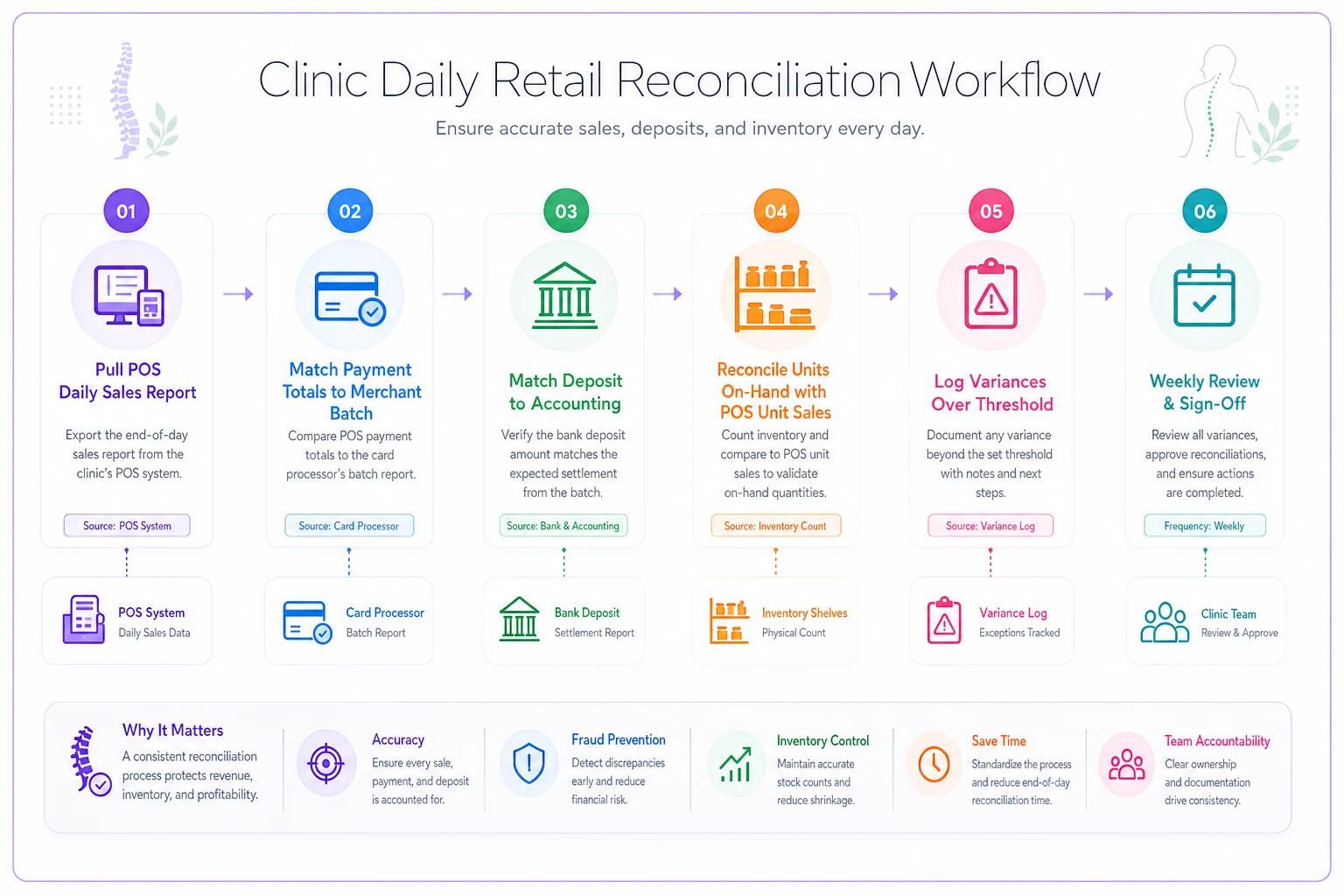
That graphic shows the steps to check each day and where automation typically helps — surface exceptions so staff only investigate flags instead of re-keying everything.
A quick real scenario
A two-provider clinic was doing roughly $600–$800 a month in retail and assumed it was basically break-even after shrinkage. Their supply closet held about $3,400 in product, and their turn rate was under 2.
They did three things: set reorder points and cut durable inventory back to display-plus-one, implemented the daily reconciliation SOP with a $5 variance flag, and moved product recommendations to provider-triggered moments only.
Within about three months, average inventory dropped to roughly $1,300, freeing up cash that had been sitting dead on the shelf. Monthly retail revenue climbed to around $1,100–$1,300 — not because they carried more product, but because the fast movers stopped stocking out. And the daily reconciliation surfaced something they never would have caught otherwise: a recurring gap that turned out to be comped product never being logged. Not theft — just no SOP for it. Once comps were logged as zero-dollar sales, the counts matched and the month-end mystery disappeared.
The revenue bump was nice. The bigger win was that their numbers finally meant something.
When a retail shelf makes sense — and when it doesn't
Retail isn't right for every clinic, and forcing it wastes cash and shelf space.
It makes sense when:
-
You have steady patient volume that generates natural product moments (adjustments, rehab, posture work)
-
Your front desk has bandwidth to run a reconciliation and complete provider recommendations
-
You can hit at least a 45% blended margin and 4+ blended turns
It's a bad idea when:
-
Patient volume is too low to move even fast consumables — you'll just tie up cash
-
Nobody owns the daily reconciliation, meaning counts will drift immediately
-
You're treating retail as a revenue rescue plan — it's a margin supplement, not a fix for underlying volume or payer-mix problems
On that last point — if retail is where you're looking to close a revenue gap, the lever is almost always chair hours and payer mix first. That's the bigger math, and it's worth working through the chair hours and payer mix financial model before you lean on the retail shelf to carry weight it can't.
The one page, summarized
If you strip this down to what goes on the actual one-pager taped inside the supply closet:
-
Turn targets consumables 8–12, durables 3–5, kill anything under 2
-
Reorder point (weekly sales × lead time) + buffer — order at the trigger, not at zero
-
Reorder quantity capped by turn target, so rep "deals" can't overstock you
-
Margin floor 45% blended; 2x on consumables, 1.6–1.8x on durables
-
Comps logged as zero-dollar sales, never deleted
-
Sales moments provider recommends, front desk fulfills — never a cold upsell at checkout
-
Daily reconciliation POS → merchant batch → deposit → unit counts, flag variances over $5 or 1 unit, review weekly
The retail shelf is small money that behaves like big money the moment it goes unmanaged. The clinics that get it right aren't buying smarter products — they're closing the loop every single day so a $12 gap never gets a chance to become a $300 one.
The retail shelf is small money that behaves like big money the moment it goes unmanaged. The clinics that get it right aren't buying smarter products — they're closing the loop every single day so a $12 gap never gets a chance to become a $300 one.
Ready to streamline your chiropractic clinic operations?
Join 1,200+ clinics using Spinesly to save time, reduce scheduling errors, and improve patient care experiences.