

Most clinics obsess over denials, coding, and payer contracts — and rightly so. But there's a quieter leak sitting at the front desk every single day: the copay, coinsurance, or self‑pay balance that walks out the door because nobody asked for it at the right moment.
The frustrating part is that this money isn't stuck in appeals or lost to a coding error. It's owed, it's collectable, and the patient is standing three feet away from your card reader. You just didn't collect it while you had them.
This article is a tight, practical point of care payment SOP for chiropractic clinics — the check‑in verification steps, prepaid and express‑pay options, staff scripts for the awkward conversations, and the end‑of‑day reconciliation that keeps the whole thing honest. No broad theory. Just the workflow that stops day‑of dollars from slipping.
Where the money actually leaks
If you sat behind the front desk for a full week and tracked every missed collection, you'd see the same handful of failure points repeating themselves:
-
The patient checks in, the DA is mid‑call, and the visit gets marked "arrived" without any payment prompt.
-
The card reader is behind the desk, so a patient who's ready to pay gets told "we'll bill you" because grabbing it is a hassle.
-
Coinsurance is "unknown" so staff skip collection entirely rather than estimate.
-
A package/plan patient shows up and nobody's sure what today's out‑of‑pocket actually is, so they wave them through.
-
The provider runs behind, the waiting room backs up, and the front desk switches into "just move people" mode — payment gets dropped first.
None of these are laziness. They're all the predictable result of a check‑in flow that treats payment as an afterthought instead of a checkpoint. When collection is optional in the moment, it becomes optional permanently — because chasing it later costs you far more in labor than the balance is worth.
A typical example: a two‑provider clinic seeing around 320 visits a month. If even 12–15% of those visits leave with an uncollected copay or coinsurance averaging $25–$40, that's somewhere in the range of $1,200–$1,900 a month drifting into A/R — money that mostly never comes back because small balances are the hardest and least worthwhile to pursue.
The core problem: verification and collection are two separate events
In a leaky front desk, insurance is verified before the visit (sometimes) and payment is collected after the visit (rarely). Those two things live in different moments, handled by different mental modes, and the handoff between them is where dollars fall out.
Never miss another patient appointment.
Spinesly helps you schedule, confirm, and manage every patient visit efficiently.
- Unified appointment management
- Automated patient reminders
- Staff and resource scheduling
No credit card required
If you've already tightened up your eligibility work — and the insurance verification SOP approach is the right foundation here — you already know the patient's plan, copay, and deductible status before they walk in. The mistake is not carrying that information forward to the point of care.
The fix is collapsing verification and collection into a single check‑in checkpoint. The patient doesn't get marked "ready for the adjustment" until the payment step has happened. Not "was offered." Happened — either paid, prepaid, or explicitly documented as a plan exception.
The check‑in verification flow (the actual sequence)
This is the sequence that should run every time a patient walks up, whether it's a new patient or their 14th visit:
-
Pull the day‑of ledger, not the plan summary. Verification told you their benefits. At check‑in you need the today number: this visit's expected copay or coinsurance, plus any prior small balance. If your system can't surface a single "collect today" figure, staff will improvise — and improvising means skipping.
-
State the number, don't ask permission. The script is "Your copay today is $30, will that be card or the one on file?" Not "Would you like to take care of your copay?" The second version invites "I'll get it next time."
-
Collect before the patient sits down. Payment at check‑in, not check‑out. Once a patient is on the table, the visit ends with them grabbing their keys and leaving — nobody wants to be the person stopping them for $30.
-
Handle the "unknown coinsurance" case with an estimate. If exact coinsurance can't be known, collect a good‑faith estimate and note that the balance may adjust. Collecting $28 now beats collecting $0 and mailing a statement for $34 later.
-
Log the exception if you don't collect. If a patient legitimately can't pay today, that's a documented exception with a follow‑up date — not a silent skip. Silent skips are invisible, and invisible losses never get fixed.
The single most important line above is #3. Front‑desk collection at check‑in versus check‑out is usually the biggest lever on your day‑of capture rate, and it costs nothing to change.
Here's a visual of the check‑in flow and where each collection step should happen.
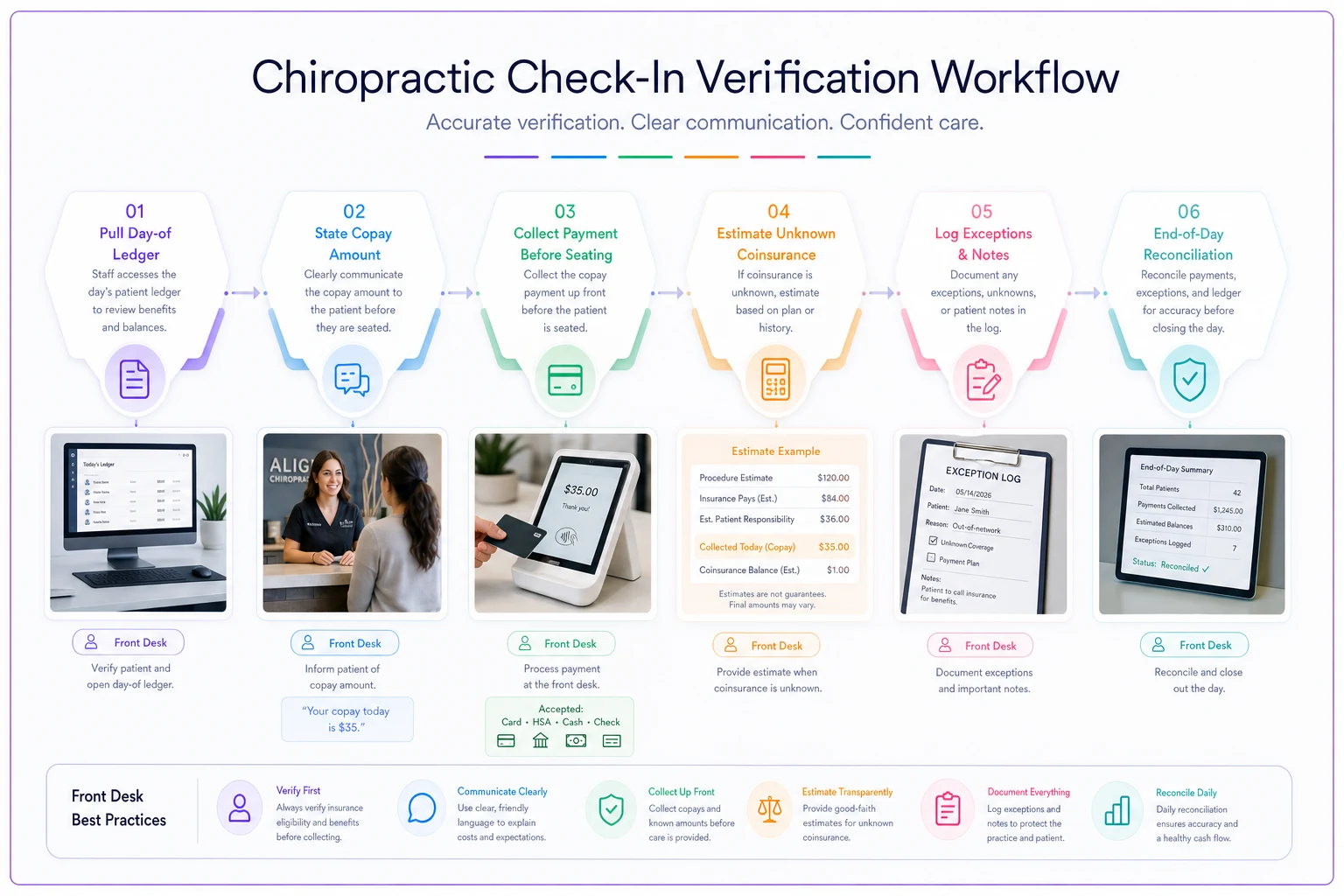
Keep collection at check‑in as a routine checkpoint rather than an optional ask.
Prepaid and express‑pay options that reduce the awkward moment
The reason collection feels uncomfortable is that it happens face‑to‑face, every visit, with a patient who's often on a plan they don't fully remember agreeing to. You can engineer most of that friction out.
Card on file. For plan patients and care packages, get a card authorized at the start of care. Then day‑of collection becomes a confirmation ("we'll run the card on file for today's $30"), not a transaction. This alone tends to lift capture noticeably because it removes the "I forgot my wallet" and "can we do it next time" outs.
Prepaid care blocks. For treatment plans — say a 12‑visit corrective plan — collect the patient portion upfront or in scheduled installments. Each visit draws down a prepaid balance, and the front desk isn't running a fresh transaction on a busy Monday. Fewer touchpoints, fewer misses.
Express‑pay at check‑in. A tablet or QR code at the front desk where the patient taps, sees "$30 copay," and pays in ten seconds. The point isn't the tech — it's that the patient completes payment themselves before staff even fully engage, which removes the DA‑is‑busy failure point entirely.
Here's a quick comparison of how these change the day‑of dynamic:
| Method | Day‑of staff effort | Miss risk | Best for |
|---|---|---|---|
| Collect at check‑out (manual) | High | High | Nothing, honestly |
| Collect at check‑in (manual) | Medium | Medium | Walk‑ins, one‑off visits |
| Card on file | Low | Low | Recurring plan patients |
| Prepaid care blocks | Very low per visit | Very low | Treatment plans |
| Express‑pay / self‑serve | Low | Low | High‑volume days |
Every method that reduces miss risk also reduces how many times a human has to have the payment conversation. That's not a coincidence. Missed copays are mostly a byproduct of repeated friction, and the fix is removing the repetition.
Scripts for the conversations nobody wants to have
Front desk staff don't skip collection because they're careless. They skip it because they haven't been given the words, and improvising a money conversation under pressure is genuinely hard. Scripts fix this faster than any lecture about "the importance of collections."
Standard copay: > "Alright, your copay today is $30 — do you want to use the card on file or a different one?"
Patient says "can I pay next time?": > "I totally get it. We do collect the copay at each visit so it doesn't pile up into one big bill for you. It's $30 today — card's easiest, or I can take cash."
Unknown coinsurance: > "Your plan has us collect a percentage rather than a flat copay, so today's estimate is about $28. If it comes back different, we'll adjust it — never more than what your plan says."
Existing small balance: > "Looks like there's a $22 balance from your last visit plus today's $30, so $52 total. Want to knock both out on the card on file?"
Genuine hardship: > "No problem at all — let's set up a plan that works. Can we do $15 today and split the rest over your next two visits?"
The goal of a script isn't to sound polished. It's to make the number feel expected and normal rather than negotiable. When the DA states the copay as a matter of routine, patients treat it as routine. When the DA sounds apologetic or asks permission, patients hear an opening.
Train the "I'll get it next time" objection specifically, because it's the most common one and the one that quietly kills your capture rate if staff cave to it.
Reconciliation: the step that keeps the whole SOP honest
You can build a solid check‑in flow and still leak money if nobody closes the loop at end of day. Reconciliation is what turns "we're supposed to collect" into "we know exactly what we collected and what we missed."
-
Match visits to collections. Every completed visit should have a matching payment, a prepaid draw‑down, or a documented exception. Any visit with none of those three is a miss to review.
-
Review the exception log. Every "couldn't pay today" note should have a follow‑up. If the same patient shows up three times as an exception, that's not hardship — that's a conversation that needs to happen.
-
Reconcile the card reader / express‑pay totals against your PM system so you catch payments that were taken but never posted.
-
Flag estimate adjustments. Coinsurance estimates that came back higher need a balance follow‑up; ones that came back lower may need a small refund. Both matter for patient trust.
Run reconciliation before staff leave so missed copays can be addressed while the visit is still fresh.
Daily reconciliation matters more than people think. A monthly reconciliation shows you a scary number with no way to fix it. A daily one shows you three missed visits you can still call about tomorrow. The gap between "we lost $1,500 last month" and "we missed three copays yesterday" is the difference between a report and an actual next step.
Where software quietly earns its keep
None of this requires fancy tooling to start — a laminated script card and a daily reconciliation habit will move the needle on their own. But the parts that break down at volume are exactly the parts worth automating.
Practically, that means a system that surfaces a single "collect today" figure at check‑in so staff never have to guess, stores authorized cards on file for plan patients, runs express‑pay at the desk, and auto‑builds the reconciliation report so nobody is hand‑matching visits to payments at 6pm. When the "what do we collect" question is answered automatically and the "what did we miss" question is flagged automatically, the human job shrinks to the one thing humans are actually needed for — the conversation. Clean coding matters upstream too; if today's charges are wrong, today's collection is wrong, which is why correct CPT choices and documentation feeds directly into accurate point‑of‑care collection.
When this makes sense — and when it doesn't
When to prioritize this now: if you're a high‑volume clinic (250+ visits/month), if a lot of your patients are on plans or packages, or if your A/R report is cluttered with small balances under $50. Those tiny balances are the fingerprint of a broken day‑of flow.
When it's lower priority: if you're a small cash practice already collecting 95%+ at the point of care, the marginal gain here is small. Fix your bigger leaks first.
Who should NOT bolt this on blindly: clinics with messy eligibility data. If your verification is unreliable, aggressive day‑of collection just means collecting the wrong amounts and issuing refunds — which erodes trust faster than under‑collecting. Get verification solid first, then layer collection on top.
A quick real scenario
A three‑provider clinic running roughly 340 visits a month was collecting copays at check‑out, manually, whenever the DA remembered. Their front desk estimated they "usually got it," but the A/R aging told a different story — a steady pile of $20–$45 balances that were never worth the postage to chase.
They changed three things: moved collection to check‑in, put plan patients on card‑on‑file, and added a two‑minute end‑of‑day reconciliation. Nothing fancy. Within about two months, their day‑of capture climbed from somewhere in the high‑70s to the low‑90s percent range, and the small‑balance clutter in A/R shrank considerably. Call it an extra $1,300–$1,800 a month — money they'd already earned and were simply failing to collect.
Staff, notably, found it less stressful. Stating a number at check‑in with a card already on file is far easier than cornering someone at the door for cash they weren't expecting to pay.
The takeaway
Missed copays aren't a discipline problem and they're not really a patient problem. They're a sequencing problem — verification and collection living in separate moments, with an easy‑to‑skip gap in between. Close that gap by collecting at check‑in, removing repeat friction with card‑on‑file and prepaid options, arming staff with scripts that state the number instead of asking for it, and reconciling every day so misses are caught while they're still fixable.
Do that, and you're not chasing new revenue. You're just keeping the money you already earned.
Ready to streamline your chiropractic clinic operations?
Join 1,200+ clinics using Spinesly to save time, reduce scheduling errors, and improve patient care experiences.