

Most chiropractic clinics treat prior authorization as a billing problem. It's not. By the time it hits billing, the damage is already done — the patient's on the schedule, the visit happened, and now someone's chasing paperwork for a service the payer was never going to cover the way you documented it.
The real leverage point is earlier. It's the moment the front desk is about to book the appointment. That's where a good prior authorization triage process either saves you or quietly sets up a denial three weeks out.
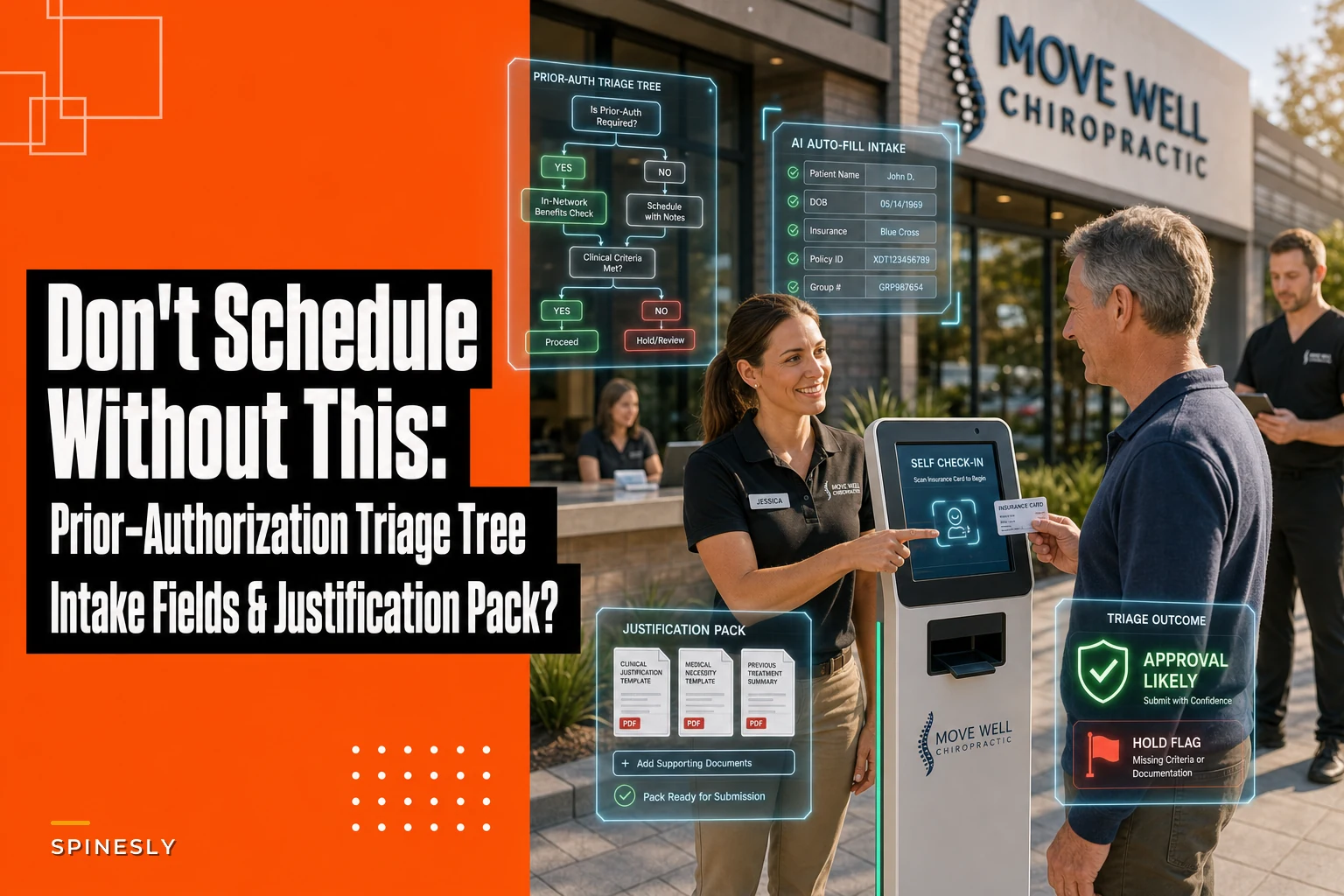
This is about building the gate that sits between "patient wants an appointment" and "patient is on the calendar." A decision tree that routes patients correctly, intake fields that actually feed your auth packet, and pre‑written justification snippets so your provider isn't reinventing the medical necessity language every single time.
The specific failure this fixes
Here's the pattern that burns clinics: a new patient with a plan that requires auth for anything beyond an initial eval gets booked for a full treatment series. Front desk sees "active insurance," books six visits, everyone's happy. Nobody checked whether visits 2 through 6 needed authorization, or whether the payer wanted the initial exam findings submitted first.
Three weeks later, visits 3, 4, and 5 come back denied. Not because the care was wrong — because the auth was never requested, or was requested with a two‑line justification that read "patient has back pain, requesting 12 visits."
What tends to happen across clinics is that the denial rarely comes down to the treatment not being justified. It happens because the timing and the documentation depth were wrong at intake. The clinical story was fine. The operational packaging failed.
A triage tree fixes the timing. The intake fields and justification snippets fix the packaging.
Why scheduling gating matters more than appeals
You can appeal denials all day. You'll win some. But appeals cost you 30–60 days of cash flow, staff hours, and a decent chunk of goodwill when the patient gets a surprise balance.
Never miss another patient appointment.
Spinesly helps you schedule, confirm, and manage every patient visit efficiently.
- Unified appointment management
- Automated patient reminders
- Staff and resource scheduling
No credit card required
| Approach | When it triggers | Staff time per case | Typical outcome |
|---|---|---|---|
| No gating (react at billing) | After 3–6 visits | 45–90 min of appeal work | Partial recovery, patient friction |
| Verify‑only (check benefits, no gate) | At booking, but no routing | 10 min, often skipped when busy | Catches obvious cases, misses auth‑required plans |
| Triage tree + doc pack | At booking, before commit | 5–8 min, standardized | First‑pass approval, no surprise balances |
The verify‑only middle row is where most clinics live, and it's deceptively dangerous. Checking benefits tells you the patient has coverage. It doesn't tell you the payer requires authorization for the specific care plan you're about to schedule. Those are two different questions, and the second one is where the money leaks. If you haven't tightened up your front‑desk verification yet, the insurance verification SOP is the foundation this whole system sits on.
The triage tree: how to route every new booking
The tree isn't complicated. It's a series of yes/no gates that any front‑desk person can run in a couple of minutes. The point is that it's consistent — the same patient scenario gets routed the same way every time, regardless of who's at the desk.
Here's the decision flow:
-
Is the patient's plan on your "auth‑required" list? If you don't have this list, build it. Pull your top 8–10 payers and note which ones require prior auth for chiropractic beyond the initial evaluation. This alone catches most of the risk.
-
If yes — what's the auth trigger? Some plans require auth after a visit threshold (say, visit 6). Others require it before any treatment beyond the exam. The trigger determines whether you can schedule the eval now and gate the rest, or whether you gate everything.
-
Is this an acute or maintenance presentation? Maintenance and wellness care is where denials cluster hard, because most plans won't authorize it. If the presentation looks like maintenance, that patient needs a different conversation up front — likely a cash or membership path, not an insurance booking.
-
Do you have the intake fields you need to submit the auth? If the required fields aren't captured, the booking is provisional — appointment held, not confirmed, until the auth packet is ready.
-
Route accordingly eval‑only booking, provisional full booking pending auth, or cash‑path conversation.
The key move is step 4's "provisional booking." A lot of clinics either book everything or book nothing. The provisional hold lets you reserve chair time while the auth clears, so you're not losing the slot and not committing to unpaid visits.
What "provisional" looks like in practice
The eval gets scheduled and confirmed. The follow‑up treatment visits get penciled in as holds with a flag: "auth pending — confirm by [date]." Your front desk knows not to send those as confirmed appointments until the auth is in hand. If the auth doesn't clear, you release the holds and rebook with a corrected plan. Nobody sat in a chair for a service that was never going to pay.
Intake fields that actually feed the auth packet
This is the part most clinics get wrong, and it's honestly the easiest to fix. Your intake form should capture the exact data your top payers require for authorization — not generic demographic fluff.
When intake and the auth requirement are disconnected, staff end up going back to the patient (or digging through exam notes) to reconstruct information that should've been captured on day one. That back‑and‑forth is where auths stall for a week.
Build your intake to capture, at minimum:
-
Mechanism and onset — when did this start, and how (injury, gradual, post‑surgical). Payers want specificity, not "chronic pain."
-
Prior conservative care — has the patient tried and failed other treatment? Many auths hinge on documented conservative care first.
-
Functional limitations — what can't the patient do now? "Can't sit longer than 20 minutes" beats "reduced function" every time.
-
Baseline outcome measure — an Oswestry or Neck Disability Index score at intake gives you the objective anchor payers look for.
-
Region and laterality — precise anatomical detail that maps cleanly to your coding and diagnosis.
-
Referral or prescription status — some plans require a referral for the auth to even be considered.
Capture baseline outcome measures at intake to avoid back‑and‑forth when assembling the auth packet.
These aren't billing fields. They're clinical justification inputs. When captured at intake in a structured way, building the auth packet becomes assembly, not archaeology.
The connection between clean intake data and fewer downstream denials is the same principle covered in the preventable denials RCM playbook — the front end determines the back end.
Templated clinical justification snippets
Your provider knows exactly why the care is medically necessary. But writing that out fresh, in payer‑friendly language, for every single auth request is a time sink — and under time pressure, the justification gets thin. Thin justification is what gets kicked back for "insufficient documentation."
The fix is a small library of pre‑built justification snippets your provider can pull from and customize. Not copy‑paste boilerplate that all reads identically (payers notice that), but structured starting points that already contain the elements a reviewer is looking for.
A justification snippet should have a consistent skeleton:
-
Objective findings (exam, ROM, ortho/neuro tests)
-
Diagnosis with specificity
-
Functional impact tied to the diagnosis
-
Treatment plan with frequency, duration, and goals
-
Expected outcome and reassessment point
A typical snippet for an acute lumbar case might frame it as: objective ROM restriction and positive ortho findings, specific diagnosis, functional limitations preventing work duties, a defined treatment frequency tapering over a set number of weeks, with a reassessment scheduled to justify continued care. The provider fills in the specifics; the structure is already payer‑shaped.
The point isn't to write the note for the provider. It's to make sure no required element gets left out when they're moving fast.
A real scenario
A mid‑size clinic — two DCs, roughly 320–360 visits a month — was running around a 22% auth‑related denial rate on their auth‑required plans. Most of those weren't clinical rejections; they were "no auth on file" or "insufficient documentation to support requested visits."
They did three things: built the auth‑required payer list, added the six intake fields above to their new‑patient form, and wrote eight justification snippets covering their most common presentations.
Over the next couple of months, the "no auth on file" denials basically disappeared because the triage tree caught those cases at booking. The "insufficient documentation" denials dropped more gradually as providers got comfortable pulling from the snippet library. Their auth‑related denial rate settled somewhere around 6–8%.
The bigger win wasn't even the denial rate. It was that the front desk stopped booking treatment plans that were doomed from the start, and patients stopped getting surprise balances. Fewer angry phone calls. Cleaner cash flow.
When this makes sense — and when it doesn't
This makes sense when a meaningful share of your patients come through plans that require authorization, and you're seeing denials that are administrative rather than clinical. If your denials are consistently "medical necessity not established" and the care genuinely is borderline, the triage tree won't save you — that's a clinical documentation problem, not a workflow one.
This is overkill when you're a mostly cash or membership‑based practice with light insurance volume. Building a full triage tree for the occasional insurance patient is more overhead than it's worth. A simple checklist for the handful of auth‑required cases is enough.
Who should not do this halfway: clinics that build the tree but don't enforce the provisional booking gate. If your front desk books everything as confirmed anyway because "the patient really wanted the times," you've built a decision tree nobody follows. The gate only works if it actually gates.
Where automation quietly earns its keep
None of this requires software to start — you can run the triage tree on a laminated sheet and keep the snippets in a shared doc. But the friction shows up at scale. Manually flagging auth‑required plans, remembering which intake fields feed which packet, keeping snippet libraries current across providers — that's where things drift.
This is where an operational platform with some AI‑assisted routing helps: intake fields that automatically populate the auth packet, triage logic built into the booking flow so the gate can't be skipped, and justification snippets that surface based on the diagnosis entered. The value isn't the automation itself — it's that the right process runs the same way every time, even on a Monday when the desk is slammed and someone's out sick.
Quick visual of the workflow:
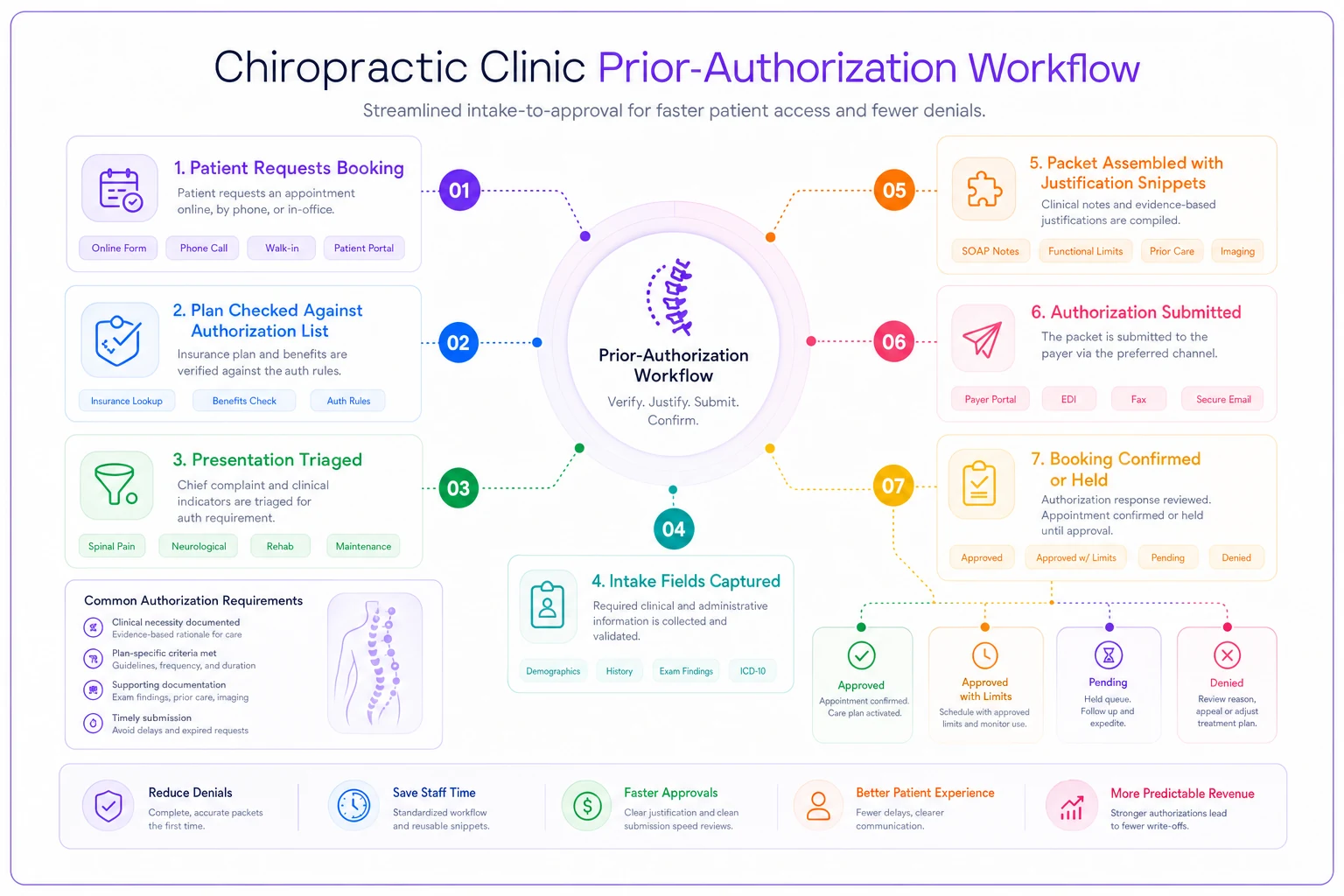
The workflow, whether you run it on paper or in software, is the same: patient requests booking → plan checked against auth list → presentation triaged → intake fields captured → packet assembled from snippets → auth submitted → booking confirmed or held. Get that sequence right and the technology is just a way to make it stick.
Start here
If you do nothing else this week, build the auth‑required payer list. It's an afternoon of work and it catches the single biggest source of these denials. Add the intake fields next. Write the snippets last, once you can see which presentations actually repeat in your patient mix.
Prior authorization triage for chiropractic isn't about working harder on appeals. It's about moving the decision upstream, to the one moment where you still have control — before the appointment is committed. That's the whole game.
Ready to streamline your chiropractic clinic operations?
Join 1,200+ clinics using Spinesly to save time, reduce scheduling errors, and improve patient care experiences.