


Most clinics that dabble in virtual care don't fail because telehealth is a bad idea. They fail because they never decided what to virtualize. They started offering "video visits" as a vague option, patients booked them for the wrong reasons, providers grumbled, billing got messy, and within a few months the whole thing quietly died. Nobody killed it intentionally. It just stopped making sense.
The clinics that get a hybrid care strategy for chiropractic right treat it as an operational filter, not a feature. Every visit type runs through a set of rules: this belongs virtual, this belongs in-person, this is a judgment call depending on where the patient is in their care. Then pricing, scheduling, and staffing all bend around those rules instead of fighting them.
That's what this article covers — the decision logic underneath the whole thing, not just "here's how to run a video call." If you've got a telehealth SOP in place and it feels bolted-on rather than integrated, this is the missing layer.
Start with the care path, not the technology
The mistake almost everyone makes is starting with "can we do this over video?" That's the wrong question. The right one is: what is the clinical purpose of this specific visit, and does that purpose require touch, equipment, or a room?
A new-patient exam where you're assessing gait, range of motion, palpating for restrictions, and running orthopedic tests — that's not a virtual visit, no matter how good your camera is. But a two-week follow-up where you're checking pain scores, reviewing home exercise compliance, and deciding whether to progress the plan? That's frequently a screen conversation, and forcing it into a chair-hour slot is quietly bleeding your schedule.
The pattern worth internalizing: the closer a visit is to hands-on treatment, the more it belongs in-person. The closer it is to assessment, education, coordination, or decision-making, the more it can live virtual. Most visits are a blend, and the art is figuring out which end of that spectrum each one actually sits on.
A simple care-path decision tree
-
Does this visit require physical treatment (adjustment, soft tissue, modalities)? → If yes, it's in-person. Stop here.
-
Does it require hands-on assessment you can't replicate visually (palpation, specific orthopedic tests)? → If yes, in-person. Stop here.
-
Is the primary purpose education, progress review, or plan adjustment? → If yes, it's a strong virtual candidate. Continue.
-
Is the patient stable, established, and comfortable with technology? → If yes, virtualize it. If no, keep it in-person or offer either.
-
Does virtualizing create a billing or documentation problem in your state/payer mix? → If yes, don't force it. The reimbursement headache isn't worth the saved room time.
That last step matters more than people expect. Plenty of visits could be virtual clinically but shouldn't be operationally because a specific payer won't cover them, or your state's telehealth rules around chiropractic are restrictive. The decision tree isn't purely clinical — it's clinical filtered through what your operation can actually bill and defend.
What actually maps to virtual in a chiropractic practice
When you run real visit types through that logic, a fairly consistent picture emerges.
Never miss another patient appointment.
Spinesly helps you schedule, confirm, and manage every patient visit efficiently.
- Unified appointment management
- Automated patient reminders
- Staff and resource scheduling
No credit card required
| Visit Type | Default Modality | Notes |
|---|---|---|
| New patient exam | In-person | Requires physical assessment; no exceptions early |
| Adjustment / manual therapy | In-person | Core hands-on treatment |
| 2–4 week progress check | Virtual-eligible | If stable and progressing per plan |
| Home exercise / rehab coaching | Virtual | Screen-share, form correction, easy to run remotely |
| Post-acute maintenance discussion | Virtual | Deciding on cadence, not treating |
| Flare-up triage | Either | Screen first to assess urgency, then route in-person if needed |
| Lifestyle / ergonomic consult | Virtual | Almost always better remote — patient shows their actual desk |
| Discharge / plan wrap-up | Virtual | Review outcomes, set maintenance expectations |
The row people underestimate is flare-up triage. A patient who tweaked their back over the weekend doesn't always need to grab your last open slot. A ten-minute video triage lets you figure out whether they need to come in today, tomorrow, or whether some at-home guidance holds them until their next visit. That single filter protects your acute-care capacity without turning away people who are actually hurting.
The ergonomic consult is a sleeper win too. Trying to fix someone's workstation in your office is basically guesswork — they describe their desk, you imagine it. On video, they point the camera at their actual monitor height and chair. Better advice, less time.
Pricing and packaging: don't let virtual become the discount tier
This is where clinics accidentally undermine themselves. They treat virtual visits as "less than," price them cheap, and train patients to see them as the budget option. Then patients start requesting video for things that genuinely need hands-on care, purely to save money, and now your clinical quality is being driven by a pricing mistake.
Better framing: virtual visits aren't cheaper care, they're different care with different cost structures. A progress-review video visit takes less room time and often less provider time, so the economics work at a modest price. But the value to the patient — convenience, no commute, no waiting room — is real. Price it to reflect that value, not just your cost savings.
-
- Bundle virtual check-ins into treatment plans. Instead of selling video visits à la carte, include them in a care package: "12 in-person visits plus 3 virtual progress reviews." The virtual touchpoints improve adherence and retention without eating a chair-hour.
-
- Use virtual as the retention bridge. When a patient wraps active care, a low-cost quarterly virtual maintenance check keeps them connected without asking them to commute for something that's mostly a conversation.
-
- Cash-pay ergonomic and lifestyle consults. These often sit outside insurance anyway, so a flat cash rate for a focused remote consult is clean and margin-friendly.
Avoid creating a lower-priced "virtual version" of an in-person treatment; instead price virtual services for their distinct value (convenience, time-savings, focused scope).
The mistake to avoid is offering the same clinical service at two prices depending on modality. If an adjustment is $65, you can't have a "$45 virtual version" — there is no virtual version of an adjustment. Keep modalities tied to distinct services and the pricing confusion mostly disappears.
When virtual pricing actually makes sense
It works when the visit has a clear standalone purpose — education, review, coordination — that patients recognize as valuable on its own. It falls apart when you're using it to discount something that should be in-person, or when you price it so low it's not worth the provider's time to prep, run, and document.
Governance: the part everyone skips until it breaks
Deciding what to virtualize is maybe 20% of the problem. The part that determines whether hybrid care actually survives is governance — the rules that keep quality, scheduling, and staffing consistent across two modalities. Without them, you don't have a hybrid strategy. You have two disconnected clinics sharing a patient list.
Quality governance
The risk with virtual visits is quiet quality drift. Because there's no room, no table, no physical ritual, providers can start treating them casually — a quick chat, loose documentation, no outcome tracking. That's how virtual visits become clinically hollow.
The fix is holding virtual visits to the same documentation and outcome standard as in-person ones. If you're tracking pain scores and functional outcomes for in-person care — and you should be, in a structured way, which is worth reading up on in this breakdown of a practical clinical outcomes system for small clinics — those same instruments run on virtual visits too. A progress review is for capturing outcomes. If it's not generating that data, it's a phone call, not a clinical encounter.
Set a rule: every virtual visit produces a documented note, a captured outcome measure where relevant, and a clear next-step decision. No exceptions. The moment virtual becomes the "note-optional" modality, quality governance is gone.
Scheduling governance
Mixing virtual and in-person visits in the same provider's schedule without buffers creates a real mess. A provider finishing an adjustment can't instantly pivot to a focused video visit — they need a moment to switch context, get to a quiet space, pull up the right screen. Skip that and virtual visits run late, which cascades into the in-person slots behind them.
-
- Block virtual visits together. Cluster them into a dedicated window — mid-morning or end of day — rather than scattering them between adjustments. The provider stays in one mode.
-
- Protect a triage slot. Keep a short daily virtual window open for flare-up triage. It gives you a pressure-release valve for acute requests without cannibalizing treatment capacity.
Clinics that scatter virtual visits randomly across the day almost always report that telehealth "slows everything down." It's not telehealth. It's the context-switching cost of bouncing between modalities with no structure.
Staffing governance
Someone has to own the hybrid workflow, and it usually isn't the provider. The front desk needs clear rules for which visit types they're allowed to book as virtual, which require a screening question first, and what to say when a patient requests virtual for something that needs to be in-person. Without those rules, your booking staff are making clinical routing decisions they're not equipped to make.
A workable setup: the front desk books directly for clearly-virtual visit types — progress reviews, ergonomic consults, maintenance checks. For anything ambiguous — a new symptom, a flare-up, an unfamiliar patient — they route to a quick screening step before confirming modality. Clinical judgment stays with someone qualified; routine bookings flow without bottlenecks.
This kind of cross-functional coordination is exactly what separates clinics that scale cleanly from ones that get tangled up in their own workflows. It connects directly to the ideas in mapping the four operational systems that let clinics scale — hybrid care is one workflow that touches all of them simultaneously: intake, scheduling, clinical delivery, and billing.
Where the tooling actually helps
Once your rules exist, keeping them consistent by hand is the hard part. A front desk that's slammed on a Monday morning isn't going to reliably apply a five-step routing tree from memory. This is where operational software earns its keep — not by making decisions for you, but by encoding the rules you've already made so they get applied every time.
In practice that means booking flows that only surface "virtual" as an option for visit types you've cleared for it, automated screening questions that route ambiguous requests before a slot gets confirmed, and reminders that flag when a virtual visit is missing documentation or an outcome measure. The value isn't automation for its own sake — it's that your governance rules stop depending on whether a busy human happened to remember them.
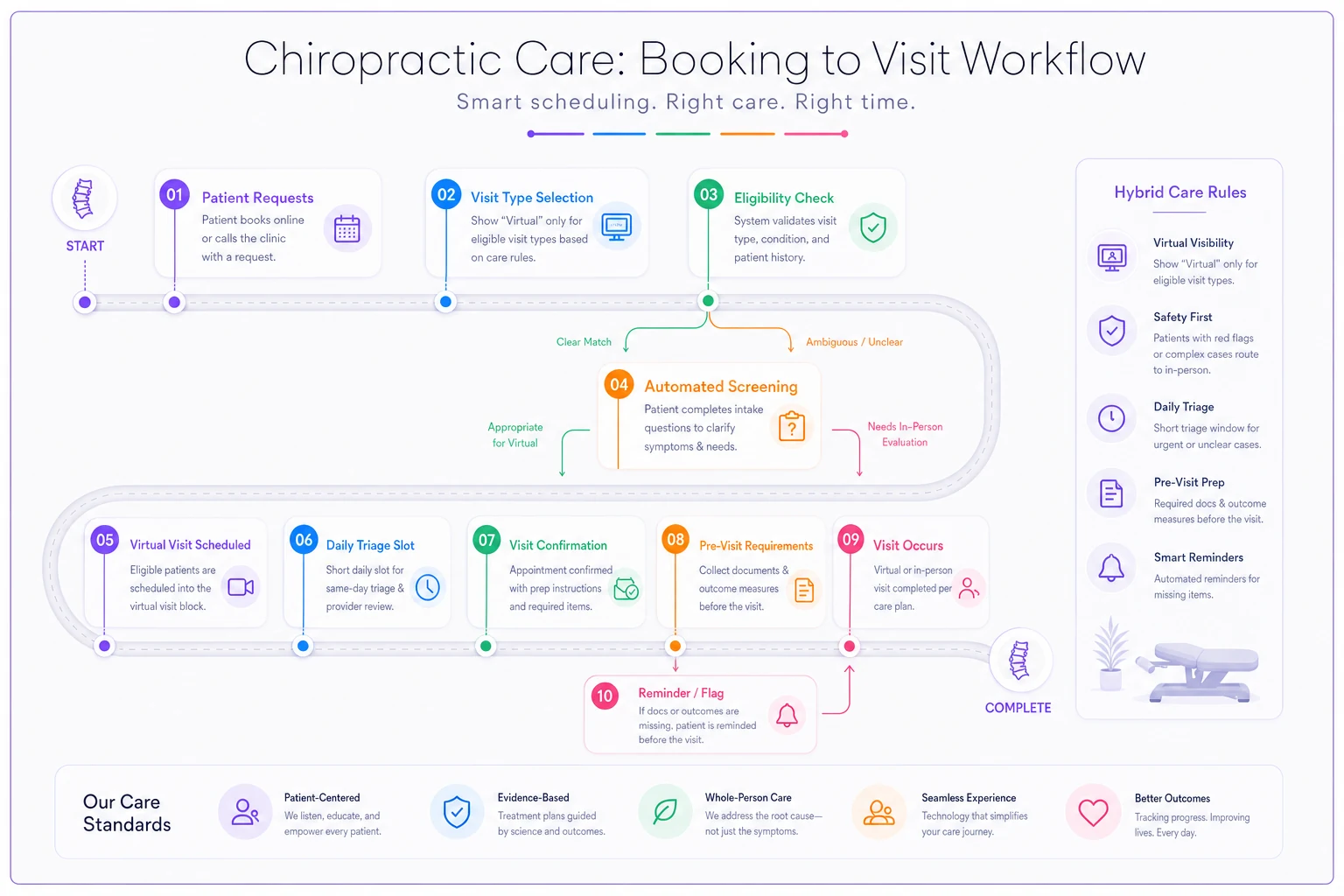
This quick visual maps the booking-to-reminder workflow described above.
Clinics that struggle with hybrid care usually have good rules living in someone's head or in a document nobody opens. The ones that scale it have those same rules quietly enforced in the workflow, so consistency doesn't erode the moment things get busy.
A real scenario
A two-provider clinic running roughly 320–350 visits a month, all in-person. Their acute schedule was constantly jammed — flare-up patients couldn't get seen same-day, and their last-minute openings were being filled by simple progress checks that didn't need a room.
They applied a basic version of the decision tree: progress reviews past week two, ergonomic consults, and maintenance discussions moved to a virtual block at the end of each day, plus a short daily triage window for flare-ups. Adjustments and new-patient exams stayed exactly where they were.
Over the next couple of months, roughly 15–20% of follow-up volume shifted to virtual. That freed up something like six to eight chair-hours a week — enough to actually see acute patients same-day again. Retention on wrapped-up cases improved noticeably too, mostly because the low-friction virtual maintenance check kept people from disappearing entirely. Revenue didn't spike dramatically, but the mix got healthier: more acute capacity, better adherence, fewer wasted slots.
The interesting part wasn't the technology. It was that they finally decided what belonged where, and then held to it.
Who should not do this
Hybrid care isn't for every clinic. If you're running a mostly-acute, high-volume adjustment practice where nearly every visit is hands-on, virtual visits will be a distraction with limited upside — you don't have enough review-and-education encounters to make the operational overhead worth it.
It's also a bad idea if your payer mix makes telehealth reimbursement a minefield, or if your in-person documentation is already inconsistent. Adding a second modality on top of shaky documentation habits just doubles the mess. Fix the foundation first, then layer hybrid care onto a system that's already running clean.
The takeaway
A hybrid care strategy isn't a telehealth feature you switch on. It's a set of decisions — what gets virtualized, how it's priced, and the governance that keeps quality, scheduling, and staffing consistent across both modalities. Get the decision tree right and the rest has something to hang on. Skip it, and you end up with the same outcome as most clinic telehealth experiments: a good idea that quietly stopped making sense because nobody ever decided what it was for.
Start with the care path. Filter it through what you can actually bill and defend. Then build the rules that make it repeatable when your front desk is slammed and your providers are booked. That's the difference between offering virtual visits and actually running a hybrid practice.
Ready to streamline your chiropractic clinic operations?
Join 1,200+ clinics using Spinesly to save time, reduce scheduling errors, and improve patient care experiences.