



Most clinics treat discharge like an off-ramp. The patient feels better, the acute plan ends, someone mumbles "come back if it flares up," and that chart goes quiet. Six months later that same person is Googling a competitor two towns over because their lower back is acting up again and they honestly forgot the name of the person who fixed it last time.
That gap — between "clinically done" and "operationally done" — is where a huge chunk of clinic lifetime value leaks out. And it's almost never a clinical problem. The adjustment was fine. The outcome was good. What failed was the handoff from active care to ongoing relationship.
Patient discharge monetization isn't about squeezing extra visits out of people who don't need them. It's about building a decision flow that cleanly separates who should keep coming (and in what structure), who should go home with a maintenance plan, and who should genuinely be released — then packaging those paths so the front desk, the provider, and your billing all point the same direction. Done right, it increases retention without making anyone feel upsold.
The real failure: discharge is a judgment call with no system behind it
In most practices, the clinical discharge decision lives entirely in the provider's head. One doctor discharges at visit 8, another drags people to visit 20, a third never formally discharges anyone and just lets the schedule thin out on its own. There's no shared definition of "done," so there's no consistent moment to introduce what comes next.
-
The front desk never knows when to offer a maintenance plan, so they don't.
-
Providers feel weird "selling" at the end of care, so they soften it into "we'll see how you feel," which converts almost no one.
-
Revenue becomes entirely dependent on new-patient flow, because you're not recapturing value from people you already helped.
A clinic doing roughly 300–350 visits a month might discharge 15–25 patients in that same window. If even half of those people walk out with no structured next step, you're quietly resetting a big portion of your base every single month and backfilling it with expensive acquisition. That's the math that keeps owners stuck on the marketing treadmill.
The fix starts by making the clinical decision explicit, then attaching a business decision to it.
Step one: a clinical discharge checklist that creates a real trigger
Before you can monetize discharge, you need a consistent clinical definition of when a patient is ready for it. This isn't about overriding provider judgment — it's about giving that judgment a shared checkpoint so the rest of the clinic can react.
Never miss another patient appointment.
Spinesly helps you schedule, confirm, and manage every patient visit efficiently.
- Unified appointment management
- Automated patient reminders
- Staff and resource scheduling
No credit card required
A workable discharge-readiness checklist usually includes:
-
Symptom resolution threshold met — patient reports pain/function at or near their stated goal for 2+ consecutive visits
-
Objective measure stable — range of motion, functional outcome score, or activity tolerance holding, not just "feels better today"
-
Visit frequency already stepped down — you've successfully spaced them out (e.g., from 2x/week to 1x/every-other-week) without regression
-
Self-management in place — patient knows their home exercises and understands their own flare-up triggers
-
No active red flags requiring referral or continued acute care
When these boxes check, that's your trigger. Not a vibe. A trigger. And because it's defined, it can fire a workflow instead of dying in the room. If you don't already have a clean way to capture those objective measures, it's worth building that in first — the approach in a practical clinical outcomes system for small chiropractic clinics pairs directly with this, because discharge decisions get a lot more confident when you're tracking function instead of guessing.
Document the discharge-readiness checklist in the chart as a quick flag so providers can trigger the downstream workflow without remembering extra steps.
One thing most clinics miss: the discharge conversation should start one or two visits before actual discharge, not on the last day. When you spring "okay you're all done, want to sign up for maintenance?" on someone cold, it feels transactional. When you've been saying "we're almost there, let's talk about keeping you here" across the final stretch, it feels like the natural end of a relationship.
Step two: decide what you're actually offering at discharge
Once the trigger fires, the patient should be routed into one of three buckets. The mistake is treating everyone as a membership candidate — they're not.
| Discharge path | Who it fits | Structure | What it protects |
|---|---|---|---|
| Membership maintenance | Patients with chronic/recurring issues, physically demanding jobs, or who clearly value routine care | Monthly recurring, 1–2 visits/month at a bundled rate | Predictable revenue + high retention |
| Episodic maintenance | Patients who respond well but only flare occasionally; price-sensitive; don't want commitment | Pre-paid visit pack or "come back when needed" with proactive recall | Keeps them in your orbit without pressure |
| Full discharge | Acute, one-off issue; strong self-management; low recurrence risk | Released with a recall check-in at 90–180 days | Trust, referrals, and clean clinical ethics |
The membership-vs-episodic distinction is the whole ballgame. Membership gives you recurring revenue and smooths out your schedule, but you can't force it on someone whose body and budget don't support monthly care. Episodic is lower revenue per patient but far more patients are eligible for it — and if you work the recall properly, episodic patients quietly become your most reliable rebooking source.
That episodic path only works if your recall engine actually runs. This is where a lot of clinics drop the ball — they "discharge to episodic" and then never contact the person again. The segment-based approach in turning recalls into revenue with rebooking workflows is what keeps that bucket from becoming a dead-letter file.
Step three: scripts that don't make the provider feel like a salesperson
The single biggest reason discharge monetization fails is that providers hate the pitch. So they don't give it, or they give it so apologetically it collapses. The fix is scripting it around the patient's goals, not your revenue.
For membership-eligible patients (said over the final 2 visits): > "You've done really well — we've gotten you from [starting point] to where you are now. The thing I care about is you not ending up back here in pain in four months. For people with [their condition/job], the folks who stay well are the ones who come in once or twice a month for upkeep. Can I show you how our maintenance plan works so you can decide?"
For episodic patients: > "I don't think you need to keep a regular schedule — you're in a good spot. But [their issue] does tend to come back, so I'd rather you have a plan. I'm going to put you on a check-in list, and if anything flares up, you call us and we get you in fast. Sound good?"
For full discharge: > "You're officially graduated — nice work. We'll check in with you in a few months just to make sure things are holding. And if anything comes up before then, you know where we are."
Notice what's missing: pressure. The membership script explicitly offers to show the plan rather than closing. The episodic script sets up a future contact as a favor to them. The provider is giving clinical guidance that happens to have a business structure attached — which is a completely different posture than selling.
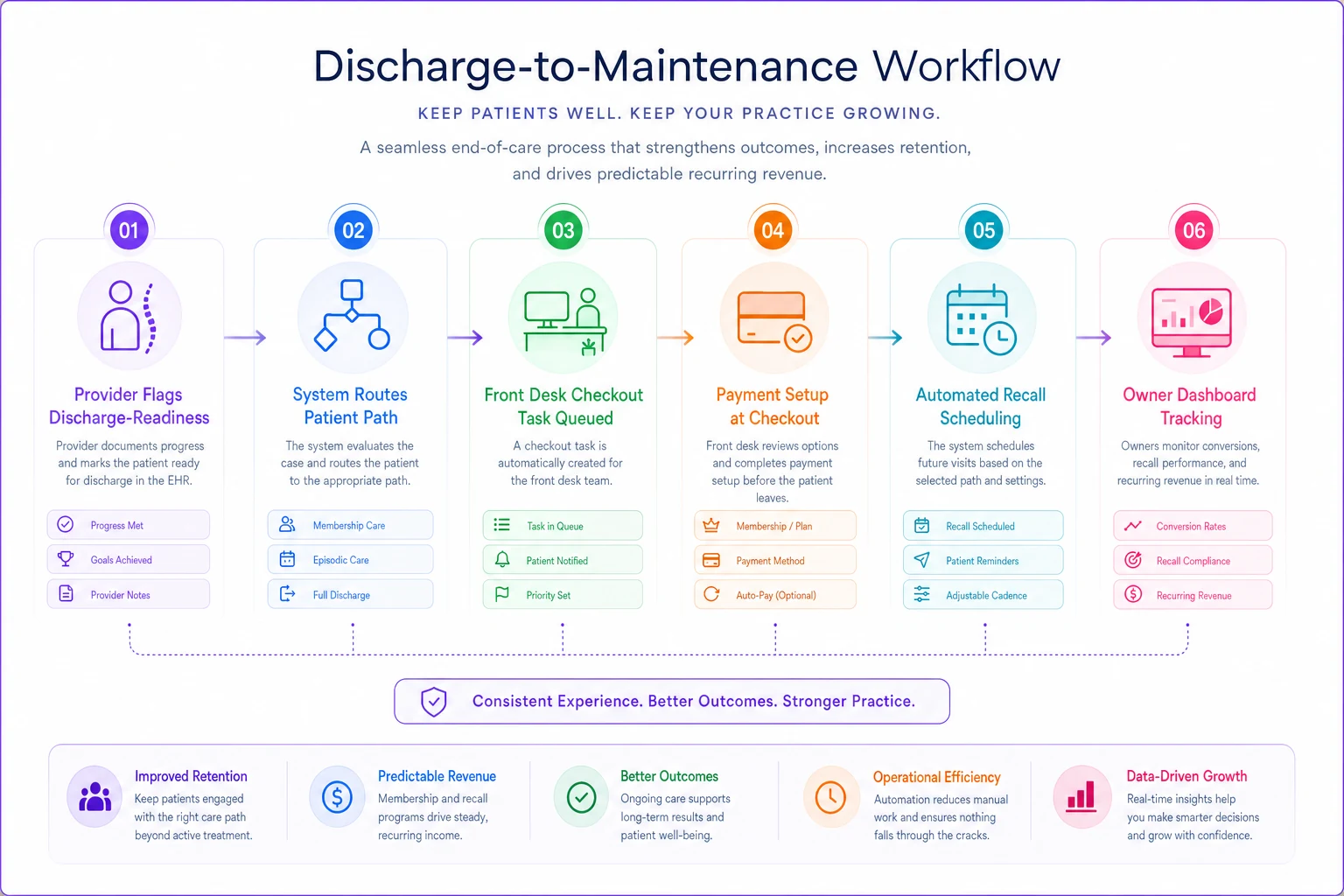
Step four: the operational triggers that make it run without you watching
A discharge system that depends on everyone remembering to do the right thing will fall apart in about three weeks. What holds it together is a short chain of triggers that each hand off to the next person automatically.
-
Provider flags discharge-readiness in the chart (the checklist above). This is the single manual input the whole system depends on.
-
System routes the patient to one of the three buckets based on the provider's selection (membership / episodic / discharge).
-
Front desk gets a task at that patient's next checkout — not a mental note, an actual queued action — telling them which conversation and which offer to present.
-
Payment setup happens at checkout, not later. Membership = card on file and recurring billing started. Episodic = visit pack sold or recall date set. Discharge = recall date set.
-
Recall sequence schedules automatically for episodic and discharge patients (e.g., a check-in text at 90 days, a follow-up at 150 if no response).
-
Owner dashboard tracks discharge-bucket conversion monthly so you can see which providers route well and which quietly skip the step.
This works because it removes decision fatigue. The provider makes one call. Everything after that is handoff, not initiative. In real operations, the failure point is almost always step 3 — the front desk never gets a clear instruction, so the moment passes. Queuing the task to the specific checkout, with the specific script and offer, is what closes that gap.
Here's a quick visual of that workflow:
AI-powered operational software earns its keep right here. Routing the flag, queuing the checkout task, starting recurring billing, and firing the recall sequence are exactly the repetitive coordination steps that fall apart when they live in someone's memory. You don't need anything exotic — you need the handoffs to be automatic so the system survives a busy Tuesday.
When membership maintenance actually makes sense (and when it doesn't)
It makes sense when:
-
A real slice of your patient base has chronic or recurring conditions
-
You have schedule capacity to absorb low-intensity recurring visits without crowding out acute care
-
Your providers genuinely believe in maintenance care for the right patients (if they don't, it'll show)
It's a bad idea when:
-
You'd be pushing monthly care on predominantly acute, one-and-done patients just to hit a membership number
-
Your schedule is already jammed and maintenance visits would displace higher-value new-patient slots
-
You haven't defined the clinical trigger yet — selling memberships without a discharge standard is how you end up with angry patients and compliance questions
Who should not build this first: a clinic that's still leaking new patients at the front door or struggling with no-shows. Discharge monetization amplifies retention, but if you're not successfully treating people to a good outcome consistently, there's nothing to monetize at the back end. Fix the clinical funnel first, then build the graduation ramp.
A realistic look at the LTV and retention impact
Let's model a mid-sized clinic doing around 320 visits a month, discharging roughly 20 patients monthly, with no structured back-end today.
Before: Those 20 discharged patients mostly disappear. Maybe 3–4 drift back on their own within a year. Everyone else is effectively a lost asset you paid acquisition cost to get.
After implementing the three-bucket flow, a reasonable — not heroic — outcome looks like:
-
~5 of 20 convert to membership at, say, $85/month → roughly $425/month in new recurring revenue added each month it runs
-
~8 of 20 route to episodic with an active recall → maybe half come back within 6 months for a short paid flare-up series
-
~7 of 20 fully discharge with a recall check-in → a chunk of these become referral sources precisely because you released them honestly
The membership line alone compounds — because it stacks. By month six you're not looking at $425, you're looking at several months of accumulated memberships minus normal churn, often landing somewhere in the low thousands of recurring monthly revenue that simply didn't exist before. On a per-patient basis, a discharged patient's lifetime value shifts from "whatever that acute episode billed" to "that episode plus an ongoing or recaptured relationship."
The retention number people chase is "patient lifetime," and discharge engineering is one of the few levers that moves it directly. If you want to connect this back to overall economics — how recurring revenue and payer mix interact with your chair capacity — the scenario modeling in turning chair hours and payer mix into profit is the natural companion, because maintenance visits change your utilization math.
A short real scenario
A two-provider clinic, roughly 300 monthly visits, was discharging people informally and backfilling almost entirely through ads. Monthly new-patient spend was climbing and their active-patient count was flat — classic treadmill.
They did one thing: defined a discharge-readiness checklist and routed every graduating patient into membership, episodic, or full discharge, with a scripted conversation starting two visits before the end.
Within about four months, they had somewhere around 18–22 active maintenance members and a working recall list feeding episodic rebookings. The front desk stopped improvising the "so you're all done" conversation because it was queued for them at checkout with the right offer. Nothing about the clinical care changed. What changed was that patients they'd already helped stopped vanishing — and the owner noticed the schedule was fuller on slow days without spending another dollar on acquisition.
The checklist to stand this up
If you want to build this in your clinic, work down this list in order:
-
[ ] Write a shared, written discharge-readiness definition (the clinical checklist) every provider agrees to
-
[ ] Decide your three buckets and your rules for sorting patients into each
-
[ ] Set membership pricing and episodic visit-pack pricing that your market and schedule can actually support
-
[ ] Write the three scripts and practice them until they feel natural, not salesy
-
[ ] Decide the exact checkout task and payment action for each bucket
-
[ ] Build the recall sequence for episodic and discharged patients (timing + messages)
-
[ ] Automate the handoffs so the provider's flag triggers everything downstream
-
[ ] Track bucket conversion monthly by provider and adjust
The list is short on purpose. Most clinics that fail at this do so because they try to build five systems at once and finish none of them. Work through it in order, get each step actually functioning before moving to the next, and you'll have a real system inside two months.
The real takeaway
The patients you've already successfully treated are the cheapest, warmest, most trusting revenue in your entire practice — and most clinics let them walk out the door with a shrug. Discharge isn't the end of care. It's a fork in the road, and the only question is whether your clinic has a system standing at that fork pointing people toward the right next step, or whether it leaves every graduating patient to figure it out alone.
Build the trigger. Define the buckets. Script the handoff. Automate the coordination so it survives your busiest day. Do that, and the back end of your practice stops being a leak and starts being one of your most dependable sources of growth.
Ready to streamline your chiropractic clinic operations?
Join 1,200+ clinics using Spinesly to save time, reduce scheduling errors, and improve patient care experiences.