


Most chiropractic clinics don't lose money on balances they never billed. They lose it on the ones they billed once, sent a single statement for, and then let drift into the 90+ column while the front desk stayed buried in today's schedule. By the time anyone notices, that $180 patient balance from March is buried under 60 newer accounts, the patient may have moved, and the practice just writes it off as not worth chasing.
The 31–180 day window is where aged a/r recovery clinic work actually pays off. Under 30 days is mostly waiting. Past 180, the odds drop hard and collections agencies start looking like the easier option. In between is a stretch where a structured, human sequence still recovers most of what's owed — if you actually run one.
This is that sequence. Buckets, scripts across email, SMS and phone, escalation rules, hardship handling, and rough recovery benchmarks so you know when a balance warrants another touch and when it doesn't.
Why owner-operators lose this money specifically
Bigger groups have a dedicated biller whose whole job is working the aging report on a schedule. In a two-to-four provider clinic, the same person handling insurance verification, posting payments, and answering the phone is "supposed to" work old balances "when there's time." There's never time.
So the pattern looks like this: statement goes out at day 20, maybe another at day 50, then silence. No call. No text. No real escalation. The account just ages. What owners tend to underestimate — a patient who owed $95 in April and heard nothing for three months has mentally closed that chapter. When you finally call in July, you're not collecting a balance anymore. You're reopening a debate.
The other piece is emotional. Providers hate feeling like bill collectors, especially with patients they still see regularly. So they avoid the conversation, or they're so apologetic on the phone that the patient picks up on the hesitation and stalls. A defined script removes that awkwardness because you're following a process, not improvising a confrontation.
Worth noting — a lot of these balances shouldn't have become patient responsibility in the first place. Many are leftover from denials and eligibility gaps. If your 31–180 bucket keeps filling with the same avoidable errors, the cadence below treats the symptom. The fix lives upstream in your operations-first RCM playbook.
The three buckets and what each one is really worth
Don't treat a 40-day balance the same as a 160-day balance. The intensity, channel mix, and expectations change significantly as accounts age. Here's the framework, with rough recovery ranges to benchmark against.
Never miss another patient appointment.
Spinesly helps you schedule, confirm, and manage every patient visit efficiently.
- Unified appointment management
- Automated patient reminders
- Staff and resource scheduling
No credit card required
| Bucket | Age | Primary channels | Touch frequency | Realistic recovery rate | Owner involvement |
|---|---|---|---|---|---|
| Tier 1 | 31–60 days | Statement + SMS + email | Every 10–12 days | ~70–85% | None |
| Tier 2 | 61–120 days | Phone-led, SMS/email support | Every 7–10 days | ~45–60% | Occasional |
| Tier 3 | 121–180 days | Live call + written final notice | Every 5–7 days | ~20–35% | Yes, on larger balances |
Those recovery numbers apply to patient-responsibility balances that are clean and undisputed. If a chunk of your Tier 2 and 3 is actually stuck on insurance follow-up, pull those out and work them separately — they don't belong in a patient outreach cadence at all.
The single biggest lever is speed into Tier 1. Clinics that start structured outreach at day 31 instead of day 70 routinely recover a noticeably larger share, because the balance is still fresh and the card on file often still works.
Tier 1 (31–60 days): make it easy, keep it warm
This tier is about friction removal, not pressure. The patient probably intends to pay and just hasn't gotten around to it, or the statement got lost somewhere. Your job is to put a pay link in front of them on a channel they actually check.
SMS (day 32): > Hi [Name], this is [Clinic]. You have a balance of $[amount] from your visit on [date]. You can pay securely here: [link]. Questions? Just reply to this text.
Email (day 42) — subject: "Quick note about your [Clinic] balance": > Hi [Name], we wanted to make sure this didn't slip through the cracks. Your remaining balance is $[amount] for services on [date], after insurance processed. You can pay online in about a minute here: [link], or call us at [number] if anything looks off. Thanks for trusting us with your care.
SMS (day 54): > Hi [Name], friendly reminder your $[amount] balance is still open. Pay here: [link], or reply "PLAN" and we'll set up smaller monthly payments.
No urgency language, no threats, and a payment-plan door opened early. Offering a plan in Tier 1 catches the people who genuinely can't pay $210 today but would happily do $35 a month — and it keeps that account from ever reaching Tier 3.
Tier 2 (61–120 days): the phone does the heavy lifting
Texts and emails have diminishing returns past 60 days. If two SMS messages and an email didn't move it, a third won't either. This is where a live call becomes the workhorse. Clinics that skip calling and just keep re-sending statements are the ones with a bloated 90+ column.
Keep the call short, factual, and give the patient a clear path. A rough script: > "Hi [Name], this is [Name] from [Clinic]. I'm calling about a balance of $[amount] from your visit on [date]. I wanted to check in before it got any older — is now an okay time? … Great. Insurance covered their portion, and this is what's left on your end. We can take care of it a couple of ways — I can text you a secure pay link right now, or if it's easier we can split it into monthly payments. Which works better for you?"
Two things make this work. First, lead with the exact amount and visit date — vagueness invites "I don't remember that." Second, present two options instead of asking "can you pay?" A yes/no question gets a no. A "which of these?" question gets a decision.
If you hit voicemail, leave one, then follow with an SMS the same day: > Hi [Name], [Name] from [Clinic] here — left you a voicemail about your $[amount] balance. Easiest way to sort it is this link: [link], or call me back at [number]. Happy to set up payments too.
For a two-provider clinic, Tier 2 usually means somewhere around 15–30 accounts at any given time. That's roughly 45 minutes of calls, twice a week. It's genuinely one of the highest-dollar-per-minute tasks in the whole practice, and it's almost always the first thing that gets skipped.
Tier 3 (121–180 days): direct, documented, final path
By this point you need to be honest about which balances are actually recoverable. Small balances under $40–$50 often cost more in staff time to chase than they return — batch those into one final combined touch and prepare to write them off. Put your energy on the larger accounts.
Tier 3 needs a live conversation and a written final notice on file. Both because it's the fair thing to do and because it protects you if the account eventually goes to collections. The call is warmer than people expect but clear about what happens next: > "Hi [Name], this is [Name] from [Clinic]. I'm reaching out one more time about the $[amount] balance from [date]. I want to get this resolved with you directly rather than send it anywhere else. I can set you up on a payment plan for as little as $[X] a month starting today — would that work?"
Then a written final notice by email and mail: > Your account shows a past-due balance of $[amount] for services on [date]. To avoid this being referred to an outside collections partner, please contact us by [date, ~10–14 days out] to pay or arrange a payment plan. We'd much rather resolve this with you directly.
The escalation date has to be real. Empty deadlines train patients to ignore you. If you say collections by the 15th, either a plan is in place or the account moves on the 16th.
Escalation rules that keep the cadence honest
The whole system falls apart without clear triggers. Otherwise every account gets "one more try" forever and nothing resolves. Rules like these keep it moving:
-
No response after 3 Tier 1 touches → move to Tier 2 and assign a live call, don't just keep texting.
-
Two failed call attempts + one voicemail with no callback in 10 days → escalate touch frequency, not just repeat the same contact.
-
Any patient who says "I can't pay right now" → immediately route to a hardship plan (below) and pause the standard cadence.
-
Balance under your write-off threshold at 150+ days → one final combined notice, then write off.
-
Balance over ~$250 at 170 days with no plan → owner reviews personally before any collections referral.
-
Any dispute about the charge itself → pull out of the collections cadence entirely and route to billing review. You may have a coding or eligibility problem, not a payment problem.
That last rule matters more than it looks. A meaningful slice of "unpaid" balances are from patients who genuinely believe the charge is wrong — and sometimes they're right. Chasing those as collections just creates an angry patient. Fixing the underlying billing accuracy keeps them.
Hardship plans: your best recovery tool, not your fallback
Owner-operators tend to treat payment plans as a reluctant concession offered at the end of a failed conversation. Flip that thinking. A patient on a $40/month plan recovers 100% of the balance over time. A patient you pressured into "pay in full or nothing" often becomes nothing.
-
Balances under $150 up to 3 monthly payments, no questions asked.
-
Balances $150–$400 up to 6 monthly payments, card kept on file for auto-charge.
-
Balances over $400 custom plan, owner sign-off, minimum monthly amount set so it clears within 12 months.
-
Genuine financial hardship (job loss, medical situation) offer a one-time settlement — collecting 60–70% now often beats chasing 100% for a year.
Keep the card on file and set up auto-charges whenever possible to drastically improve plan completion rates.
Two operational must-haves: keep a card on file so payments run automatically instead of relying on the patient to remember, and put every plan in writing (a short SMS confirmation is enough). Plans that depend on the patient actively paying each month fail at a much higher rate than auto-charged ones.
When NOT to run this cadence
A few situations where this whole sequence is the wrong tool:
-
The balance is really an insurance problem. If the payer never processed correctly, no amount of patient texting fixes it. Sort the claim first.
-
The charge is genuinely disputed and you haven't reviewed it. Chasing a possibly-wrong balance damages trust and can backfire badly.
-
The balance is tiny and old. A $22 balance at day 160 isn't worth three staff touches. Batch and write off.
-
You have no clean data on who owes what.
Nothing burns goodwill faster than dunning someone who already paid.
A quick real-world picture
A three-provider clinic had roughly $18k–$22k sitting in the 60–180 day patient-responsibility column, most of it untouched after the initial statements. No calls, occasional second statements, and a growing habit of writing off anything past 120 days.
They didn't add staff. They carved out two 45-minute blocks a week for Tier 2 calls, started Tier 1 SMS at day 32 instead of relying on mailed statements, and let the front desk offer payment plans up to $400 on the spot without checking with the owner.
Over about four months, they recovered somewhere in the $11k–$13k range from that stale balance. More importantly, they stopped feeding the 120+ column because most accounts were now getting a real call before they aged that far. The write-off pile shrank to genuinely uncollectible small balances instead of "we ran out of time" ones.
Keeping the cadence running without it eating your week
The reason this system decays isn't that anyone disagrees with it. It's that manually tracking which account is on which touch, on which day, across three channels, is a job the front desk simply doesn't have capacity for. Accounts fall out of sequence, follow-ups get missed, and within a couple months you're back to sporadic statements and a growing 90+ column.
Clinic software that handles the mechanical parts earns its keep here — automatically bucketing accounts by age, scheduling the SMS and email touches, flagging which accounts need a live call today, and logging every contact so nothing gets worked twice or quietly forgotten. The goal isn't to automate the human calls, which still recover the most money. It's to make sure the right accounts surface at the right moment so your team spends its limited time on conversations that actually collect, not on hunting through the aging report to figure out who to call next.
Whatever you use to run it, tie the results to the numbers you already track. Recovery rate per bucket, days-in-A/R, and the size of your 120+ column belong right alongside everything else on your owner-focused KPI dashboard — so the aging report never quietly balloons again.
Here's a simple visual of the workflow to keep the cadence running smoothly:
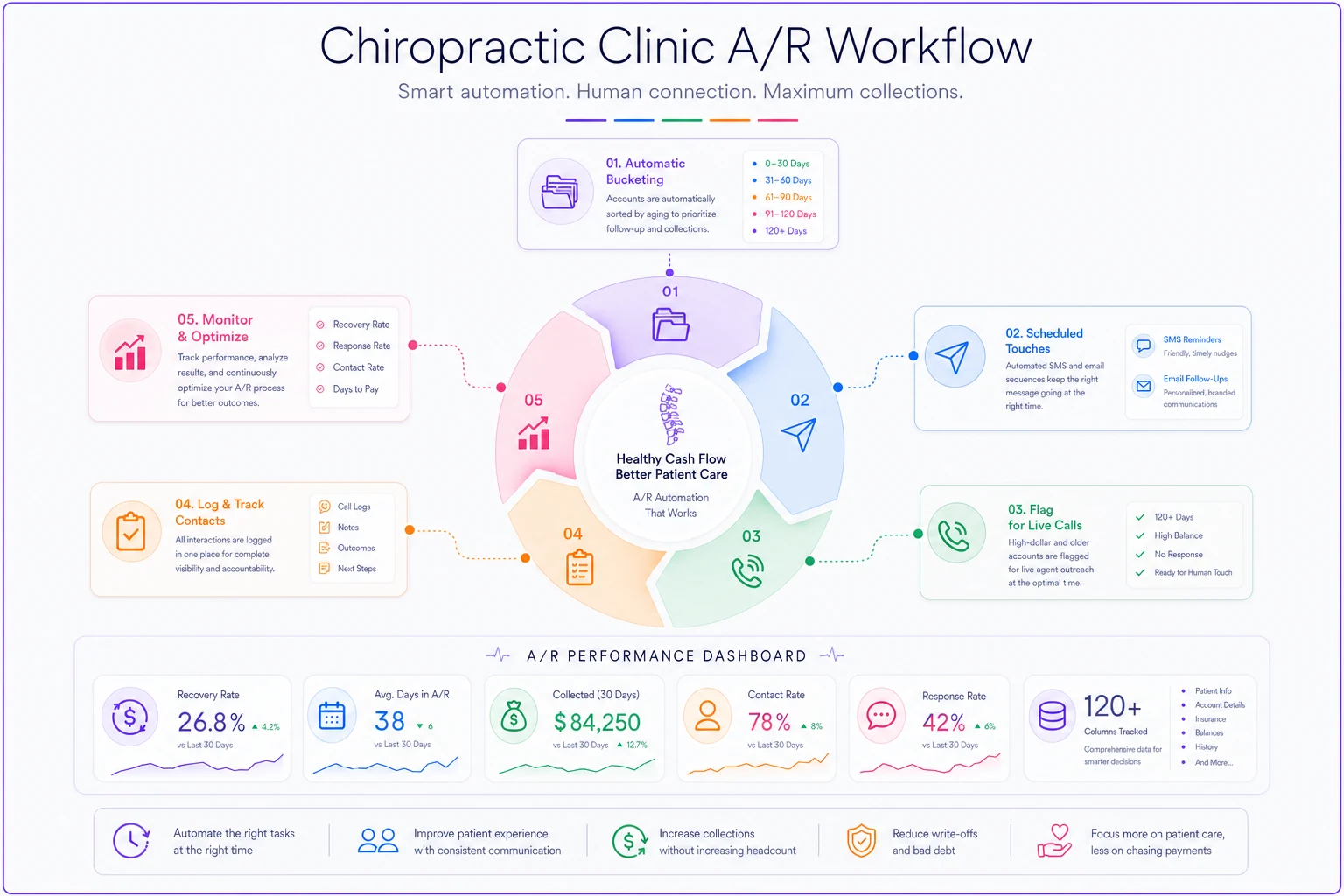
The image shows how automation surfaces the right accounts so staff time focuses on live conversations that collect, not on finding who to call next.
The 31–180 day window is recoverable money that most small clinics leave on the table — not because the balances are hard to collect, but because nobody owns a repeatable sequence. Set the buckets, use the scripts, enforce the escalation dates, and lean on payment plans instead of treating them as a last resort. Do that consistently and you'll pull a solid share of those aging balances back into the practice, while the ones you do write off will genuinely be the ones not worth chasing.
Ready to streamline your chiropractic clinic operations?
Join 1,200+ clinics using Spinesly to save time, reduce scheduling errors, and improve patient care experiences.