
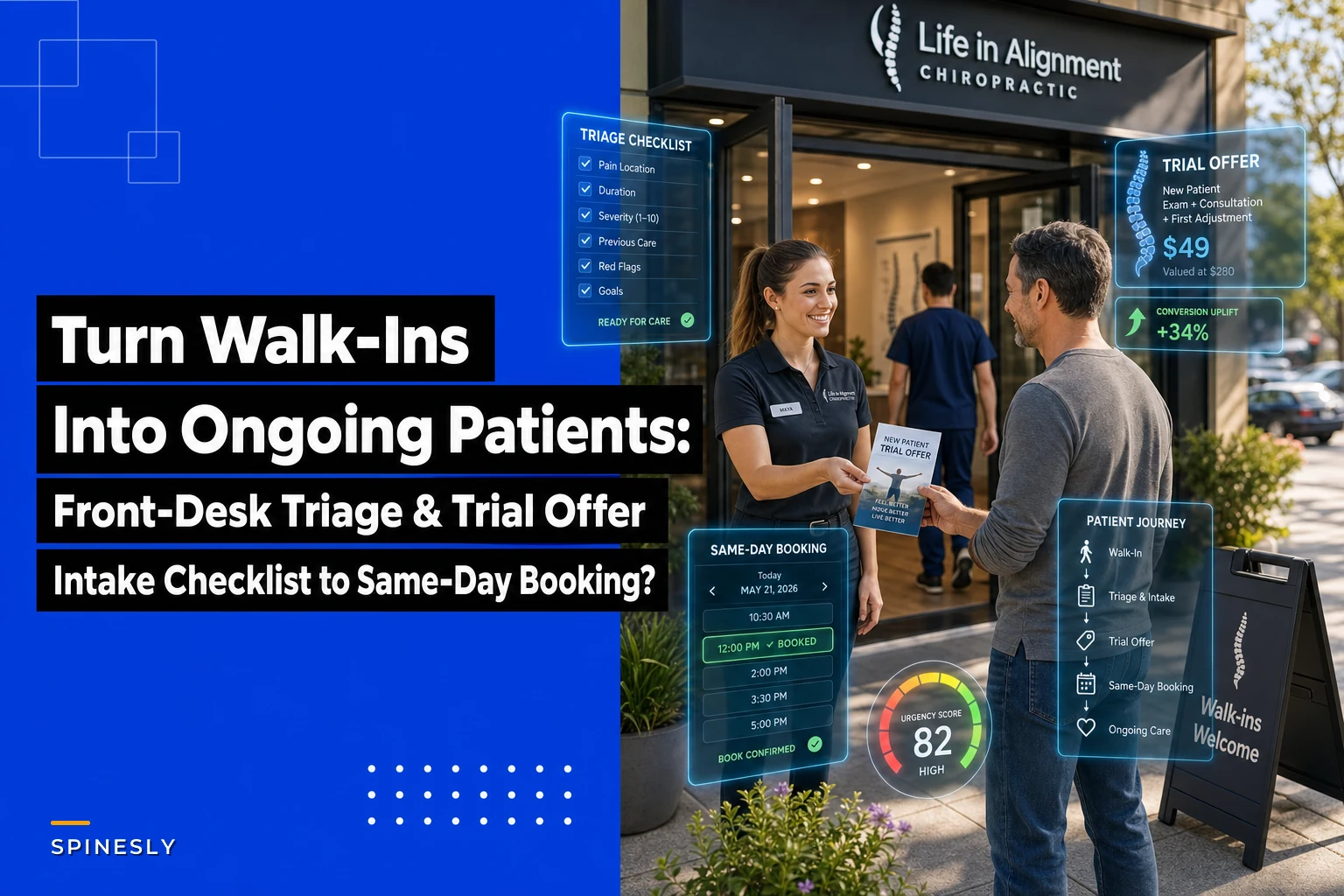

Walk‑ins are strange revenue. Someone tweaks their back moving a couch, googles "chiropractor near me open now," and shows up at your front desk with zero history, zero paperwork, and a decent amount of pain. They're motivated. They want relief today.
And most clinics blow it.
Not because the adjustment is bad — the adjustment is usually fine. They blow it because the front desk treats the walk‑in like an interruption to the scheduled day instead of someone who is, at that exact moment, more ready to commit to care than almost anyone else on the calendar. They get squeezed into a gap, adjusted quickly, handed a receipt, told "come back if it flares up." One visit. Gone.
The clinics that actually convert walk ins chiropractic‑style — turning acute, spontaneous demand into a multi‑visit care plan — do a handful of specific things in a specific order. This post is about that order.
Why walk‑ins get wasted
The core problem is that a walk‑in creates operational friction a scheduled patient doesn't. A booked new‑patient slot comes with intake forms already filled out, insurance already verified, a block of time reserved. A walk‑in shows up cold and forces the front desk to make three decisions on the spot:
-
Can we even see this person today?
-
Do we have the clinical time to do it properly?
-
Is this someone worth building a plan around, or a one‑off?
When those decisions get made under pressure, the default answer is "get them adjusted and get them out." That's the path of least resistance — and it's why a clinic can see 12–15 walk‑ins a month and retain almost none of them past visit one.
Clinics that convert walk‑ins well don't actually see more walk‑ins. They just stop letting the spontaneous ones fall through the same cracks that first‑visit patients fall through. If you haven't tightened your new‑patient flow yet, the checklist in Cut New‑Patient No‑Shows: A Testable Checklist to Protect First‑Visit Conversions is a good place to start — walk‑ins are basically the same conversion problem with a compressed timeline.
Step one: a 60‑second triage script at the front desk
The front desk person is your triage nurse whether you've trained them for it or not. What they say in the first minute decides whether the walk‑in becomes a plan or a receipt.
Never miss another patient appointment.
Spinesly helps you schedule, confirm, and manage every patient visit efficiently.
- Unified appointment management
- Automated patient reminders
- Staff and resource scheduling
No credit card required
The common mistake is that most front desks open with logistics. "Do you have insurance? Can you fill out these forms?" That signals transaction, not care. The person in pain immediately feels like a billing event.
Flip the order. Lead with the problem, triage urgency, then handle logistics.
> Front desk: "Okay, so tell me what's going on — what happened and when did it start?" > (listen, don't interrupt) > "Got it. On a scale where 10 is 'I can barely stand here,' where are you right now?" > (if 7+, flag as same‑day priority) > "Alright, here's the good news — Dr. [Name] has a spot to get you looked at today. Let me grab a couple quick details and we'll get you back."
You've done three things: made them feel heard, captured a rough urgency signal, and committed to seeing them before touching insurance. The paperwork comes after the commitment, not before.
The urgency question isn't just bedside manner — it's a routing signal. A 3/10 who "figured they'd stop by" is a different scheduling decision than an 8/10 who couldn't sleep last night. One fills a gap; the other should bump a non‑urgent slot if it comes to that.
Step two: an intake checklist built for speed, not completeness
The intake form for a walk‑in should be shorter than your standard new‑patient packet. This feels wrong to clinics used to collecting everything up front. But a walk‑in in pain will abandon a six‑page form. Collect the minimum to legally and clinically treat them today, and get the rest at the second visit when they're calmer and committed.
-
Name, DOB, contact (phone + email — you need both for the follow‑up sequence later)
-
Chief complaint + onset date
-
Pain rating (already captured verbally, confirm in writing)
-
Red‑flag screen (numbness, loss of bladder/bowel control, recent trauma, unexplained weight loss)
-
Consent to treat
-
Insurance card photo OR a note that they're paying cash today
Notice what's not on there: full medical history, prior surgeries, family history, detailed insurance verification. Those matter — just not in the 90 seconds you have before this person decides whether you're worth their time.
The red‑flag screen is the one thing you never compress for speed. A same‑day walk‑in is exactly the situation where a serious presentation slips through because everyone's rushing. Build those questions in as hard stops, not optional fields.
Step three: same‑day scheduling rules that don't wreck your day
The tension is real. You want to see walk‑ins today because that's when they'll commit. But you can't let every unannounced patient blow up your booked schedule and make on‑time patients wait 40 minutes.
The fix is pre‑decided rules so the front desk isn't improvising every time. A simple tiered approach based on urgency and open capacity:
| Walk‑in urgency | Current schedule state | Rule |
|---|---|---|
| High (7+/10, acute) | Any | See today. Bump a routine maintenance slot if needed, rebook that patient with a call. |
| Moderate (4–6/10) | Open slot within 2 hrs | Offer the slot now. |
| Moderate (4–6/10) | Fully booked | Offer earliest same‑day gap or first slot tomorrow AM with a "hold." |
| Low (1–3/10, curious) | Open capacity | See today if convenient. |
| Low (1–3/10, curious) | Booked | Book proper new‑patient appointment for next available. |
The rule most clinics miss: never send a high‑urgency walk‑in away. Even if it costs you a bumped maintenance visit, the acute patient is the one most likely to convert into a full plan. The maintenance patient is easy to rebook. Sending someone away in pain is sending away lifetime value.
The rule most clinics miss: never send a high‑urgency walk‑in away.
If your clinic already runs a same‑day fill or waitlist system for cancellations, walk‑in rules slot right into it — walk‑ins and last‑minute cancellations are the same open‑slot problem approached from two directions.
Step four: the trial‑package offer (this is where conversion actually happens)
The single biggest lever for turning a walk‑in into a multi‑visit patient is what you offer them at the end of the first visit. And the mistake most clinics make is offering nothing but "come back if it flares up."
A walk‑in came in for relief. After a good first adjustment, they feel better. That relief is your window — and it closes fast, usually within a day or two as the acute pain fades and life gets busy again.
So the doctor makes a specific, time‑boxed recommendation before the patient leaves the table. Not a sales pitch — a clinical recommendation with a trial structure attached.
> Doctor: "So here's what I'm seeing. That's not just a one‑time thing — the muscle's guarding around a joint that's not moving well, and if we don't retrain it, this comes back in a few weeks, usually worse. What I'd recommend is a short series — three visits over the next two weeks — so we can actually settle it down instead of just taking the edge off today. I put together a trial package for exactly this so it's not a big commitment. Want me to have the front desk set that up before you go?"
Three things make this work:
-
It's clinical, not commercial. The recommendation comes from what the doctor found, not a package menu.
-
It's short and defined. "Three visits over two weeks" is easy to say yes to. A 24‑visit plan is not.
-
It's decided at the table, booked at the desk. The doctor plants it; the front desk closes it. The handoff has to be tight or the moment evaporates in the lobby.
Price the trial package to lower the barrier — a modest discount versus per‑visit, positioned as "so you can see if this helps before committing to anything longer." The margin on the trial isn't the point. Getting them to visit two and three is, because that's where the real retention decision happens.
When the trial offer is a bad idea
Don't offer a trial package to a red‑flag or clearly non‑musculoskeletal presentation. If someone needs imaging or a referral, that's the recommendation — not a visit package. Pushing care plans on patients who need something else is how clinics get into ethical and compliance trouble fast.
Also skip the trial framing for the low‑urgency walk‑in who clearly just wants a single tune‑up. A hard pitch to the wrong person doesn't just fail — it costs you the referral they might've sent otherwise.
Step five: post‑visit follow‑up that actually books the second visit
Even with a trial package agreed to, a chunk of walk‑ins won't lock in the next appointment before leaving. The relief fades, the calendar fills, they ghost. The follow‑up sequence is what recovers those.
The workflow, plainly:
-
Same evening (2–4 hours post‑visit) A short check‑in message. "Hey [Name], this is [Clinic]. How's the back feeling tonight? Reply if anything's flaring up." Not a booking push — just care. It opens a reply thread you can convert.
-
Next morning If they didn't book a second visit, a message referencing the doctor's recommendation. "Dr. [Name] wanted to make sure you got that follow‑up scheduled — here's the link, or reply and I'll grab a time for you."
-
Day 3 If still unbooked, one more nudge tied to outcome. "Most people feel the acute pain drop after the first visit but the fix isn't done yet — don't want you back to square one. Want me to hold a spot this week?"
-
Day 7 Final soft touch, then move them to a longer‑cadence recall list instead of continuing to follow up.
Where the front desk drops this is memory and timing. Nobody's manually tracking which of last Tuesday's walk‑ins booked a second visit and which need a day‑3 nudge — not when the lobby is full. This is exactly the kind of follow‑up that quietly runs in the background of a well‑run clinic. The same discipline is mapped out in What Separates High‑Retention Chiropractic Clinics: An End‑to‑End Patient Journey & Automation Blueprint. When check‑in messages and day‑3 nudges fire automatically off the visit record instead of relying on someone remembering, the recovery rate on unbooked walk‑ins climbs without adding anything to the front desk's plate.
Here's a quick flowchart that shows the end‑to‑end process.
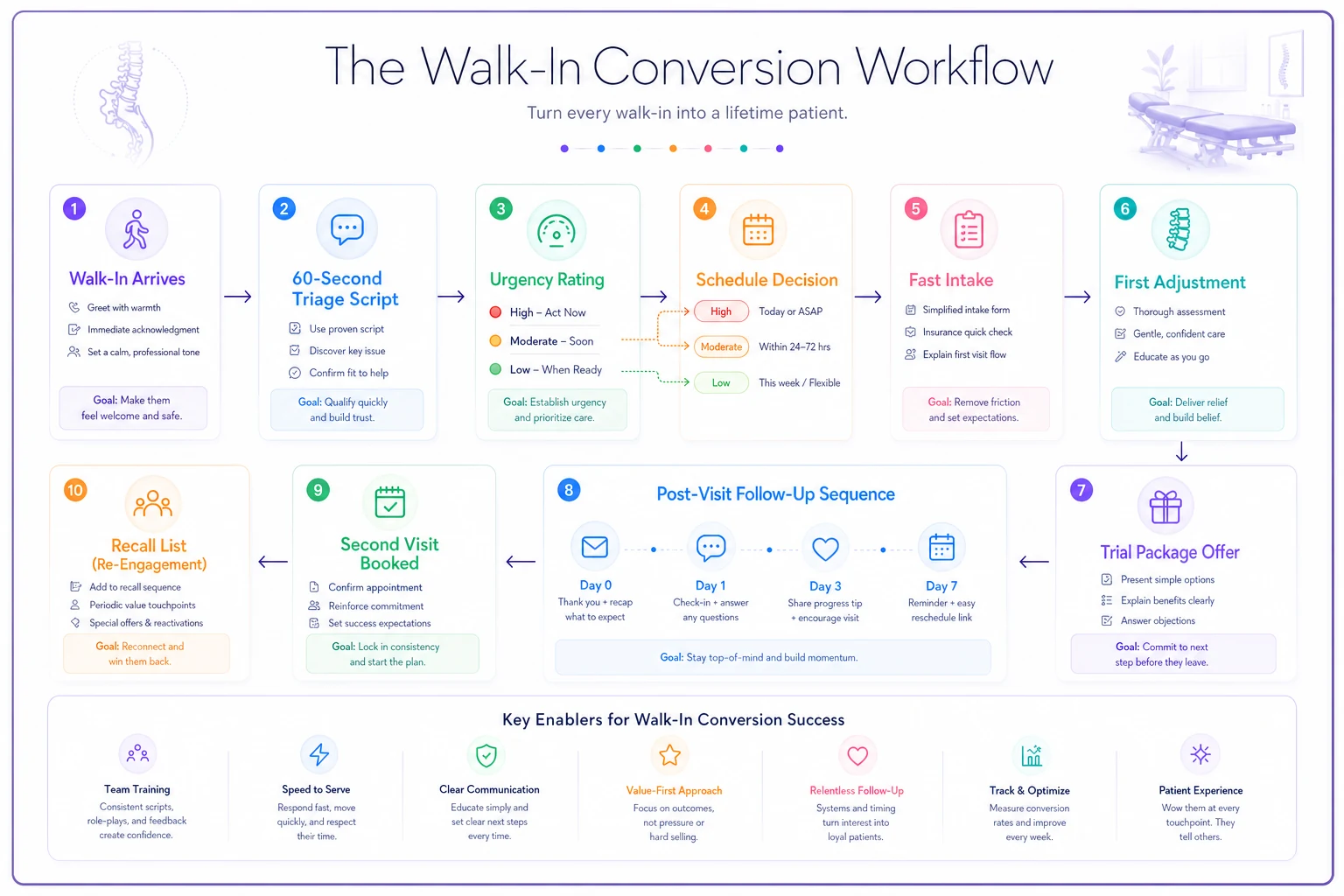
The workflow above is the backbone of the follow‑up: night‑of care, a next‑morning booking push tied to the doctor's recommendation, a day‑3 outcome nudge, and a final day‑7 soft touch before switching cadence.
A real scenario
A two‑doctor clinic in a strip‑mall location was seeing around 10–14 walk‑ins a month — decent foot traffic from a nearby gym and a busy retail stretch. Their conversion to a second visit was basically luck. Maybe 2 of those walk‑ins ever came back, and almost none started a real plan.
They changed four things: a triage‑first front desk script, a stripped‑down walk‑in intake, a "three visits in two weeks" trial package the doctors recommended from the table, and a follow‑up sequence over the first week.
Over the next quarter, second‑visit conversion on walk‑ins moved from roughly 2 in 12 to about 6 in 12. A meaningful share of those rolled into longer care plans. Nothing about their marketing changed and they didn't see more walk‑ins — they just stopped wasting the ones they already had. The added revenue worked out to somewhere in the low‑ to mid‑four‑figures a month, which for a two‑doc practice paying strip‑mall rent is not a rounding error.
The doctor's comment afterward stuck with me: "We weren't losing them clinically. We were losing them in the lobby."
The one thing to fix first
If you only change one thing, change the moment the walk‑in is on the table feeling relief. That's where the second visit is either planted or lost. Everything else — the triage script, the fast intake, the scheduling rules, the follow‑up — exists to protect and extend that moment.
Walk‑ins are the warmest patients you'll ever get. They came to you, in pain, ready to say yes. The clinics that grow off spontaneous demand aren't the ones with the fanciest ads or the most aggressive outreach. They're the ones with a boring, repeatable flow that catches motivated people before the motivation fades and makes it easy to say yes to visit two.
Walk‑ins are the warmest patients you'll ever get. They came to you, in pain, ready to say yes. The clinics that grow off spontaneous demand aren't the ones with the fanciest ads or the most aggressive outreach. They're the ones with a boring, repeatable flow that catches motivated people before the motivation fades and makes it easy to say yes to visit two.
Ready to streamline your chiropractic clinic operations?
Join 1,200+ clinics using Spinesly to save time, reduce scheduling errors, and improve patient care experiences.