



Most clinic owners treat payment security as a checkbox their processor already handles. "We use Square" or "We're on the payment module inside our EHR, so we're covered." That assumption is exactly where the trouble starts. Card-on-file storage, recurring care plan billing, and daily copay collection all create quiet exposure points that don't show up until something goes wrong — a chargeback wave, a disputed recurring charge, or worse, a processor freezing your deposits while they investigate.
Payment security for a small clinic isn't one thing. It's a chain of small controls stretching from your front desk keyboard all the way to your monthly vendor statements. When one link is loose, the whole thing gets fragile. This is a walkthrough of how that chain works, where it breaks in real practices, and what a solid clinic PCI compliance checklist actually looks like when you build it around how a clinic really operates.
Why card-on-file is where clinics get exposed
Chiropractic practices store cards more than almost any other small healthcare business. You've got care plans billed over 12 weeks, missed-appointment fees, product purchases, patient responsibility after insurance adjudicates. Keeping a card on file feels efficient, and it is — but it also means you're holding sensitive data across many patients for long stretches, and the way most clinics do it creates avoidable risk.
The pattern that keeps coming up: a front desk person writes a card number on a sticky note or an intake form so they can "enter it later." Or the card lives in a free-text notes field in the practice management system. Or someone emails a photo of the card to the billing person working remotely. Every one of those moves takes card data out of the protected zone your processor built and drops it into places PCI rules specifically forbid.
The insight most owners miss: you don't reduce your PCI scope by using a good processor. You reduce it by never touching raw card data yourself. The moment a full card number passes through your email, your paper forms, or your EHR notes, your clinic — not the processor — becomes the storage point. And you inherit all the liability that comes with it.
The three zones your payment data lives in
Before you can secure anything, you need to know where card data actually flows. In a typical clinic it lives in three zones, and each one has different rules.
Never miss another patient appointment.
Spinesly helps you schedule, confirm, and manage every patient visit efficiently.
- Unified appointment management
- Automated patient reminders
- Staff and resource scheduling
No credit card required
| Zone | Where it lives | Who touches it | Main risk |
|---|---|---|---|
| Capture | POS terminal, online payment page, card-on-file form | Front desk, patient | Skimming, keylogging, written-down numbers |
| Storage | Processor vault (tokenized) vs. your systems (raw) | Billing, admin | Raw data stored where it shouldn't be |
| Reconciliation | Deposits, statements, EHR ledger | Owner, bookkeeper | Undetected fraud, missed disputes, mismatches |
The goal of a good payment hygiene system is straightforward: keep raw card data only in the capture zone for a few seconds, push it straight into a tokenized vault, and never let it land anywhere in between. Most breaches and disputes in small clinics trace back to card data leaking sideways out of the capture zone into email, paper, or notes fields.
Tokenization, in plain clinic terms
You've probably heard "tokenization" thrown around. Strip away the jargon and here's what it means for your practice: when a card is entered, your processor swaps the real number for a meaningless placeholder — a token — and stores the real number in their vault. Your system only ever holds the token. When you bill a care plan next month, you send the token, and the processor matches it back to the card on their end.
Why this matters operationally: if your practice management system is only holding tokens, then a stolen laptop, a hacked login, or a curious employee gets nothing useful. There's no card number to steal. This is the single biggest lever a small clinic has for shrinking its risk, and most owners never actually confirm whether their setup does it.
Here's the check that separates real tokenization from wishful thinking. Ask your processor or EHR vendor directly: "When a patient's card is saved for recurring billing, is the full card number stored anywhere in my system or database, or only a token that references your vault?" If they can't answer clearly, or if the answer is "it's encrypted in our system," that's not the same as tokenized and stored offsite. Encrypted-but-stored still leaves you holding the data.
Worth watching for: clinics that migrated practice management software often carried over old card data in a way that broke tokenization. Cards that were tokenized in the old system got re-imported as raw data or re-entered manually. If you switched systems in the last couple years, this deserves an explicit audit.
The daily reconciliation SOP that catches problems early
Payment security isn't only about preventing theft from outside. A huge share of the money clinics lose comes from things reconciliation would have caught: duplicate charges, failed recurring bills nobody noticed, refunds that never posted, and small fraud flying under the radar for months.
-
Pull the processor's daily batch total and compare it against the day's posted transactions in your practice management system. They should match to the dollar.
-
Flag any transaction where amounts don't tie out. A $45 copay recorded in the EHR but a $54 charge at the processor is either a keying error or something worse.
-
Review declined and failed recurring charges and queue them for re-run or patient outreach same day, not next week.
-
Confirm all refunds issued that day were authorized by someone other than the person who issued them, if staffing allows.
-
Log the reconciliation — even a shared sheet with a checkmark and initials. The log itself is a deterrent.
Keep the reconciliation log in a shared cloud sheet with timestamped edits to preserve an audit trail.
Daily beats weekly because fraud and errors compound. A staff member skimming small refunds to a personal card can go unnoticed for months on a monthly review. On a daily one, the pattern surfaces in days. And the failed recurring charges you catch same-day are the ones you actually recover — this connects directly to the discipline behind a point-of-care payment SOP that reduces missed copays, where same-day habits are what protect the money.
When failed charges pile up unnoticed for weeks, they don't just disappear — they turn into aged receivables. That's the exact problem covered in the tiered A/R recovery sequence for 31–180 day balances. Clean daily reconciliation is the cheapest way to keep money from ever reaching that stage.
Reading dispute and chargeback flags before they become freezes
Chargebacks can genuinely hurt a small clinic because processors watch your dispute ratio closely. Cross a threshold — usually somewhere around 1% of transactions — and you can get flagged for monitoring, hit with fees, or in bad cases have deposits held. For a clinic running 300–500 card transactions a month, that's a thin margin. A handful of disputes in one month can spike your ratio fast.
-
Recurring care plan charges patients forgot they authorized. The number one cause. They see a $200 charge, don't recognize it, and call their bank instead of your office.
-
Unclear billing descriptors. If the charge shows up as some cryptic LLC name instead of your clinic name, patients dispute it because they don't recognize it.
-
Balance-after-insurance charges billed to a card on file without a heads-up, weeks after the visit.
-
Product returns that weren't refunded promptly.
The prevention here is mostly communication, not technology. Send a receipt every time you charge a card on file. Make your billing descriptor obviously your clinic name. Get explicit, documented consent for recurring plans that spells out the amount, frequency, and how to cancel.
The signed authorization form is your single best defense in a dispute. When a patient challenges a recurring charge and you can produce a signed agreement showing they knew the amount and schedule, you win the dispute most of the time. Without it, you almost always lose — and you eat the chargeback fee on top. Many disputed charges are avoidable and overlap with the broader denial and revenue-leak problems laid out in the operations-first RCM playbook.
The card-on-file consent and controls checklist
This is the part to actually print out and audit against. Run through it once, fix the gaps, then re-check quarterly.
-
[ ] Signed card-on-file authorization on record for every stored card, stating amount, frequency, and cancellation terms
-
[ ] No full card numbers stored in EHR notes, intake forms, email, or paper anywhere in the office
-
[ ] Tokenization confirmed in writing with your processor/EHR vendor
-
[ ] Billing descriptor clearly shows your clinic name on statements
-
[ ] Receipts sent automatically on every card-on-file charge
-
[ ] Refund authority limited and requiring a second set of eyes
-
[ ] Daily reconciliation logged with initials
-
[ ] Recurring charges paused automatically when a care plan ends or a patient goes inactive
-
[ ] Staff access to payment functions tied to individual logins, not a shared one
-
[ ] Terminals and payment devices inspected periodically for tampering
-
[ ] A written process for what happens when a patient disputes a charge
That shared-login item deserves emphasis. When everyone at the front desk uses one login to process payments, you lose the ability to trace who did what. If a refund goes to the wrong place, you can't tell whether it was a mistake or theft. Individual logins turn an unsolvable mystery into a two-minute investigation.
Vendor contract checkpoints owners skip
Your payment security is only as good as the contracts underneath it, and this is the area owners rush through fastest. When you signed with your processor or your all-in-one clinic platform, you agreed to terms that decide who's liable when things go wrong. Most owners have never read them.
Things worth pulling up and checking:
-
PCI compliance responsibility split. Which controls are theirs, which are yours? Get this in writing so a breach doesn't turn into a finger-pointing contest.
-
Chargeback fees and thresholds. Know your per-dispute fee and the ratio that triggers penalties before you hit it.
-
Deposit hold and reserve terms. Under what conditions can they hold your money? This is what strangles cash flow when a processor gets nervous.
-
Data ownership and export on exit. If you leave, do you get your tokenized data, or do you have to re-enter every patient's card? This one alone can trap you with a vendor.
-
Breach notification obligations. Who tells whom, and how fast?
-
Auto-renewal and rate-change clauses. Rates that creep up quietly eat margin no one budgeted for.
The one that bites hardest: deposit holds. A processor can freeze incoming deposits for weeks if a fraud pattern trips their system. A clinic running on tight cash reserves can't cover payroll in that window. Knowing your reserve terms ahead of time — and keeping a small buffer — is the difference between an inconvenience and a crisis.
A real scenario: what tightening this up looks like
A two-provider clinic running roughly 350–400 card transactions a month had been storing cards the loose way — numbers written on intake sheets, entered later, a few kept in a spreadsheet for recurring plans. Nothing had gone catastrophically wrong yet, which is exactly why nobody had touched it.
Then a run of disputes hit. Six chargebacks in one month, mostly patients not recognizing recurring care plan charges, plus one balance-after-insurance charge nobody had warned the patient about. The dispute ratio spiked past the processor's comfort zone and they got a warning letter. Two of the disputes were lost outright because there was no signed authorization to produce.
The fix wasn't complicated. They confirmed tokenization with the vendor and purged the spreadsheet. They put a one-page card-on-file consent in front of every recurring-plan patient. They fixed the billing descriptor to show the clinic name, turned on automatic receipts, and started a 10-minute daily reconciliation.
Over the next couple of months, disputes dropped to one or two, both winnable because the paperwork existed. The chargeback fees they'd been quietly absorbing — a few hundred dollars a month — mostly disappeared. Nothing dramatic on the revenue chart, but the exposure that could have frozen their deposits was gone, and the front desk stopped guessing about which charges were legitimate.
When to keep cards on file — and when not to
Card-on-file isn't right for every situation, and pretending it is creates more disputes than it prevents.
When it makes sense: structured care plans with clear terms, patients who've explicitly opted in, missed-appointment policies patients agreed to in writing, and product accounts where the patient buys regularly.
When it's a bad idea: one-time visits, patients who seem hesitant or confused about recurring billing, or any situation where you can't get clean documented consent. If a patient is fuzzy on what they're agreeing to, storing their card is buying yourself a future dispute.
Who should not run card-on-file at all: a clinic that hasn't confirmed tokenization, doesn't have a consent form, and can't commit to reconciliation. Without those three, you're not saving time — you're stacking liability you'll pay for later.
Building the whole system, not just the pieces
The mistake running through nearly every clinic payment problem is treating these controls as separate tasks. Tokenization over here, disputes over there, contracts in a drawer somewhere. They're one system. Tokenization limits what a breach can expose. Consent forms win the disputes that tokenization can't prevent. Daily reconciliation catches what slips past both. Vendor terms decide what happens when the system actually gets tested.
Start with the audit, not the tools. Confirm where your card data actually lives right now — the honest answer, not the assumed one. Purge anything sitting outside the vault. Get the consent forms signed. Then make reconciliation a daily habit somebody owns by name. That sequence closes the gaps in the order they're most likely to hurt you.
A visual workflow of the audit → purge → consent → reconcile sequence helps teams follow the order.
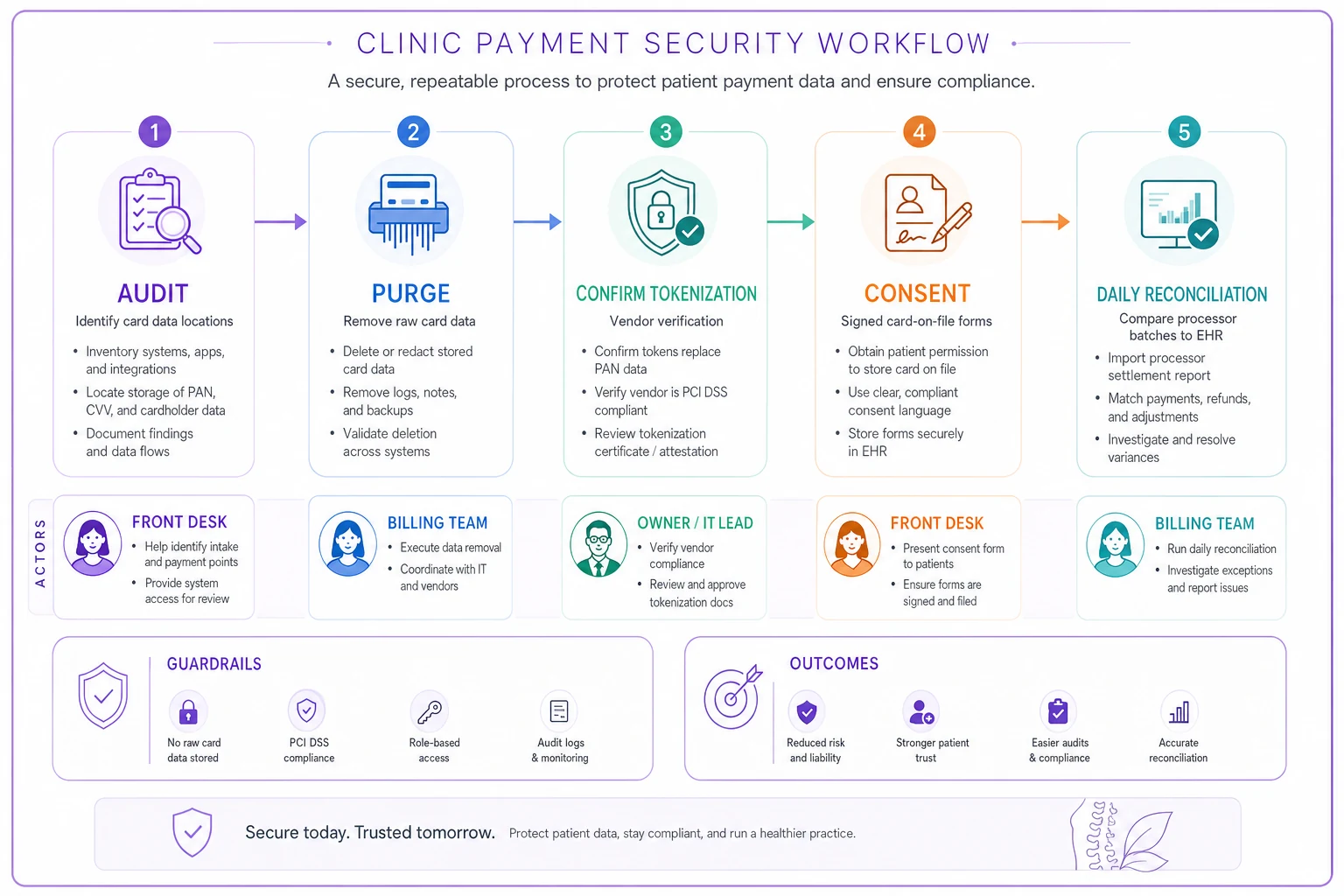
That sequence closes the gaps in the order they're most likely to hurt you.
None of this is glamorous, and none of it shows up on a P&L as a win. But payment hygiene is the kind of thing that costs you nothing when it's working and costs you everything the week it isn't.
Build the chain tight, check it quarterly, and it quietly protects both your patients and your cash flow while you get back to running the practice.
Ready to streamline your chiropractic clinic operations?
Join 1,200+ clinics using Spinesly to save time, reduce scheduling errors, and improve patient care experiences.