



Most chiropractic clinics don't lose money on imaging because they order too many films. They lose it in the gaps between systems — the flag that never got set at booking, the note that says "AP lumbar" when the biller submitted for three views, the room that sat unturned while the next patient waited. Each gap is small. Stack them across a few hundred imaging encounters a year and they turn into denials, rework, and slow days that feel busier than they actually are.
This is a workflow problem, not a clinical one. And it's fixable with tighter handoffs. Below is the imaging encounter from end to end — from the moment someone books to the moment the claim clears — with the failure points marked and something practical to put in place instead.
Where the chiropractic x-ray billing chain actually breaks
If you trace a denied imaging claim backward, it almost never starts at billing. It starts at scheduling. Someone books a new patient, the front desk assumes films will happen "if the doc decides," and nobody flags the visit as an imaging encounter. So the room isn't blocked long enough, the tech isn't ready, and the intake paperwork doesn't capture what the payer needs.
-
Scheduling doesn't distinguish an adjustment-only visit from an exam-plus-imaging visit, so time blocks are wrong.
-
Documentation describes clinical findings but never states the specific views taken or medical necessity in payer-friendly language.
-
Coding picks a CPT that doesn't match the number of views actually documented.
-
Reconciliation never happens — nobody checks that every film taken produced a charge, and every charge maps to a note.
These four functions are usually owned by four different people who rarely talk during the visit. The fix isn't a better biller. It's a shared checklist that follows the encounter across all four.
Step one: flag the imaging encounter at booking
The single highest-leverage move is deciding — at the moment of scheduling — whether imaging is likely. You won't be right every time, but even a "possible imaging" flag changes how the visit gets built.
Never miss another patient appointment.
Spinesly helps you schedule, confirm, and manage every patient visit efficiently.
- Unified appointment management
- Automated patient reminders
- Staff and resource scheduling
No credit card required
-
Extends the appointment block (an imaging exam realistically needs 10–15 extra minutes over a standard visit).
-
Triggers an eligibility check specifically for radiology benefits, since imaging coverage often differs from adjustment coverage.
-
Prompts the intake form to capture onset date, mechanism, and prior imaging — the exact fields your documentation will need later.
That eligibility piece matters more than most people expect. Radiology and manipulation don't always share the same coverage rules, and a plan that covers adjustments may exclude in-office x-ray entirely or require a specific place-of-service. Getting ahead of that follows the same discipline as the process for verifying insurance before chiropractic appointments — imaging just adds a second benefit category to confirm.
When the flag is worth setting even if you're unsure: new patients with trauma histories, personal-injury or workers' comp cases, and anyone referred specifically for evaluation. When it's usually unnecessary: established maintenance patients, wellness visits, and returns where the plan of care is already documented and stable.
Step two: a room-turn checklist that prevents the silent bottleneck
Imaging rooms create a hidden scheduling tax. An adjustment room turns in a minute or two. An imaging room needs positioning, exposure, image review, and often a retake — plus the tech confirming the films are readable before the patient leaves. If that turn isn't standardized, you get one of two failures: patients stacking up in the hall, or films discovered to be non-diagnostic later that can't be repeated without recalling the patient.
-
Confirm patient identity and the specific views ordered before positioning
-
Verify pregnancy screening is documented (where applicable) before exposure
-
Capture each view and immediately confirm it's diagnostic — not later
-
Log the actual number of views taken (this becomes your coding anchor)
-
Mark the room ready and note any retakes with reason
Log the view count immediately in the room; coders rely on that single fact.
The line that saves the most money is logging the actual number of views taken, in the moment. That's the fact your coder needs, and it's almost always the fact that's missing when a denial lands.
The room-turn process typically flows like this:
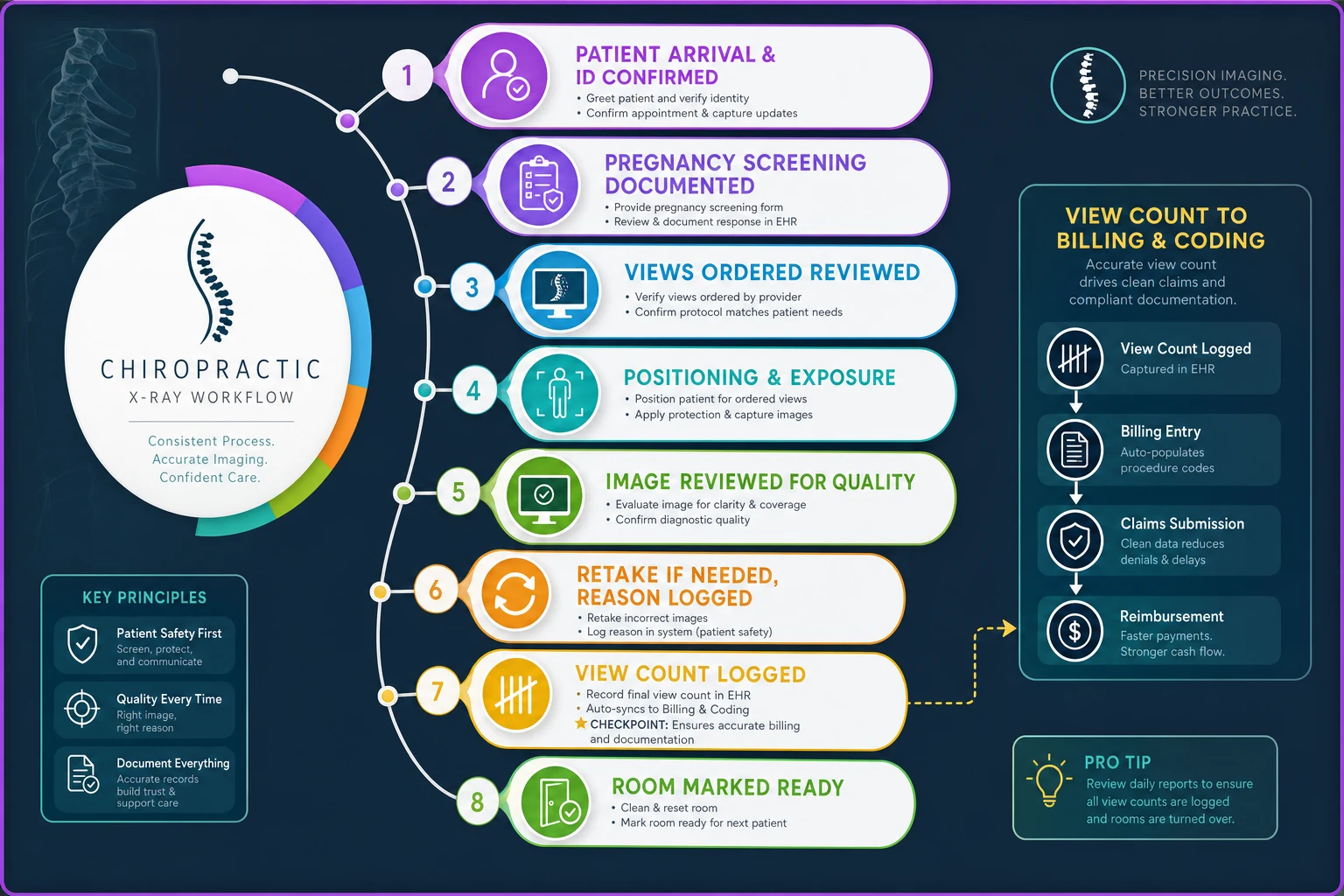
Every step feeds the next. Skip the view count log and you've broken the chain between the imaging room and billing.
Step three: documentation snippets that match how imaging gets paid
Here's the pattern that quietly drives imaging denials: the clinical note is excellent for care and useless for billing. It describes subluxation, palpation findings, and the treatment plan — but never plainly states which views were taken, why they were medically necessary, or what they showed.
-
Indication snippet "Imaging ordered due to [acute trauma / neurological deficit / failure to respond to conservative care over X weeks / suspected pathology]."
-
Views snippet "Obtained [AP and lateral lumbar / 3-view cervical / etc.], total [N] views."
-
Findings snippet "Films demonstrate [findings]. Impact on plan of care: [modification / confirmation / referral]."
Providers don't resist documentation — they resist retyping the same three sentences forty times a month. Give them reusable snippets and the payer-relevant facts show up consistently without adding charting time. It's the same principle behind reducing documentation time on SOAP notes: structure the repeatable parts so clinicians only fill in what's actually unique.
The snippet library doesn't need to be sophisticated. A shared document or a few saved templates in your EHR is enough to make this consistent.
Step four: code-to-doc mapping
This is where the view count has to reconcile against the CPT selected. The most common mismatch is a note documenting two views while the claim goes out for a code implying more — or vice versa. Either way, it's a red flag to payers and a denial waiting to happen.
| Region / study documented | Views documented | CPT should reflect | Common failure |
|---|---|---|---|
| Cervical spine | 2 views | 2-view code | Note says "cervical series" but only 2 films logged |
| Cervical spine | 4–5 views | Complete study code | Coded as 2-view; underbilled |
| Lumbar spine | 2–3 views | Matching view-count code | View count in note doesn't match room-turn log |
| Full spine | Single film | Full-spine code | Billed as multiple regional studies |
The core rule: the CPT follows the documented view count, and the documented view count follows the room-turn log. All three must agree. When they don't, reconcile before the claim goes out — not after it bounces. Getting CPT selection right on imaging follows the same logic as avoiding the coding mistakes that trigger denials on adjustment and exam codes.
The daily reconciliation step nobody wants to own
Everything above prevents errors going forward. Reconciliation catches the ones that slipped through. It's a five-minute end-of-day pass, and it's the difference between finding a missing charge today versus discovering it in a denial report six weeks from now.
-
Pull the list of encounters flagged for imaging that day.
-
For each, confirm a film was actually taken (matches the room-turn log).
-
Confirm a documentation snippet exists stating views and indication.
-
Confirm a charge was created, and the CPT matches the logged view count.
-
Flag anything missing one of the three — film without charge, charge without note, or note without matching code.
The two failure modes this catches are the expensive ones: films taken but never charged (pure lost revenue) and charges submitted without supporting documentation (guaranteed denial plus audit exposure). Both are invisible without a deliberate daily check.
This step doesn't require extra staff. It just requires someone to own it. Assign it, build it into closing duties, and it becomes routine within a few weeks.
A real scenario
A two-provider clinic running roughly 25–30 in-office imaging studies a month kept seeing radiology denials cluster at month-end. When they traced them, the pattern was consistent: about a third came from view-count mismatches, and a handful came from films that were taken but somehow never got a charge attached.
They didn't add staff. They added the imaging flag at booking, a posted room-turn checklist that logged actual view counts, three documentation snippets, and a five-minute end-of-day reconciliation. Within two months, the view-count denials mostly stopped and they were catching a few hundred dollars of previously-missed imaging charges each month. Nothing dramatic — just a workflow that stopped leaking.
Who should not overbuild this
If you refer nearly all imaging out to a radiology partner, most of this collapses to the booking flag and the eligibility check — you don't need room-turn logs for films you don't take. And if you're running only a handful of in-office studies a month, a shared spreadsheet checklist is plenty; you don't need software for that volume.
The reconciliation discipline still matters either way, but keep the tooling proportional to the volume. If you're weighing whether in-house imaging even earns its keep, that's really a margin question worth running through a proper go/no-go and pilot test before you build any of this out.
Where practice software quietly helps
The reason imaging errors persist isn't ignorance — it's that four people own four steps and the information doesn't travel between them cleanly. Practice management software that lets the booking flag carry through to the intake form, room-turn log, documentation snippet library, and charge screen removes the manual handoffs where facts get dropped. The view count logged by the tech shows up where the coder works. The reconciliation list builds itself instead of someone reconstructing it from three different screens.
AI-assisted operational platforms take this further by flagging encounters where the documented view count doesn't match the CPT before the claim goes out, or surfacing imaging encounters with no attached charge at the end of the day automatically. That kind of check used to require someone manually cross-referencing logs. Now it can run in the background without adding to anyone's workload.
You don't need software to make this workflow function — a whiteboard and some discipline will get you most of the way there. But when the same view-count fact has to survive four handoffs and forty encounters a month, having it flow through one system instead of four is what keeps that discipline from quietly eroding on a busy Tuesday.
Imaging revenue leaks are almost never caused by one big mistake. They're the accumulation of small disconnects between booking, the imaging room, the chart, and the claim.
Set the flag early, log the actual views in the moment, keep a snippet library so the payer-facing facts are always present, and reconcile once a day. The clinics that do those four things consistently find that the denials which used to pile up at month-end mostly stop arriving in the first place.
Ready to streamline your chiropractic clinic operations?
Join 1,200+ clinics using Spinesly to save time, reduce scheduling errors, and improve patient care experiences.