


Most clinics treat locum coverage like an emergency instead of a repeatable process. A provider goes out on leave, someone gets hurt, maternity dates move, and suddenly the owner is scrambling to find a warm body who can adjust patients and sign notes. The locum shows up Monday morning, nobody knows their NPI, the EHR login isn't provisioned, and the front desk is quietly rescheduling half the schedule because "the new doc isn't credentialed with that payer yet."
That's not a staffing problem. It's a missing system.
A real locum onboarding playbook isn't a folder of forms. It's the connective tissue between credentialing, scheduling, documentation standards, and billing — all of which have to survive a provider swap without quality or throughput falling off a cliff. When any one of those pieces lags, the others break in ways that are expensive and slow to detect.
This is the full picture: how the handoff works, where it fails, and what a turnkey kit actually needs to contain so a temporary provider is productive in hours instead of days.
Why locum coverage breaks more than it should
The usual story isn't that the locum is bad. It's that the clinic never built the coverage muscle because it only needs it a few times a year. Infrequent processes are the ones nobody documents, so every time coverage comes up, the clinic rebuilds the wheel from memory.
And here's where it compounds. Credentialing lead times don't care about your emergency. Payer enrollment and privileging can take weeks, and if your locum isn't enrolled with a given payer, every visit they bill under their own name for that plan is at risk of denial. Meanwhile, if you bill under the absent provider's name to dodge that gap, you've wandered into territory that can look a lot like misrepresentation depending on the payer rules and whether a reciprocal billing or locum tenens arrangement actually applies.
-
Slow the schedule down to only the visits the locum can cleanly bill (protects compliance, kills throughput)
-
Keep the schedule full and sort out billing later (protects throughput, creates a denial backlog)
Most owners pick the second one without realizing they picked anything. Three weeks later the A/R report tells the story.
The second failure mode is clinical documentation drift. A locum documents the way they were trained at their last few clinics. Your established patients have treatment plans, re-exam cadences, and note structures that your billing and outcomes tracking depend on. When the locum's notes don't line up with your SOAP structure, you get coding mismatches, re-exam gaps, and continuity problems the regular provider has to untangle when they return.
The four systems a locum touches on day one
A locum doesn't just fill a chair. They plug into four systems that normally run quietly in the background. If you've already mapped these for your clinic — and if you haven't, the four operational systems that let chiropractic clinics scale is the right place to start — then onboarding a locum is really about making a stranger safe to operate inside each one.
Never miss another patient appointment.
Spinesly helps you schedule, confirm, and manage every patient visit efficiently.
- Unified appointment management
- Automated patient reminders
- Staff and resource scheduling
No credit card required
| System | What the locum needs | What breaks if it's missing |
|---|---|---|
| Credentialing & billing | NPI, payer enrollment status, locum arrangement rules, billing name/modifier guidance | Denials, compliance exposure, delayed revenue |
| Scheduling | Which visit types they can take, chair hours, re-exam ownership | Underfilled schedule or overbooked beyond competency |
| Clinical documentation | SOAP template, treatment plan context, re-exam triggers | Note mismatches, coding errors, continuity gaps |
| Access & security | EHR login, scope limits, e-sign, device access | Day-one downtime, shared logins, audit problems |
The point of the table isn't the categories. It's that these four move at different speeds. Access can be solved in an hour. Payer enrollment can take weeks. A good playbook sequences the work so the slow things start early and the fast things happen the morning the locum walks in.
The pre-approved credential checklist
Credentialing is the part that will not be rushed, so it's the part you prepare before you ever need it. The goal is a pre-approved packet that's sitting ready, so when a locum is identified you're verifying and activating rather than starting from zero.
What belongs in the credential checklist:
-
Active state license and verification (with expiration tracked, not just filed)
-
NPI and confirmation of individual vs. group billing setup
-
DEA if relevant to scope
-
Malpractice coverage confirmation and effective dates
-
Payer-by-payer enrollment status
enrolled, pending, or not participating
-
Locum tenens / reciprocal billing eligibility per payer, documented in plain language
-
Signed BAA and any required HIPAA attestations
-
Background and sanctions check (OIG exclusion list is non-negotiable)
-
Copy of CV and board/association standing
The piece most clinics skip is the payer-by-payer status column. "Credentialed" is not a yes/no state — it's a per-payer state. A locum can be perfectly enrolled with your top two commercial plans and completely unenrolled with the Medicare Advantage plan that happens to be 30% of your panel. Without that column, your front desk can't make safe scheduling decisions, and your billing team finds out after the claims come back.
Keep the checklist as a living record with expiration dates, not a one-time intake form. Licenses and malpractice coverage lapse. The clinic that gets burned is usually the one that credentialed someone correctly eight months ago and never re-checked.
The one-hour handoff sheet
This is the document that gets the locum operational the morning they arrive. It's deliberately short. If it takes more than an hour to walk through, people skip it — and skipped onboarding is how you get day-one chaos.
A workable handoff sheet covers, in order:
-
Access — EHR login provisioned and tested the day before, not during the first patient. E-signature set up. Scope of access matched to their role so they're not one misclick from editing billing.
-
Schedule map — which visit types they're taking today, which they're not, and who catches the overflow. This is where the credential status column pays off: no booking a patient into a plan the locum can't bill.
-
Clinical context — the three to five active patients with complex plans, flagged with a one-line summary each. Not the whole panel. Just the ones where a wrong turn causes real harm or a confused patient.
-
Documentation standard — a one-page version of your SOAP template with required fields and re-exam triggers highlighted.
-
Escalation path — who to call for a clinical question, a billing question, and a "the system is down" question. Three names, three numbers.
-
End-of-day checklist — notes closed, charges captured, anything flagged for the returning provider.
The mistake is front-loading too much. Clinics hand the locum a 40-page binder and feel organized. The locum reads none of it. A one-page handoff that actually gets used beats a comprehensive manual that doesn't, every time.
A quick visual of the one-hour handoff workflow:
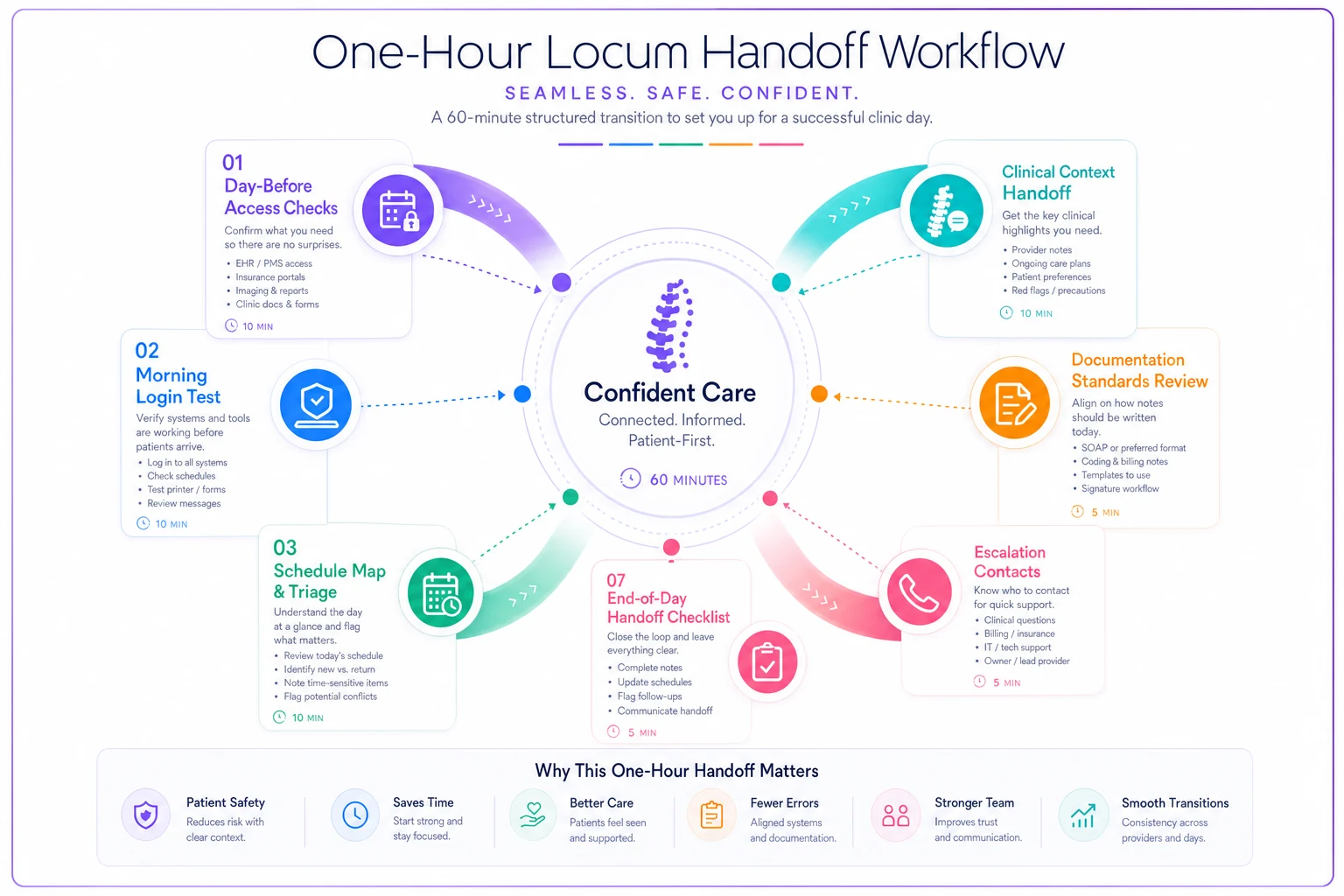
The one-page flow ensures the fast items happen at arrival and the slow items were already started earlier.
Aligning the SOAP template so documentation doesn't drift
Documentation is where a locum quietly costs you money for weeks after they leave. Their notes get written, visits get seen, and then the coding doesn't support the billing, or the re-exam that was due never got flagged, or the returning provider can't reconstruct what happened during the gap.
The fix is template alignment, not template training. You don't retrain a locum on how to think. You give them a note structure that already contains your required fields, your typical CPT-supporting language prompts, and your re-exam cadence built in. When the structure carries the requirements, you're not depending on a temporary provider to remember your clinic's conventions.
-
Pre-built note templates in the EHR, already loaded for the locum's profile, matching exactly what your regular providers use
-
Required fields that can't be left blank where billing depends on them — region, segments, exam findings, plan
-
Re-exam triggers surfaced in the note, so the locum sees "re-exam due" instead of having to know your 12-visit convention
-
A short documentation review at end of week one — someone checks a sample of the locum's notes against your standard and corrects drift before it's 200 notes deep
Clinics that handle coverage well treat the SOAP template as infrastructure, not preference. The template enforces the standard so the person doesn't have to. The clinic's note quality shouldn't swing based on who's in the chair.
24 and 72-hour competency gates
This is the part most playbooks miss entirely: you don't let a locum run at full throughput on day one and hope it works out. You gate it.
Competency gates are simple checkpoints where someone verifies the locum is actually operating safely inside your systems before you open the throttle.
The 24-hour gate is about safety and basics. Did they document correctly? Did charges capture? Did they follow the schedule map and not book themselves into visits they can't bill? Any patient complaints or confusion? This isn't a performance review — it's a "are the rails holding" check. If something's off, you catch it after a handful of patients, not a hundred.
The 72-hour gate is about throughput and clinical fit. Now you look at pace, note quality across a larger sample, treatment plan consistency, and whether the schedule can safely widen. If 24 hours was clean and 72 hours looks solid, you open up more visit types and more chair hours.
A typical pattern: day one the locum runs at maybe 60-70% of a normal schedule with a narrowed visit mix. After a clean 24-hour gate, you add volume. After 72 hours, you're near full throughput with the schedule widened to everything their credentialing allows. The gates protect you from both failure modes — crawling along underbooked out of caution, or going full speed into a quality problem you don't find until it's expensive.
If you've built a hire-to-competency staffing system for permanent hires, the gates are the compressed, high-speed version of the same idea. You're measuring competency against milestones — just on a 72-hour timeline instead of 30/60/90 days.
A real scenario
A two-provider clinic had one doctor go out for shoulder surgery with about six weeks of recovery. Panel was roughly 340 active patients, mixed commercial with a meaningful chunk of Medicare Advantage.
The first week went badly. The locum started on a Monday, EHR access wasn't ready until mid-morning, and the front desk had been booking patients across all plans assuming "a chiropractor is a chiropractor." By Friday there were denials stacking up on the MA plan the locum wasn't enrolled with, and the returning provider's patients were getting notes that didn't match the clinic's re-exam structure.
They rebuilt it the next time, about four months later. Credential packet was pre-approved with the payer status column filled in, so the front desk knew the MA plan patients had to stay with the covering provider only where the locum arrangement rules actually applied. Handoff sheet got the locum into a tested login by 8am. SOAP template was pre-loaded. They ran the 24 and 72-hour gates.
The second coverage period, denials attributable to the locum dropped to nearly nothing, and the schedule hit roughly 85-90% of normal volume by the second day instead of limping along for a week. The returning provider came back to notes they could actually read. The difference wasn't a better locum — it was the same kind of person dropped into a system that was ready for them.
When a turnkey locum kit actually makes sense
This level of preparation isn't worth it for every clinic. If you've never used coverage and don't expect to, building the full kit is over-engineering.
It makes sense when:
-
You have more than one provider and predictable leave events (parental leave, surgery, vacation coverage)
-
A meaningful share of your revenue sits with payers that have real enrollment barriers
-
Your documentation and billing are tightly coupled, so note drift costs you quickly
-
You're planning to grow and will use coverage repeatedly
It's probably overkill when:
-
You're a solo provider with no realistic coverage plan — your gap is continuity, not onboarding
-
Your payer mix is simple and credentialing lead times are short
-
You only expect coverage once and can afford a slower ramp
The honest middle ground: even a lean version — a credential checklist with a payer status column and a one-page handoff sheet — prevents most of the day-one damage. You don't need the whole kit to get 80% of the protection.
Where this connects to the rest of your operation
Locum onboarding doesn't exist in isolation. It leans on your scheduling discipline, because the whole handoff depends on booking the locum into visits they can actually see and bill. If your scheduling is already structured with clear visit types and utilization rules — the kind of setup covered in sample schedules for multi-provider clinics — then the schedule map on your handoff sheet is a two-minute edit instead of a guessing game.
It leans on your documentation standards, because SOAP alignment only works if there's a standard to align to. And it leans on your billing setup, because the credential checklist is only useful if someone's tracking payer enrollment as a living record.
The clinics that handle coverage smoothly aren't the ones with the best locums. They're the ones where the underlying systems are solid enough that a temporary provider can plug in without everything bending around them. The playbook just makes those connections explicit and fast.
Closing thought
Coverage will come up whether you've prepared or not. Someone will go out, and a stranger will walk into your clinic and start touching your patients, your notes, and your claims. The question is whether your systems are ready to absorb that or whether you'll rebuild the process from scratch under pressure, again.
Build the credential packet before you need it. Keep the handoff sheet to one page so people actually use it. Align the SOAP template so documentation can't drift. Gate the throughput at 24 and 72 hours so you ramp on evidence instead of hope. None of it is complicated. It just has to exist before the emergency does.
Ready to streamline your chiropractic clinic operations?
Join 1,200+ clinics using Spinesly to save time, reduce scheduling errors, and improve patient care experiences.