



Most group program attempts inside chiropractic clinics die for one boring reason: the owner tries to build the whole thing at once. They rent a bigger space, print materials, block off three provider hours a week, and then wait for people to show up. Six weeks later they've spent money, burned goodwill, and quietly stopped mentioning it at the front desk.
The fix isn't a better marketing funnel. It's running the whole thing as a contained experiment with clear kill/scale points at 30, 60, and 90 days. This is the actual playbook — pricing buckets, room math, registration flow, staffing, and the conversion numbers you need to hit before you commit another dollar.
Why group programs fail before they start
The failure almost always traces back to one of three things, and none of them is "not enough patients interested."
First, the pilot has no exit. Owners commit to a 12-week posture series before they've validated that eight people will show up on a Tuesday at 6pm. When week 3 has four attendees, they feel trapped finishing something that's already losing money.
Second, the price is set emotionally. People either price it like a favor ($20 a session because "I just want to help") or price it like a premium coaching program with no track record. Both kill the pilot. Cheap pricing attracts no-shows and signals low value. Premium pricing with zero social proof gets three sign-ups.
Third, there's no clean handoff from the group to actual clinic revenue. The group runs, people enjoy it, and then nothing. No pathway into care plans, memberships, or ongoing visits. The workshop becomes a cost center with a nice vibe.
A 30/60/90 blueprint solves all three because it forces small commitments, real pricing tests, and a measurable conversion path from the start.
The 30/60/90 structure at a glance
Each phase has a single job and a decision gate at the end. You don't move forward unless the numbers say to.
Never miss another patient appointment.
Spinesly helps you schedule, confirm, and manage every patient visit efficiently.
- Unified appointment management
- Automated patient reminders
- Staff and resource scheduling
No credit card required
| Phase | Days | Primary Job | Decision Gate to Continue |
|---|---|---|---|
| Validate | 0–30 | Prove people will register and show up | ≥60% of registrants attend at least one session |
| Monetize | 31–60 | Test that people will pay a real price | ≥50% of pilot attendees convert to a paid tier |
| Systematize | 61–90 | Make it repeatable without you babysitting it | Program runs one full cycle with staff, not owner, driving logistics |
If you fail a gate, you either fix the specific broken piece or kill it. No emotional attachment. The blueprint gives you permission to stop.
Phase 1 (Days 0–30): Validate demand cheaply
The mistake here is spending money to answer a question you can answer for free. In the first 30 days you're only trying to learn one thing: will actual humans register and physically attend?
Run a single free or near-free workshop. One session. Sixty to seventy-five minutes. Something concrete and outcome-focused — "Desk Posture Reset for Neck and Shoulder Pain" beats "Wellness and You." Cap it at 12 seats even if you have room for 30. Scarcity does more for attendance than any email sequence.
Room logistics for a validation session:
-
12 chairs, mats if you're doing movement, one demo table
-
A space where you can dim or adjust lighting so people aren't staring at fluorescent glare
-
Water and a sign-in sheet at the door (that sign-in sheet is your conversion list later)
Your validation metric is simple. If you get 12 registrations and 8+ show up, demand is real. If you get 12 registrations and 4 show up, you don't have a demand problem — you have a registration friction and reminder problem, which is fixable. If you can't fill 12 free seats from your existing patient base, stop. You don't have a group program problem; you have a marketing problem to solve first.
Clinics that pull attendees from their active patient list consistently see higher show rates than clinics blasting a cold community email. Your best first workshop audience is people who already trust you. The same segmentation logic that drives good recall campaigns applies here — the way you'd approach segment-based rebooking to boost retention works for filling group seats too. Pull the patients who fit the topic, not everyone.
Phase 2 (Days 31–60): Test whether they'll pay
Free workshops always fill better than paid ones. That's exactly why validation isn't the same as monetization. Phase 2 exists to answer the harder question: will people hand over money for a multi-session program?
This is where pricing buckets matter. Don't offer one price. Offer three, because you learn more from how people choose than from whether they buy at all.
Pricing bucket example for a 4-week small-group program:
-
Bucket A — Entry ~$99 for the 4-session series, group only
-
Bucket B — Core ~$179 for the series plus one 1-on-1 assessment
-
Bucket C — Committed ~$299 for the series, the assessment, plus a discounted starter care plan credit
The magic is in Bucket C. It's the bridge between "group program" and "clinic revenue." The care-plan credit means the workshop is no longer a standalone thing — it's a doorway into your real business.
What you're watching:
-
Overall conversion — of everyone who saw the offer, what % bought anything?
-
Bucket distribution — are people clustering at Entry, or reaching for Core/Committed?
-
Show-and-pay behavior — did they actually pay upfront, or ghost after "reserving"?
If most people pick Entry and nobody touches Committed, your bridge to clinic care is weak — usually a positioning problem, not a pricing one. If a solid chunk reaches for Core or Committed, you've found something worth systematizing.
Collect payment at registration, not at the door. Day-of collection for group programs has the same leakage problem as clinical visits — the same discipline behind a solid point-of-care payment SOP should apply to your workshop registrations. Money upfront also dramatically improves show rates, because paid seats show up at nearly double the rate of free RSVPs.
Conversion math you can actually test
Here's the arithmetic that tells you if this is a business or a hobby.
-
15 people register for the paid series
-
Blended average price lands around $165 (mix across buckets)
-
Gross
roughly $2,475 for one 4-week cohort
Now the part most owners skip — the downstream number. If 4 of those 15 people take the care-plan credit and convert into ongoing care worth somewhere around $600–$900 each over the following months, that's another $2,400–$3,600 in clinic revenue attributable to the group.
So the workshop's real value isn't the $2,475. It's closer to $5,000–$6,000 per cohort once you count conversion into care. That's the number that justifies running it monthly. If your downstream conversion is zero, the program has to stand on its own P&L — and most standalone workshops barely break even after staff time.
Phase 3 (Days 61–90): Make it run without you
A group program that only works when the owner personally recruits, reminds, teaches, and collects is not a program. It's a second job you invented for yourself.
Phase 3 is about handing off everything except the actual teaching (and eventually even that, if you have an associate). The goal by day 90 is a documented, repeatable cycle a front-desk lead can run.
Staffing template for one monthly cohort:
-
Owner/Provider teaches sessions + designs curriculum (roughly 5–6 hrs/month)
-
Front-desk lead owns registration, reminders, room setup, payment reconciliation (roughly 3–4 hrs/month)
-
Assistant/CA day-of check-in, materials, follow-up messaging (roughly 2 hrs/month)
That's under 12 total staff-hours to run a cohort generating $5k+ in blended value. That ratio is what makes it worth systematizing.
The 90-day handoff checklist:
-
[ ] Registration page/form that captures name, email, phone, and reason for joining
-
[ ] Automated reminder sequence (48-hour + 2-hour before each session)
-
[ ] Payment collected at signup, reconciled weekly
-
[ ] A written run-of-show for each session so anyone can set the room
-
[ ] Post-program follow-up message with the care-plan offer
-
[ ] A simple tracker
registrations → attendance → paid tier → care conversion
-
[ ] One named owner for each of the above (not "the team")
The tracker is the piece owners resist and need most. Without registration-to-conversion visibility, you're guessing every month. With it, you know exactly which cohort topic and which pricing bucket actually feeds the clinic.
Where practice-management software earns its keep here isn't anything fancy — it's automating the reminders and payment capture so no-shows drop and nobody's manually texting 15 people the night before. That reminder automation alone tends to lift group attendance meaningfully, the same way it does for individual appointments. The operational lift from centralizing registration data and automating follow-ups is real, especially once you're running multiple cohorts.
Here's a simple visual of the handoff workflow.
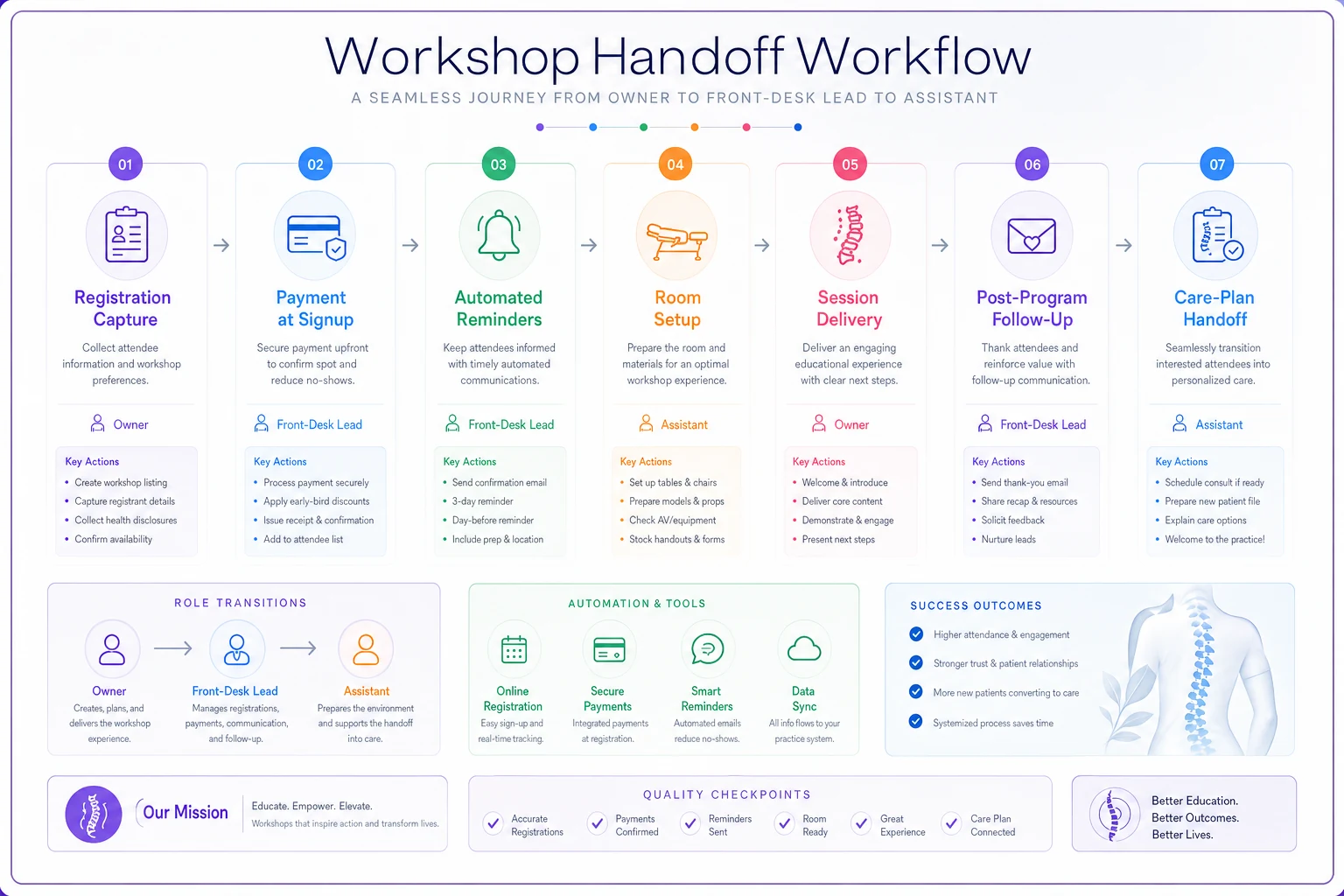
The operational lift from centralizing registration data and automating follow-ups is real, especially once you're running multiple cohorts.
A real scenario
A two-provider clinic wanted a "posture and mobility" series but had been burned by a prior workshop attempt that lost money and ate weekend hours.
They ran the blueprint. Phase 1: one free 12-seat session, 9 showed. Good enough to proceed. Phase 2: a paid 4-week cohort, 13 registrations, blended price around $155, so roughly $2,000 gross. Three of those attendees took the care-plan credit and became ongoing patients, adding somewhere in the $1,800–$2,600 range over the following couple of months.
By Phase 3 the front-desk lead was running registration and reminders, and the owner's involvement dropped to teaching plus about an hour of prep. The program went from "the thing we tried once and quietly buried" to a monthly cohort producing a blended $4k–$5k. Not life-changing on its own — but repeatable, low-risk, and feeding new patients into the practice every single month.
The interesting detail: their second cohort converted better than the first, purely because they'd fixed the registration friction and tightened the care-plan handoff. The blueprint didn't just validate the idea — it showed them exactly which lever to pull.
When this actually makes sense
You have an active patient base of at least a few hundred to recruit from
-
You have an active patient base of at least a few hundred to recruit from
-
You (or an associate) can teach a coherent 4-week curriculum without winging it
-
You have a genuine downstream offer — care plans, memberships, ongoing visits — for the group to feed into
-
You can commit staff hours to logistics so the owner isn't doing everything
You can commit staff hours to logistics so the owner isn't doing everything
When it's a bad idea
Your schedule is already at capacity and you have no chair hours to convert new interest into visits (fix utilization first)
-
Your schedule is already at capacity and you have no chair hours to convert new interest into visits (fix utilization first)
-
You have no clear care-plan or membership pathway, so the group can't convert into anything
-
You're doing it purely for marketing optics with no intention of tracking conversion
If a group program is really just a new service line you're evaluating, run it through the same lens as any addition — the go/no-go checklist for ancillary services applies cleanly to workshops, since a paid program is functionally a new offering with its own margin and staffing math.
Who should not do this
Solo practitioners who are already maxed on hours and have no support staff will find the logistics eat any margin the program creates.
If check-in, reminders, payment, and teaching all land on one person, the math stops working around the second cohort. Build the front-desk handoff capacity first, or wait until you've added support.
The one thing that separates the clinics that make this work
It's not the curriculum or the marketing. It's treating each phase as a decision, not a commitment. The clinics that succeed are willing to kill a cohort at day 30 if the attendance gate fails — and equally willing to systematize hard once the numbers say go.
The 30/60/90 structure isn't there to guarantee the program works. It's there to make sure that if it doesn't, you find out for a few hundred dollars instead of a few thousand.
Start with 12 free seats and one honest question: will they show up? Everything else in this playbook only matters after you've answered that.
Ready to streamline your chiropractic clinic operations?
Join 1,200+ clinics using Spinesly to save time, reduce scheduling errors, and improve patient care experiences.