



Most clinics that open weekends do it backwards. They see a stack of Monday no-shows and Friday overflow, decide "we should really be open Saturday," and hand the shift to whoever complains the least. Six weeks later the Saturday provider is fried, the notes are thin, and the front desk is quietly rebooking Saturday patients into weekday slots because "it's just easier." The demand was real. The staffing model wasn't.
Weekend scheduling fails less because of demand and more because owners treat Saturday like a stretched-out Wednesday. It isn't. Weekend patients behave differently, your staffing pool is thinner, and the coordination between weekday and weekend care breaks in ways that don't show up until a patient falls through the cracks.
This post covers three shift models that actually hold up, the numbers that tell you which one to pick, and the handoff rules that stop weekend care from becoming a lower-quality version of your weekday clinic.
Why weekend coverage collapses even when demand is obvious
The demand signal is almost never the problem. Look at your booking data and you'll usually see the same pattern: a cluster of requests for Saturday mornings, a smaller after-work bump on weekdays, and a steady stream of "do you have anything on the weekend?" calls that never get logged because the front desk just says no.
Where it falls apart is on the supply side, and it's predictable.
One person carries the whole thing. The most common weekend setup is a single provider working every Saturday. It's simple to schedule and feels efficient. But a provider working five weekdays plus every Saturday is on a six-day week indefinitely. That's not a schedule, it's a countdown. The burnout shows up first in documentation quality, then in adjustment care, then in a resignation email.
Weekend care becomes disconnected from weekday care. The weekday team plans a treatment progression, the Saturday provider sees the patient once with half the context, makes a reasonable but slightly different call, and now the plan has drifted. Nobody did anything wrong. The handoff just didn't exist.
Utilization runs hot or cold with nothing in between. Weekend slots either overfill — walk-ins plus overflow plus new patients all landing on one provider — or sit at 40% because you opened "to see how it goes" without any threshold for pulling the plug.
If you've already built solid weekday coverage using utilization math and multi-provider templates, the weekend is where those same principles get tested under thinner staffing. The models below assume you understand chair-hour utilization already — this is about adapting it to a smaller bench and a two-day window.
The three shift models that actually work
There's no universal right answer. The correct model depends on your provider count, your demand shape, and how much weekend revenue actually matters to your P&L. Here's how the three compare before getting into each one.
Never miss another patient appointment.
Spinesly helps you schedule, confirm, and manage every patient visit efficiently.
- Unified appointment management
- Automated patient reminders
- Staff and resource scheduling
No credit card required
| Model | Best clinic size | Provider load | Weekend capacity | Main risk |
|---|---|---|---|---|
| Rotating pods | 4+ providers | Low per person | Medium–high | Coordination overhead |
| Part-time weekend providers | Any size with hiring capacity | None on core team | Medium | Continuity of care |
| Condensed weekday coverage | 2–3 providers | Moderate, redistributed | Low–medium | Weekday capacity trade-off |
Model 1: Rotating pods
A pod is a small group of providers — usually three or four — who share weekend coverage on a rotation. Instead of one person owning Saturday, each provider in the pod works roughly one Saturday every three or four weeks.
The math is what makes this humane. In a four-person pod, each provider picks up about one weekend day per month. That's the difference between "I work every Saturday" and "I work one Saturday a month," and it changes everything about retention.
How the rotation runs in practice:
-
Group three to four providers into a pod based on overlapping treatment styles and patient familiarity.
-
Assign each provider a fixed rotation slot (Provider A works week 1, B works week 2, and so on).
-
Publish the rotation a full quarter ahead so people can plan their lives.
-
Build a swap protocol — providers trade slots directly and log it, so the front desk always knows who's in.
-
Keep pod members loosely aware of each other's active patients so a Saturday visit isn't cold.
The reason pods beat single-provider Saturdays isn't just fairness. A rotating provider actually wants the shift to go well because they're not resentful. A provider working their 30th consecutive Saturday is not bringing their best adjustment or their best notes.
Where pods get messy: coordination. Four people rotating means four people who need to know each patient's plan. Without a clean handoff (covered below), the continuity problem gets worse, not better, because now the patient sees a different face every visit with no thread connecting them.
Model 2: Part-time weekend providers
Here you hire specifically for weekend coverage — a provider who works Saturdays and maybe Friday evenings, nothing else. Sometimes it's a semi-retired chiropractor, sometimes it's someone building toward their own practice who wants steady weekend income, sometimes it's a provider with weekday commitments elsewhere.
The appeal is obvious: your core team never touches a weekend, and you get dedicated capacity from someone who actually wants those hours.
The catch is continuity. A weekend-only provider sees a patient on Saturday, then that patient's next three visits are weekday with someone else. Without deliberate coordination, you get plan drift — the weekend provider makes decisions that don't quite line up with the weekday progression.
This model works best when you treat the weekend provider as a real member of the team, not a contractor you barely onboard. That means running them through the same competency and onboarding process you'd use for any hire. If you've built a proper hire-to-competency staffing system with scorecards and 30/60/90 milestones, extend it to weekend hires instead of shortcutting it because "they're only here Saturdays." That shortcut is exactly why weekend hires underperform.
When part-time weekend providers make sense:
-
You have consistent weekend demand, not sporadic.
-
You can offer enough hours to attract a decent provider — usually both Saturday and at least one weekday evening.
-
Your documentation and handoff systems are strong enough to bridge the weekday/weekend gap.
When it's a bad idea: if weekend demand is still unproven. Hiring a dedicated person for a shift that fills at 45% means paying for empty chair hours every single Saturday. Prove demand first with a rotation, then hire.
Model 3: Condensed weekday coverage
This one isn't technically a weekend model, and that's the point. Some clinics don't actually need Saturday — they need extended hours that capture the same patients without opening a new day.
The pattern: instead of 9-to-5 five days a week, you run something like 7 AM starts two days a week and 7 PM closes two other days, redistributing the same total provider hours to catch early-morning and after-work patients. People who say they "can only come Saturday" often can actually make a 7 AM Tuesday or 6:30 PM Thursday — they just never had the option.
For a two- or three-provider clinic, this is frequently the smarter move. You capture the same demand, you don't take on a sixth working day, and you don't need to hire.
The trade-off is real though. Condensed coverage means non-standard hours, and a 7 AM start followed by a full day is its own kind of fatigue. You're not eliminating the load, you're reshaping it. Done well it's sustainable; done carelessly it just moves the burnout to a different time of day.
The utilization triggers that tell you which model fits
Don't pick a model based on gut feel. Pick it based on what your booking data is telling you. Here are the thresholds worth watching.
Trigger 1 — Turn-away volume. Count how many weekend requests you decline in a month. If your front desk is saying "no, we're closed weekends" more than roughly 25–30 times a month, there's a real demand signal. Below that, you're likely fine with condensed weekday hours.
Trigger 2 — Weekday overflow. If Monday and Friday are running above 85% utilization and patients are waiting 8+ days for an appointment, weekend or extended capacity relieves the pressure. If your weekdays sit at 70%, opening a weekend just spreads the same patients thinner.
Trigger 3 — Provider count. Pods need at least four providers to keep the rotation humane. With two or three, you're really choosing between a part-time hire or condensed hours.
A simple decision path:
-
Under 4 providers + unproven demand? Start with condensed weekday coverage.
-
4+ providers + steady demand? Rotating pods.
-
Proven, heavy weekend demand + hiring capacity? Part-time weekend provider, run alongside a partial rotation for coverage gaps.
Trigger 4 — New-patient timing. If a meaningful chunk of new-patient inquiries come in wanting weekend first visits, that's a growth signal worth capturing with dedicated capacity. New patients who can't get a convenient first slot often just don't rebook.
Handoff rules: the part everyone skips
This is where weekend quality lives or dies. Every model above creates a gap between the provider who plans the care and the provider who delivers it on the weekend. The handoff is how you close that gap.
WEEKEND HANDOFF WORKFLOW Weekday provider (Thursday/Friday) ↓ Writes weekend-ready summary for each patient likely coming Saturday — current care phase, what to adjust, what to avoid, any red flags — lives in the patient record where weekend provider will actually see it ↓ Weekend provider (Saturday morning, before shift starts) — reads summaries before seeing patients — delivers care within the established plan ↓ Weekend provider (end of shift) — writes return handoff: what was done, anything Monday team needs to know ↓ Owning weekday provider (Monday morning) — reviews return handoffs — adjusts plan if needed, logs any changes back to front desk
The workflow below summarizes the steps to keep weekend care aligned with weekday plans.
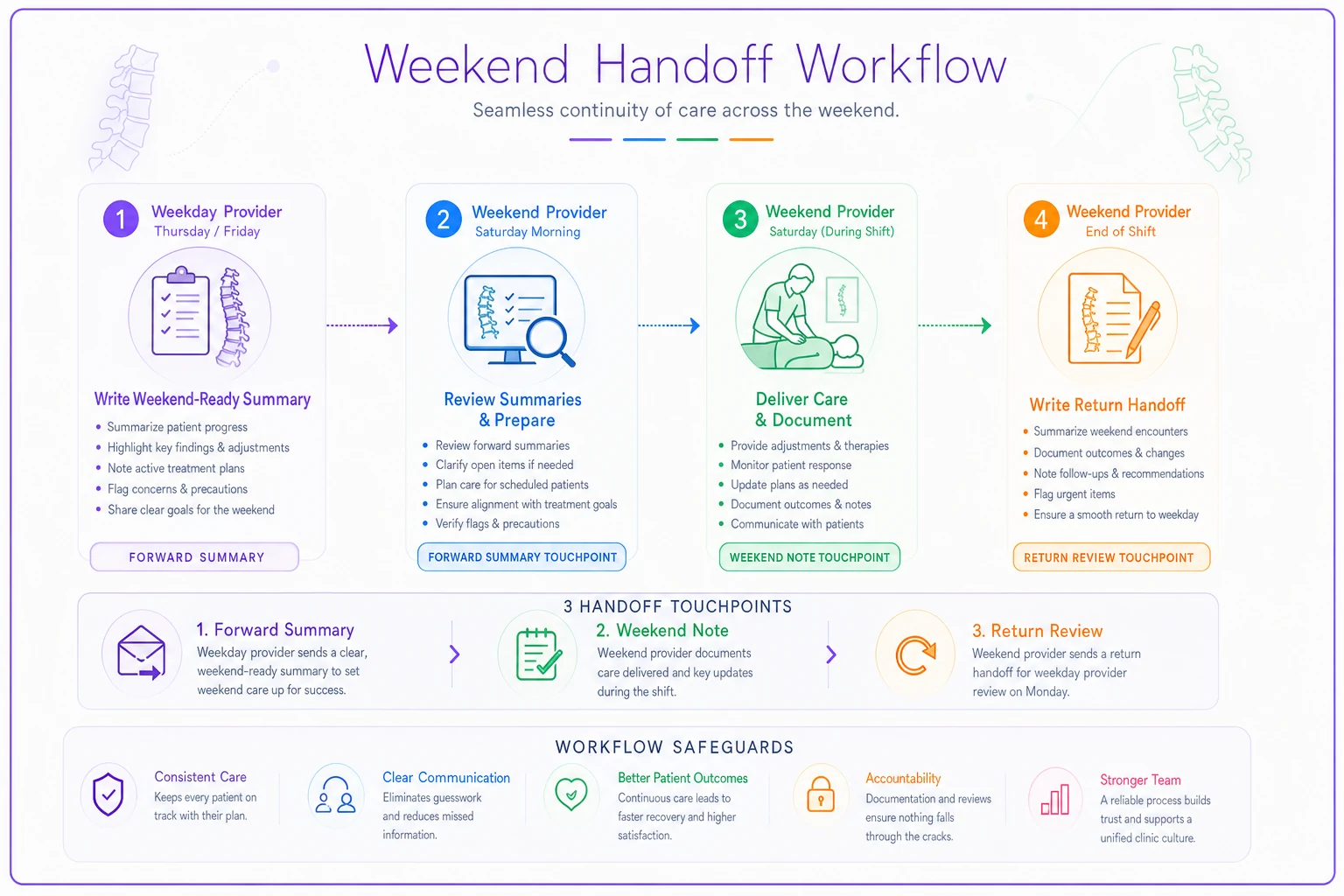
Three touchpoints: forward summary, weekend note, return review. It sounds like extra work, but it's the difference between a patient getting continuous care across seven days and a patient getting two disconnected treatment approaches that quietly cancel each other out.
The handoff checklist for weekend shifts:
-
[ ] Forward summary written for every patient with a likely weekend visit
-
[ ] Weekend provider has read-access and reviews summaries before shift
-
[ ] Red-flag conditions flagged clearly, not buried
-
[ ] Weekend provider documents a return handoff before leaving
-
[ ] Owning provider reviews return handoffs Monday morning
-
[ ] Any plan changes logged and communicated back to front desk
-
[ ] Swap/coverage changes logged so the desk always knows who's in
Tag weekend-ready summaries in the patient's chart with a consistent label so weekend providers can find them quickly.
The clinics that get weekend care right treat these handoffs as non-negotiable. The ones that struggle treat them as "nice to have when there's time," and there's never time.
A real scenario
A four-provider clinic in a mid-size suburb was turning away roughly 30–35 weekend requests a month and burning out their most senior provider, who'd been working every Saturday for close to a year. Weekday utilization was running hot — Mondays around 90%, wait times pushing 9 days.
They stopped the single-provider Saturday and built a rotating pod across all four providers, each working about one Saturday a month, plus a forward/return handoff on every weekend patient. Nothing exotic.
Within two months, weekend slots were filling in the 75–80% range instead of the erratic overfill-then-empty pattern they'd had before. Monday wait times dropped to around 5 days as overflow shifted to Saturday. The senior provider went from one Saturday a week to one a month. That retention alone was worth more than the weekend revenue — and the owner said as much.
The weekend revenue was real too, somewhere in the low-to-mid four figures monthly, but keeping that senior provider was the win that mattered.
When you should NOT open weekends at all
Not every clinic should. If your weekdays aren't full — say you're sitting at 65–70% utilization Monday through Friday — opening a weekend is solving the wrong problem. You don't have a capacity problem, you have a demand-capture problem, and that gets fixed with better rebooking and retention, not more open hours.
Same goes if your documentation and handoff systems are shaky. Adding a weekend on top of weak coordination just multiplies the plan-drift problem across more visits and more providers. Fix the handoff discipline on weekdays first.
And if you're a solo provider, weekends are almost always a trap. There's no rotation to spread the load, no one to hand off to, and the math just becomes "work a sixth day forever." Condensed hours — an early morning here, a late evening there — capture most of the same demand without walking into that.
Bringing it together
Weekend and after-hours coverage isn't a demand question, it's a staffing-model question. The demand is usually already sitting in your turn-away logs. What determines whether weekend care helps or hurts is whether you pick a model your team can actually sustain, whether you know the utilization thresholds that justify it, and whether you build the handoffs that keep weekend care connected to weekday plans.
Rotating pods spread the load across a team. Part-time providers add dedicated capacity when demand is proven. Condensed weekday hours capture the same patients without a sixth working day. Any of them can work — the failures come from picking one without the data to back it up and the handoffs to protect quality.
One last practical note: weekend slots are also where last-minute cancellations sting most, because your bench is thinner and there's less room to backfill. Pairing your weekend model with a solid same-day fill and waitlist workflow keeps those thinner-staffed days from bleeding revenue when someone drops out Saturday morning. Get the model, the triggers, and the handoffs right, and the weekend stops being the shift nobody wants and becomes the one that actually protects your team.
Ready to streamline your chiropractic clinic operations?
Join 1,200+ clinics using Spinesly to save time, reduce scheduling errors, and improve patient care experiences.