


Most clinics don't lose money on workers' comp because they treated the wrong patients or used the wrong codes. They lose it because a case sat in the wrong lane for three weeks before anyone noticed it was a comp case at all. By then the injury date is fuzzy, the employer info is missing, and the adjuster already assigned a claim number nobody wrote down.
Workers' comp chiropractic triage isn't really about workers' comp knowledge. It's about routing. The moment a patient walks in with a work injury, a completely different set of rules kicks in — different authorization, different documentation, different billing timelines, different everything. If your intake process treats that patient like a standard private-pay or commercial visit, the mistake compounds quietly for weeks before anyone catches it.
This is a systems problem. Here's how the whole thing connects, where it breaks, and what a clinic-ready routing engine actually looks like.
The real problem: comp cases get misrouted at the very first touch
A patient calls or walks in with back pain. The front desk asks the usual questions — insurance card, reason for visit, availability — and books them like anyone else. Somewhere in the conversation the patient mentions "I hurt it at work," but that detail doesn't trigger anything. It just becomes a note in the chart.
Nobody flags it. Nobody asks for the claim number, the employer's insurance carrier, the date of injury, or whether there's an assigned adjuster. The patient gets treated. Two or three visits happen. Then billing tries to submit and realizes there's no authorization, no claim on file, and the employer hasn't even reported the injury yet.
Now you're stuck. You've delivered care you may not get paid for, the timely-filing clock is running on the wrong assumption, and you're chasing information that was easy to get on day one and nearly impossible to get on day 21.
The misroute almost always happens at intake — not at billing. Billing is just where the damage finally becomes visible.
Why this breaks in nearly every clinic
The core issue is that workers' comp runs on a completely different operational track than the rest of your patients, but most intake workflows only have one track.
Never miss another patient appointment.
Spinesly helps you schedule, confirm, and manage every patient visit efficiently.
- Unified appointment management
- Automated patient reminders
- Staff and resource scheduling
No credit card required
A private-pay or commercial patient path looks roughly like this: verify eligibility, collect copay, treat, submit claim, done. Fast, predictable, mostly self-contained.
-
The payer isn't the patient's health insurance — it's the employer's comp carrier
-
There's often a mandatory injury report the employer has to file first
-
Authorization rules vary wildly by state and by carrier
-
Documentation requirements are stricter (mechanism of injury, work status, causation language)
-
Billing uses different fee schedules and sometimes different forms
-
Communication runs through an adjuster or nurse case manager, not the patient
When your front desk only has one mental model — "get the insurance card and book" — every comp case gets forced into the wrong shape. The staff aren't being careless. They just don't have a decision point that says stop, this is a different animal, route it differently.
That missing decision point is the whole problem.
What actually breaks as you scale
At two or three comp cases a month, a good office manager can hold it all in their head. They remember which adjuster is slow, which employer forgets to file reports, which cases need re-auth at visit six. It works because one person is the system.
The trouble starts when volume grows, or that person takes a vacation.
A typical pattern: a clinic goes from a handful of comp cases to 15–20 active claims after a local warehouse and a couple of construction firms start referring. Suddenly the "one person remembers everything" model collapses. Cases get treated past their authorized visit count. Re-authorizations get missed. Nobody's tracking which claims are approaching timely-filing deadlines. The aging report fills up with 60- and 90-day comp balances that are painful to work.
The failure points stack across the operation:
-
Intake doesn't reliably flag comp vs. private-pay
-
Scheduling books comp patients without confirming active authorization
-
Clinical documentation misses the causation and work-status language adjusters require
-
Billing submits to the wrong payer or misses filing windows
-
Follow-up has no owner, so denied and pending claims just sit
Each one hands off to the next. A weak intake flag turns into a documentation gap, which turns into a denial, which turns into aging A/R. It's the same pattern behind most preventable denials in small clinics — the problem originates far upstream from where it finally shows up.
The decision engine: routing patients before they ever sit on the table
The fix is building an actual decision point into intake — a short set of flags that force the patient down the correct payer path before scheduling confirms anything.
Think of it as a fork in the road with a handful of yes/no questions. The answers determine which packet, which timeline, and which billing rules apply.
The intake flags that route the case
-
Is this injury related to your job? If yes, the comp path opens.
-
Have you reported it to your employer? Determines whether an injury report exists yet.
-
Do you have a claim number and carrier? If yes, you can verify. If no, you're pre-claim and need to slow down.
-
Is there an assigned adjuster or case manager? Your communication channel.
-
Has any provider authorized chiropractic care for this injury? Determines whether you can treat and bill or need auth first.
If the patient answers "yes, work injury" but can't produce a claim number or adjuster, that's not a reason to book normally — it's a reason to route into a pre-authorization holding path. Treating a comp case with no claim on file is one of the most expensive assumptions a clinic makes.
Routing table: what each answer triggers
Below is a simple routing table that maps intake situations to payer paths, collection needs, and scheduling rules.
| Intake Situation | Payer Path | What to Collect First | Scheduling Rule |
|---|---|---|---|
| Work injury, active claim + auth | Workers' comp | Claim #, adjuster, auth visit count, DOI | Book within authorized visits only |
| Work injury, claim open, no auth yet | Comp – auth pending | Claim #, adjuster, injury report status | Hold or book eval only |
| Work injury, no claim reported | Comp – pre-claim | Employer info, DOI, injury details | Do not treat as comp until reported |
| Not work-related | Private-pay / commercial | Insurance card, eligibility | Standard booking |
| Patient unsure / disputed | Flag for review | All of the above, verify with employer | Manager review before booking |
The point of the table isn't complexity. It's that every front-desk person makes the same routing decision every time, whether it's a busy Monday or the office manager is out sick.
Here's a simple visual of that routing workflow.
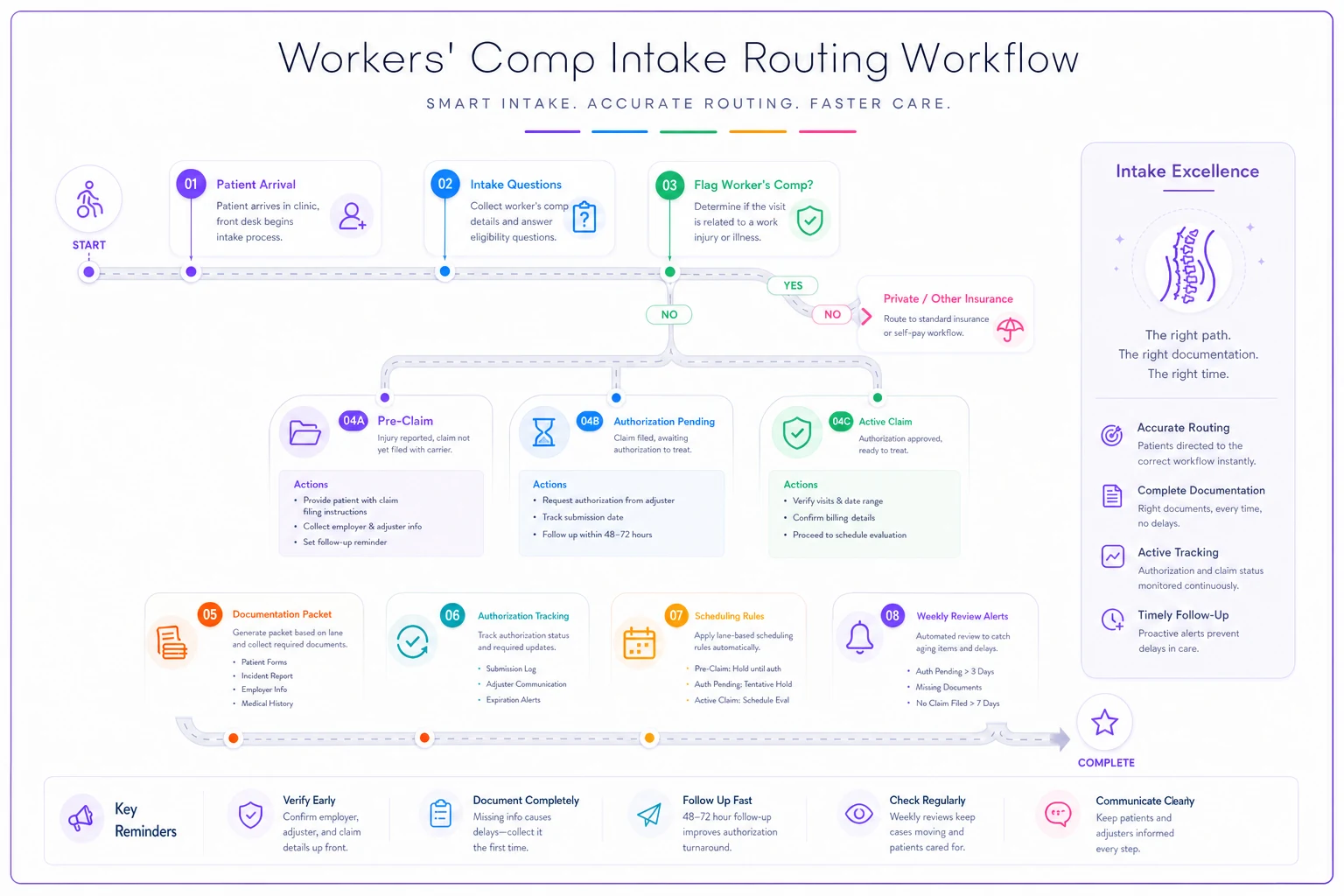
The visual shows the decision fork at intake, the required collections for each lane, and the timeline reminders that trigger re-auth and filing checks.
If a patient reports a work injury but lacks a claim number, route them into a pre-authorization holding path rather than booking full treatment.
The point of the table isn't complexity. It's that every front-desk person makes the same routing decision every time, whether it's a busy Monday or the office manager is out sick.
The documentation packet each path actually needs
Routing is only half of it. Once a case is in the comp lane, the documentation requirements are stricter than most chiropractors are used to, and vague notes are the fastest way to a denial.
A clinic-ready comp documentation packet should capture, from the first visit:
-
Date of injury and mechanism — exactly how it happened at work
-
Body parts affected, tied specifically to the work event
-
Causation language — a clear statement connecting the condition to the injury
-
Work status — full duty, modified duty, or off work, with restrictions listed
-
Objective findings that support the treatment plan
-
Authorized visit count and where you are against it
-
Adjuster/case manager contact and the last date you communicated
The re-authorization trigger is what clinics forget most. If care is authorized for six visits and the plan needs twelve, someone has to request the extension before visit six, not after. Build the trigger into the treatment plan itself. This connects to a broader prior-authorization triage approach — comp is just a stricter version of the same discipline.
Scheduling and billing timelines that keep cases from stalling
Comp cases live and die on timelines, and those timelines aren't the same as your commercial book. Two clocks matter most:
The authorization clock. You can only bill for authorized visits. Booking a patient into visit nine when only eight were approved means you either eat that visit or scramble for retroactive auth — which carriers love to deny.
The filing clock. Comp filing windows vary by state and can be short. A case that sits misrouted for three weeks has already burned a chunk of that window on the wrong assumption.
A simple timeline discipline for every active comp case:
-
Day 0 (intake) flag, verify claim, confirm auth, record DOI and adjuster
-
Visit 1 full comp documentation packet, work status, treatment plan with visit count
-
Two visits before auth expires submit re-auth request
-
Every submission confirm correct payer, correct fee schedule, correct form
-
Weekly review all comp cases against auth remaining and filing deadlines
That weekly review is non-negotiable once you're past a handful of active claims. It's the single habit that keeps comp A/R from quietly aging into the 90+ day bucket. The same verification discipline you'd apply to any insurance check before an appointment applies here — comp just adds the auth-count layer on top.
Where software quietly earns its keep
None of this requires fancy tools to design. It requires consistency to run — and consistency is exactly what breaks when one person is holding the whole system in their memory.
An AI-assisted operational platform earns its place here not as a gimmick, but as a way to make the routing happen without relying on anyone remembering anything. A workflow platform can flag a comp intake the moment "work injury" is captured, hold the appointment until a claim and auth are confirmed, and surface which active cases are two visits away from needing re-authorization. Instead of a manager combing through charts every Friday, the system pushes the list to whoever needs it.
The value isn't that software does the thinking. It's that the routing decision, the documentation checklist, and the timeline alerts fire the same way every time — so a busy front desk and an overwhelmed billing person still stay on the right path. That's the difference between catching a stalling comp case at visit three versus discovering it at day 75.
A real scenario
A two-provider clinic started getting steady referrals from a few local employers and went from roughly 3–4 comp cases a month to around 18 active claims. Within a couple months, their comp A/R over 60 days had climbed to somewhere in the $11k–$14k range, mostly from missed re-authorizations and two cases that got treated before a claim was ever reported.
They didn't hire anyone. They built a routing checklist into intake, added a required comp documentation packet at visit one, and started a 15-minute weekly comp review flagging any case within two visits of its auth limit.
Over the next quarter, misrouted cases basically stopped. Re-auth requests started going out on time. Their aged comp balance dropped to a fraction of what it had been — a noticeable shift in cash flow without adding a single hour of provider time.
When a formal triage system makes sense (and when it doesn't)
When it's worth building: You're seeing more than a handful of comp cases a month, you get referrals from local employers, or your comp A/R is aging faster than your commercial book. Any of those means the "one person remembers" model is already at risk.
When it's overkill: If you genuinely see one or two comp cases a year, a full routing engine is more structure than you need. A simple checklist at the front desk will do. Don't build machinery for a problem you don't have.
Who should not skip this: Clinics in states with short filing windows or strict authorization rules. There, a single misrouted case can be a total write-off, and the cost of not having a triage system shows up fast.
Bringing it together
Workers' comp chiropractic triage works when you stop treating comp as a billing task and start treating it as a routing decision that happens at the very first touch. The flags at intake determine the documentation packet. The packet supports the authorization. The authorization drives the scheduling limit. The timeline discipline keeps the filing window intact. Break any one link and the whole chain drags a case into aged A/R.
Get the routing right on day zero, and comp goes from your most frustrating payer to just another well-run lane in your practice — predictable, documented, and paid on time.
Ready to streamline your chiropractic clinic operations?
Join 1,200+ clinics using Spinesly to save time, reduce scheduling errors, and improve patient care experiences.